

Bài tập bổ trợ ôn thi tốt nghiệp THPT môn Tiếng Anh - Đề 1 (Có đáp án)
 7 trang
01/12/2025
910
7 trang
01/12/2025
910
Bạn đang xem tài liệu "Bài tập bổ trợ ôn thi tốt nghiệp THPT môn Tiếng Anh - Đề 1 (Có đáp án)", để tải tài liệu gốc về máy hãy click vào nút Download ở trên.
Tóm tắt nội dung tài liệu: Bài tập bổ trợ ôn thi tốt nghiệp THPT môn Tiếng Anh - Đề 1 (Có đáp án)
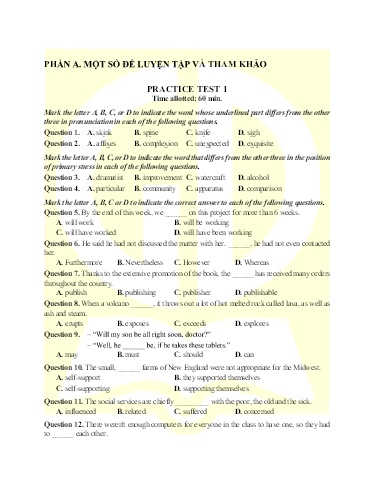
 A. divide into B. join in C. add to D. share with
Question 13. My cousin, who had been driving all day, suggested ______ at the next town.
 A. to stop B. stopping C. stop D. being stopped
Question 14. If you often consult others, you will do everything successfully; if you ______
stubbornly ______ your own view, you will get into trouble everywhere.
 A. focus  on B. hold  out C. adhere  to D. replacewith
Question 15. Greater effort to increase agricultural production must be made if food shortage
______ avoided.
 A. is to be B. can be C. will be D. has been
Question 16. Similar elements in the prehistoric remains from both areas suggest that Indians and
their neighbours had maintained distant but real connections ______ before 1500 BC.
 A. ever B. even C. never D. still
Question 17. Part of Jane Colden’s work involved collecting plant specimens, cataloging plants,
and ______ with other botanists.
 A. exchanging correspondence B. he exchange of correspondence
 C. correspondence exchanging D. correspondence was exchanged
Question 18. The job of a demographer is to investigate ______ in specific locations.
 A. how people are there B. how many people are there
 C. how many people there are D. there are how many people
Mark the letter A, B, C or D to indicate the word(s) CLOSEST in meaning to the underlined
word(s) in each of the following questions.
Question 19. Australian aborigines are dark skinned people whose descendants came to the
continent from Asia about 25,000 years ago.
 A. predecessors B. relatives C. offspring D. children
Question 20. Despite the fact that she is a nice person and has many good qualities, she still gets
on my nerves and I find it hard to like her.
 A. concerns B. irritates C. admires D. examines
Mark the letter A, B, C or D to indicate the word(s) OPPOSITE in meaning to the underlined
word(s) in each of the following questions.
Question 21. Being the second child of three, he tends to admire his elder brother and despise his
younger sister.
 A. look up to B. make over C. make up to D. look down on
Question 22. There is ample rain and intense sunlight in tropical climates; consequently, plant life
is luxuriant and varied.
 A. detrimental B. abundant C.continuous D. little
 In fact, plants absorb all their food directly from the soil in inorganic form, no matter where
the nutrients may originally have come from. Experiments in Michigan and in England that went
on for twenty-five years were unable to find any difference in plants raised organically and plants
raised with chemical fertilizers. Things that do affect nutrient content are climate, time of harvest,
and genetics - but no difference results when plants are grown organically.
 Neither are organically grown plants free from chemicals such as pesticides. Some pesticides
leave traces in the soil for years; these traces may be absorbed by the plant that is “organically”
grown. Rainfall may wash pesticides from neighboring farms onto “organic” fields, and sprays or
other applications of chemicals may drift and cause the same problem.
Furthermore, all foods – whether grown conventionally or organically - may contain toxic
substances to some degree; the Food and Drug Administration (FDA) maintains constant checks
to ensure that these substances are kept at a harmless level. But aflatoxin, a mold that causes cancer,
may grow on crops such as peanuts, or be present in milk. Lead and arsenic are sometimes present
in bone meal or seafood. And many vegetables contain poisonous compounds such as oxalic acid
and nitrite compounds. The point is, all these toxins may be present in a given food, no matter how
the food was grown and cultivated. Toxic substances in food do not necessarily have to come from
fertilizers or chemical sprays.
 (https://www.english.com.tw › forum › the-article-about-org...)
Question 30. This passage is mainly about ______.
 A. the rise in demand for organic food in the last decade
 B. how organic plants are grown in different kinds of soil
 C. the toxic substances contained in both organically and inorganically grown food
 D. the numerous fallacies that exist about organically grown foods
Question 31. The popularity of organic foods can be traced to all of the following EXCEPT
______.
 A. people’s longing for a simpler life style
 B. people’s fear of eating more and more food
 C. people’s belief that organic foods are safer
 D. people’s belief that plants grown traditionally are not as nutritious
Question 32. Which of the following can be concluded from the passage?
 A. There is some risk of toxic substances in all types of food grown in the earth.
 B. Organic foods are more expensive because of the expense of growing them.
 C. Organic foods are more nutritious, though more expensive.
 D. The FDA strongly recommends organically grown foods.
Question 33. “Organic food” in the passage can be used interchangeably with ______.
 A. Traditional food B. Popular food
 C. Ethnic food D. Natural food
Question 37. To which are crows in the passage compared in the use of tools?
 A. Rooks B. Corvids C. Apes D. Walnuts
Question 38. According to the passage, we learn that ______.
 A. apes are sure to be cleverer than crows
 B. crows and apes can find a way out only after trying
 C. crows and apes can think through hard problems by using tools
 D. crows and apes have thought of the result before action
Question 39. The underlined word “that” in the passage refers to ______.
 A. consequences B. actions C. solutions D. problems
Question 40. It can be inferred from the passage that the intelligence in crows ______.
 A. develops from their cognitive abilities
 B. makes them live in pairs
 C. is generally their born quality
 D. comes from their predicting ability
Question 41. The underlined word “evolved” in the passage is closest in meaning to ______.
 A. developed gradually B. changed suddenly
 C. remained unchanged D. diminished rapidly
Question 42. What’s the author’s purpose of writing this passage?
 A. To introduce the research discovery.
 B. To compare crows and apes.
 C. To describe an Aesop’s story.
 D. To help readers understand the crow family.
Mark the letter A, B, C or D to indicate the underlined part that needs correction in each of the
following questions.
Question 43. When Tony drove into Germany, the customs men searched for his car.
 A B C D
Question 44. In artifacts from as early as the Stone Age, mathematics and art can
 A B
be seen to have fused in the geometric patterns decorate pottery and carpentry.
 C D
Question 45. All nations may have to make fundamental changes in their economic,
 A B
political, and the technological institutions if they are to preserve the environment.
 C D
File đính kèm:
- bai_tap_bo_tro_on_thi_tot_nghiep_thpt_mon_tieng_anh_de_1_co.pdf
- ANSWER KEY.pdf

