

Bài tập bổ trợ ôn thi tốt nghiệp THPT môn Tiếng Anh - Đề 6 (Có đáp án)
 7 trang
01/12/2025
750
7 trang
01/12/2025
750
Bạn đang xem tài liệu "Bài tập bổ trợ ôn thi tốt nghiệp THPT môn Tiếng Anh - Đề 6 (Có đáp án)", để tải tài liệu gốc về máy hãy click vào nút Download ở trên.
Tóm tắt nội dung tài liệu: Bài tập bổ trợ ôn thi tốt nghiệp THPT môn Tiếng Anh - Đề 6 (Có đáp án)
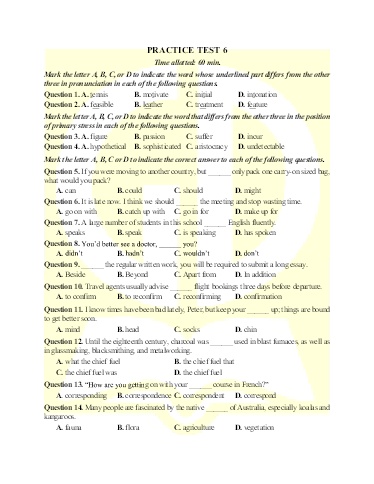
Question 15. Most popular magazines have a(n) ______ page where letters about difficulties with
relationships are answered.
 A. agony B. personal C. advice D. problem
Question 16. I couldn't quite ______ what they were doing because they were so far away.
 A. see off B. make out C. think about D. try on
Question 17. The people who ______ the survey said that they had examined over 1,000 accidents.
 A. gave B. proceed C. set D. conducted
Question 18. Some language experts say ______ to a person speaking a language one does not
understand and still determine whether the speaker is excited or exhausted, angry, or pleased.
 A. that possible it is listen B. what is possible to listen to it
 C. that it is possible to listen D. whether is it a possibility to listen
Mark the letter A, B, C or D to indicate the word(s) CLOSEST in meaning to the underlined
word(s) in each of the following questions.
Question 19. His father died of lung cancer and the doctor attributed it to the fact that he was a
heavy smoker.
 A. took it off B. carried it back C. thought it over D. put it down
Question 20. Here passengers can eat delicacies prepared by a master chef who came from France.
 A. hard-working B. skillful C. well-dressed D. educated
Mark the letter A, B, C or D to indicate the word(s) OPPOSITE in meaning to the underlined
word(s) in each of the following questions.
Question 21. His career in the illicit drug trade ended with the police raid this morning.
 A. elicited B. irregular C. secret D. legal
Question 22. It is this extra spending that, given full employment and consequent constant number
of transactions, pushes up the price level.
 A. increases B. stabilizes C. decreases D. manages
Mark the letter A, B, C, or D to indicate the option that best completes each of the following
exchanges.
Question 23. – “Could I use your bike for a moment?”
 – “______”
 A. OK. It's well. B. By all means.
 C. It doesn't matter. D. I have no idea.
Question 24. – “______?”
 – “He’s of medium height and build, and he’s witty.”
 A. What does David look like B. How is David
 C. What is David like D. What does David do
Read the following passage and mark the letter A, B, C, or D to indicate the correct word or
phrase that best fits each of the blanks from 25 to 29.
Question 30. According to the passage, what is now believed about the stone tools used by the
Neanderthals compared to those of the Homo sapiens?
 A. They were at least as long lasting.
 B. They could not have been used as spear tips.
 C. They were longer and narrower.
 D. They indicate a superior mental capacity.
Question 31. The passage states that the Neanderthals relied on the dense forests ______.
 A. for firewood and shelter
 B. to provide cover when hunting
 C. to provide wood for spears
 D. to hide from their attackers
Question 32. The hyoid bone is evidence of ______.
 A. a capacity for language
 B. an ability to adapt to a cold climate
 C. skull capacity
 D. the inferior anatomy of the Neanderthal
Question 33. The Neanderthals were wiped out ______.
 A. before the Homo sapiens arrived
 B. in battles with their opponents
 C. after the climate changed
 D. due to their primitive social organization
Question 34. According to the passage, which of the following is NOT an older assumption that
has now been cast in doubt?
 A. Neanderthals were less intelligent than Homo sapiens.
 B. The Neanderthals evolved first in Africa.
 C. Flakes were inferior to blades in all respects.
 D. Neanderthals had very poor communication skills.
Read the following passage and mark the letter A, B, C, or D to indicate the correct answer to
each of the questions from 35 to 42.
 English teenagers are to receive compulsory cooking lessons in schools. The idea is to
encourage healthy eating to fight the country’s increasing obesity rate. It’s feared that basic
cooking and food preparation skills are being lost as parents turn to pre-prepared convenience
foods.
 Cooking was once regarded as an important part of education in England - even if it was
mainly aimed at girls. In recent decades cooking has progressively become a minor activity in
schools. In many cases the schools themselves have given up cooking meals in kitchens in the
Question 40. The well-known cookery writer, Pru Leith, thinks it ______ to offer compulsory
cooking lessons in schools.
 A. difficult B. necessary C. funny D. timely
Question 41. The underlined word “which” in the last paragraph refers to ______.
 A. the renewed interest B. a response
 C. the level of obesity in Britain D. Britain
Question 42. It can be inferred from the passage that ______.
 A. cooking has always been an important part of school education in England
 B. the obesity rate in Britain has been rapidly growing in recent decades
 C. English teenagers will have their cooking lessons twice a week for
 one year
 D. the students will pay a lot of money to the school for the cooking lessons
Mark the letter A, B, C or D to indicate the underlined part that needs correction in each of the
following questions.
Question 43. In 1862 Abraham Lincoln signed the Homestead Act, allowed settlers
 A B
160 acres of free land after they had worked it for five years.
 C D
Question 44. The system for helping slaves escape to the North was called the
 A B
“Underground Railroad”, though it was neither underground or a railroad.
 C D
Question 45. After the police had tried unsuccessfully to determine to who the car
 A B
belonged, they towed it away.
 C D
Mark the letter A, B, C, or D to indicate the sentence that is closest in meaning to each of the
following questions.
Question 46. Our opinions on the subject are identical.
 A. We have the same opinions on the subject.
 B. We differentiate our opinions on the subject.
 C. There's some difference in our opinions on the subject.
 D. Fortunately our subjects are almost identical.
Question 47. He left a message so that I could know where to find him.
 A. He left a message, which I knew where to find.
 B. I could know where to find him, so he left a message.
 C. He left a message, because I knew where to find him.
File đính kèm:
- bai_tap_bo_tro_on_thi_tot_nghiep_thpt_mon_tieng_anh_de_6_co.pdf
- ANSWER KEY.pdf

