

Bài tập bổ trợ ôn thi tốt nghiệp THPT môn Tiếng Anh - Đề 7 (Có đáp án)
 8 trang
01/12/2025
770
8 trang
01/12/2025
770
Bạn đang xem tài liệu "Bài tập bổ trợ ôn thi tốt nghiệp THPT môn Tiếng Anh - Đề 7 (Có đáp án)", để tải tài liệu gốc về máy hãy click vào nút Download ở trên.
Tóm tắt nội dung tài liệu: Bài tập bổ trợ ôn thi tốt nghiệp THPT môn Tiếng Anh - Đề 7 (Có đáp án)
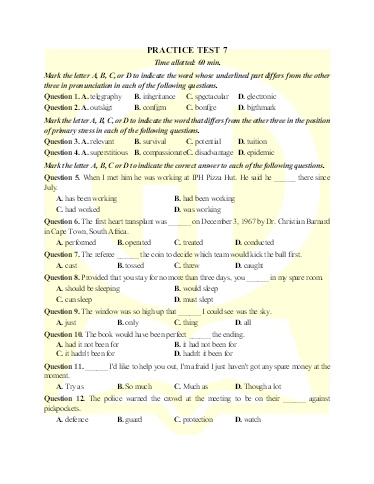
Question 13. It is hard to find a vaccine for influenza because there are so many different ______
of the disease.
 A. species B. strains C. branches D. divisions
Question 14. My grandma is usually willing to listen to and accept other people’s ideas: she is
______.
 A. unmindful B. mindless C. right-minded D. open-minded
Question 15. ______ orders have been issued on the three stretches of the town wall which remain.
 A. Preservative B. Preserving C. Preservation D. Preserve
Question 16. Henry Ford revolutionized production management by ______ into small steps on a
moving line.
 A. breaking down auto assembly B. broken down auto assembly
 C. he broke down auto assembly D. auto assembly breaking down
Question 17. My sister is ______ seafood, so she never tries these delicious dishes.
 A. allergic to B. tired of C. keen on D. preferable to
Question 18. Fingerprints form an unchangeable signature, and ______ for identification, despite
changes in the individual’s appearance or age.
 A. the use of fingerprint records B. with the use of fingerprint records
 C. when fingerprint records are used D. fingerprint records can be used
Mark the letter A, B, C or D to indicate the word(s) CLOSEST in meaning to the underlined
word(s) in each of the following questions.
Question 19. I lost too much money betting at the races last time, so you won’t persuade me to go
again.
 A. convince B. impress C. order D. advise
Question 20. The presidential candidates touched on the subject of health care during the debates.
 A. gave a long explanation of B. dealt with in detail
 C. talked about for a short time D. knew very little about
Mark the letter A, B, C or D to indicate the word(s) OPPOSITE in meaning to the underlined
word(s) in each of the following questions.
Question 21. There is now a massive expansion in the private schooling system, with an emphasis
on building schools in new urban areas.
 A. very big B. substantial C. very little D. current
Question 22. In questions of preserving peace and saving mankind from the threat of a nuclear
war, let no one remain indifferent or stand aloof.
 A. give an unfriendly glance B. boldly stand up to
 C. stay away from D. become actively involved in
Read the following passage and mark the letter A, B, C, or D to indicate the correct answer to
each of the questions from 30 to 34.
 Statuses are marvelous human inventions that enable us to get along with one another and to
determine where we "fit" in society. As we go about our everyday lives, we mentally attempt to
place people in terms of their statuses. For example, we must judge whether the person in the
library is a reader or a librarian, whether the telephone caller is a friend or a salesman, whether the
unfamiliar person on our property is a thief or a meter reader, and so on.
 The statuses we assume often vary with the people we encounter, and change throughout life.
Most of us can, at very high speed, assume the statuses that various situations require. Much of
social interaction consists of identifying and selecting among appropriate statuses and allowing
other people to assume their statuses in relation to us. This means that we fit our actions to those
of other people based on a constant mental process of appraisal and interpretation. Although some
of us find the task more difficult than others, most of us perform it rather effortlessly.
 A status has been compared to ready-made clothes. Within certain limits, the buyer can choose
style and fabric. But an American is not free to choose the costume of a Chinese peasant or that of
a Hindu prince. We must choose from among the clothing presented by our society. Furthermore,
our choice is limited to a size that will fit, as well as by our pocketbook. Having made a choice
within these limits we can have certain alterations made, but apart from minor adjustments, we
tend to be limited to what the stores have on their racks. Statues too come ready made, and the
range of choice among them is limited.
 (
Question 30. In the first paragraph, the writer tells us that statuses can help us ______.
 A. determine whether a person is fit for a certain job
 B. behave appropriately in relation to other people
 C. protect ourselves in unfamiliar situations
 D. make friends with other people
Question 31. According to the writer, people often assume different statuses ______.
 A. in order to identify themselves with others
 B. in order to better identify others
 C. as their mental processes change
 D. as the situation changes
Question 32. The underlined word "appraisal" in the second paragraph mostly means ______.
 A. involvement B. appreciation C. assessment D. presentation
Question 33. By saying that "an American is not free to choose the costume of a Chinese peasant
or that of a Hindu prince" (Paragraph 3), the writer means ______.
 A. our choice of statuses is limited
 B. ready-made clothes may need alterations
 D. The differences between public art in Europe and the United States.
Question 36. The underlined word “exceptional” in the passage is closest in meaning to ______.
 A. remarkable B. fearless C. expert D. visible
Question 37. All of the following are mentioned in paragraph 1 as results of the trend toward
installing contemporary art in public places in the United States EXCEPT ______.
 A. the transfer of artwork from private to public sites
 B. artworks that represent a city’s special character
 C. greater interest in art by the American public
 D. a broader understanding of the varieties of contemporary art
Question 38. According to the passage, new settings for public art are appearing as a result of
______.
 A. communities that are building more art museums
 B. artists who are moving to urban areas
 C. urban development and renewal
 D. an increase in the number of artists in the United States.
Question 39. The author mentions Roy Lichtenstein and Alan Sonfist in line 12 in order to ______.
 A. show that certain artist are famous mostly for their public art
 B. introduce the subject of unusual works of art
 C. demonstrate the diversity of artworks displayed in public
 D. contrast the cities of Miami Beach and New York
Question 40. It can be inferred from the passage that the city of Memphis sponsored a work by
Richard Hunt because the city authorities believed that ______.
 A. the sculpture would symbolize the urban renewal of Memphis
 B. Memphis was an appropriate place for a memorial to Martin Luther Ling, Jr.
 C. the artwork would promote Memphis as a center for the arts
 D. the sculpture would provide a positive example to other artists.
Question 41. The underlined word “that” in the passage refers to ______.
 A. contemporary art B. opportunity
 C. audience D. distinction
Question 42. According to paragraph 3, artists who work on public art projects are doing all of
the following EXCEPT ______.
 A. creating artworks that are unusual in size
 B. raising funds to sponsor various public projects
 C. exposing a large number of people to works of art
 D. using new materials that are long-lasting.
Mark the letter A, B, C, or D to indicate the sentence that best combines each pair of sentences
in the following questions.
Question 49. The squirrel was frightened. The squirrel ran up the tree.
 A. Frightened, the squirrel ran up the tree.
 B. The frightened squirrel was on the tree.
 C. Running up the tree, the squirrel was frightened.
 D. The squirrel was frightened after running up the tree.
Question 50. All his friends have been praising the high quality of service in the new shop. When
he went there, the server was quite rude.
 A. Since all his friends have been praising the high quality of service in the new shop, when
 he went there, the server was quite rude.
 B. All his friends have been praising the high quality of service in the new shop, so when he
 went there, the server was quite rude.
 C. All his friends have been praising the high quality of service in the new shop, and no wonder
 when he went there, the server was quite rude.
 D. All his friends have been praising the high quality of service in the new shop; nevertheless,
 when he went there, the server was quite rude.
File đính kèm:
- bai_tap_bo_tro_on_thi_tot_nghiep_thpt_mon_tieng_anh_de_7_co.pdf
- ANSWER KEY.pdf

