

Bài tập bổ trợ Tiếng Anh Lớp 11 Global Success theo unit - Unit 4: Asean and Viet Nam (Có đáp án)
 7 trang
11/11/2025
18021
7 trang
11/11/2025
18021
Bạn đang xem tài liệu "Bài tập bổ trợ Tiếng Anh Lớp 11 Global Success theo unit - Unit 4: Asean and Viet Nam (Có đáp án)", để tải tài liệu gốc về máy hãy click vào nút Download ở trên.
Tóm tắt nội dung tài liệu: Bài tập bổ trợ Tiếng Anh Lớp 11 Global Success theo unit - Unit 4: Asean and Viet Nam (Có đáp án)
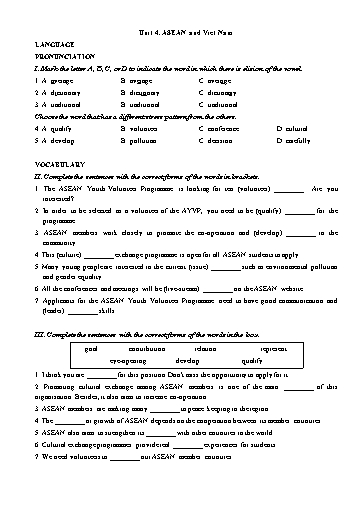
 IV. Choose the correct answer to indicate the word(s) CLOSEST in meaning to the underlined
word(s).
1. Generally, we need to exchange some money when we go to other countries.
 A. change B. spend C. takeaway D. take off
2. On New Year's Day, people often wish one another success and prosperity.
 A. happiness B. luck C. health D. wealth
V. Choose the correct answer to indicate the word(s) OPPOSITE in meaning to the underlined
word(s).
1. In some cultures, people believe that water will help wash away bad luck, so they often splash each
other with water on the New Year's Day.
 A. remove B. decrease C. gain D. change
2. What is at issue is improving collaboration and cooperation among the member countries.
 A. the most important B. the least important
 C. the most successful D. the least successful
GRAMMAR
VI. Choose the correct options to complete the following sentences.
1. My mother's work involves ________ .
 A. using English everyday
 B. use English everyday
2. My brother is interested in ________ .
 A. collect information about ASEAN countries
 B. collecting information about ASEAN countries
3. I always dream of ________ .
 A. visiting all ASEAN countries.
 B. to visit all ASEAN countries.
4. We have decided ________ .
 A. to travel to Thailand next year
 B. travelling to Thailand next year
5. ________ helps me know more about different places.
 A. Travel regularly
 B. Travelling regularly
VII. Choose the best answer to complete each of the sentences.
1. My father's hobby is ________ sports programmes on television.
 A. watching B. watch C. watches D. watched
2. We often avoid _______ about political issues in other countries.
 A. to talk B. talking C. talk D. have talked 5. A. maintain B. participate C. persuade D. stop
II. Read the text and decide whether the following statements are true (T) or false (F).
 Training Program for Young Leaders
 Training Program for Young Leaders (the Japan - ASEAN Youth Friendship Program formerly) is
the program in which young people of developing countries are invited to Japan to take part in activities
of fields which are considered very important fields of the countries. Through these activities, human
resources who would bear high responsibility for the future of those developing countries are developed.
This is the main objective of the program. Besides, this program also aims to establish the mutual
understanding and cooperation relations between Japan and developing countries.
 For its part, the program is also the chance for the people and local towns of Japan to develop their
international cooperation. For example, the local governments, universities, NGO and charitable
corporations, etc. of Japan can contribute to the development of developing countries through
conducting the training in which experience and technology of concerned countries are shared.
 This program has been implemented for Viet Nam since 1995. By April 2007, 1,249 young people
of Viet Nam had been invited to Japan under this program.
 (Source: https://www.jica.go.jp/vietnam)
1. Training Program for Young Leaders helps young people in developed countries. __________
2. Training potential leaders is the main aim of this program. __________
3. Japan and developing countries also want to set up their cooperation relations. __________
4. Only Japan's experience and technology is shared through the training. __________
5.1,249 young people of Viet Nam were invited to Japan under this program in 2007. __________
III. Read the following passage and mark the letter A, B, or C to indicate the correct answer to each
of the questions.
 The ASEAN Youth Forum (AYF) is a movement that represents and fights for the young people in
ASEAN to voice out their concerns and strategies for ways to achieve a better ASEAN. AYF has been
a platform of the youth in the ASEAN to raise their voice and claim for their rights for a sustainable,
inclusive, people-centered, and youth-driven regional community. The network aims to focus the
engagement on important and timely local issues affecting the youth, and consolidate policy proposal
and agenda to put forward to the relevant ASEAN offices.
 AYF holds an annual and regular meeting of youth civil society organisations in Southeast Asia,
which is held as a parallel meeting to the ASEAN Summit. It is a strategic avenue to engage with ASEAN
member states and mechanisms. It is also a venue to discuss the issues and concerns of young people in
ASEAN and how to address them.
 AYF has been working at the local, national and regional level. In the last ten years, AYF has been
organised in Thailand (2009), Viet Nam (2010), Indonesia (2011), Cambodia (2012), Brunei Darussalam
(2013), Myanmar (2014), Malaysia (2015), Cambodia (2016), The Philippines (2017), and Indonesia
(2019). It has already involved more than 2,500 young leaders of Southeast Asia.
 (Source: https://aseanyouthforum.org/)
1. This passage is mainly about _______.
 A. The ASEAN Youth Forum and its activities A. It is easier for the people of ASEAN members to travel in ASEAN countries.
 B. Travelling in ASEAN countries has never been easy for ASEAN people.
 C. Travelling in ASEAN countries used to be easy, but now it isn't any longer.
 D. It is easy to travel in ASEAN countries if you come from a non-ASEAN state.
2. My brother's hobby is collecting stamps of ASEAN countries.
 A. Collecting stamps of ASEAN countries hardly makes my brother interested.
 B. My brother usually collects stamps of ASEAN countries.
 C. My brother used to collect stamps, but now he is interested in ASEAN culture.
 D. Collecting ASEAN countries' stamps never satisfies my brother.
3. Do you mind sharing some information about ASEAN scholarships?
 A. Are you interested in applying for ASEAN scholarships?
 B. Who wants to apply for ASEAN scholarships next year?
 C. Could you share some information about ASEAN scholarships?
 D. Does anyone want to get detailed information about ASEAN scholarships?
4. ASEAN has succeeded in maintaining peace and cooperation in the region.
 A. Maintaining peace and cooperation in ASEAN countries have never been easier.
 B. ASEAN has never managed to maintain peace and cooperation in the region.
 C. Regional peace and cooperation have never been ASEAN's priority.
 D. ASEAN has managed to maintain peace and cooperation in the region.
5. Participating in the ASEAN Youth Forum last year was unforgettable for Mai.
 A. Mai can never forget the ASEAN Youth Forum she participated in last year.
 B. Mai participated in the ASEAN Youth Forum last year, then she forgot it.
 C. Mai forgot participating in ASEAN Youth Forum last year, then she regretted.
 D. Mai forgot to participate in ASEAN Youth Forum last year, then she regretted.
6. My father's work involves travelling in ASEAN countries.
 A. ASEAN countries offer great travelling experiences for my family.
 B. My father's work is connected with travelling in ASEAN countries.
 C. ASEAN countries are my father's favourite tourist attractions.
 D. Travelling in ASEAN countries is my father's hobby.
7. Following these rules was more complicated than I expected.
 A. I followed the rules in the way I expected them.
 B. After I followed the rules, I expected them to be complicated.
 C. I didn't expect that following these rules was so complicated.
 D. I followed the rules, so I know they were complicated.
VII. Write a proposal (120-150 words) about a welcome event. Use the outline below to help you.
File đính kèm:
- bai_tap_bo_tro_tieng_anh_lop_11_global_success_theo_unit_uni.docx
- KEY.docx


