

Bài tập bổ trợ Tiếng Anh Lớp 11 Global Success theo unit - Unit 8: Becoming independent (Có đáp án)
 7 trang
11/11/2025
1860
7 trang
11/11/2025
1860
Bạn đang xem tài liệu "Bài tập bổ trợ Tiếng Anh Lớp 11 Global Success theo unit - Unit 8: Becoming independent (Có đáp án)", để tải tài liệu gốc về máy hãy click vào nút Download ở trên.
Tóm tắt nội dung tài liệu: Bài tập bổ trợ Tiếng Anh Lớp 11 Global Success theo unit - Unit 8: Becoming independent (Có đáp án)
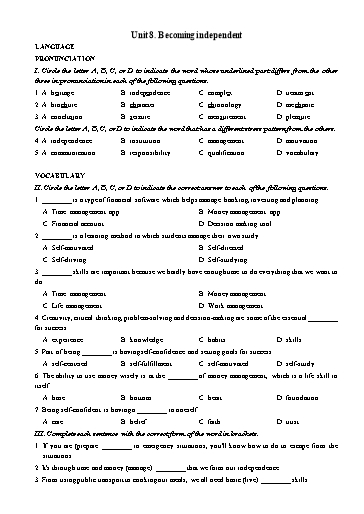
 4. Being good at (communicate) ________ means ones are successful in interacting with others.
5. Apart from paper diary and to-do list, there are now plenty of tools available to help you with
 (schedule) ________ .
6. The ability to be financially (responsibility) ________ is essential for everyone.
7. Teenagers should learn how to (priority) ________ the most important things each day, so they can
 focus on the most necessary tasks first.
IV. Circle the letter A, B, C, or D to indicate the word(s) CLOSEST in meaning to the underlined
word(s) in each of the following questions.
1. If children are challenged by a difficult situation, have them come up with their own plan for how to
handle the situation.
 A. apply B. bring C. demand D. supply
2. In order to become independent, get into the habit of controlling your thoughts, feelings, and
behaviors.
 A. come up with B. get rid of
 C. begin ... regularly D. start... definitely
V. Circle the letter A, B, C, or D to indicate the word(s) OPPOSITE in meaning to the underlined
word in each of the following questions.
1. The students are encouraged to carry out their demanding task.
 A. abandon B. deal with C. implement D. solve
2. Making use of financial management apps is one step toward effective budgeting.
 A. Applying B. Accepting
 C. Ignoring D. Taking advantage of
GRAMMAR
VI. Circle the letter A, B, C, or D to indicate the correct answer to each of the following questions.
1. ________ some teens are given pocket money, others earn their money through independent jobs.
 A. Although B. Because C. If D. While
2. Most teens save their money by putting a little away each month, ________ it can grow into big
savings over time.
 A. as B. but C. so that D. so as
3. It is parents ________ help their children understand the risks and responsibilities that come with
using money.
 A. when B. where C. which D. who
4. It was last year ________ his teachers taught him to better accomplish the goals he set for himself.
 A. that B. where C. which D. who
5. It's important ________ teenagers understand the value of money.
 A. how B. that C. what D. who 1. A. care B. life C. study D. work
2. A. about B. for C. from D. to
3. A. difficulty B. hardship C. lesson D. struggle
4. A. balanced B. nutrient C. next D vital
5. A. what B. who C. where D. which
II. Read the following passage and circle the letter A, B, C, or D to indicate the correct answer to each
of the following questions.
 Self-study is a learning method where students direct their own studying outside the classroom and
without help from teachers.
 First, self-study allows students to take learning at their own pace, focusing on areas they are most
interested in. This helps reduce feelings of frustration, anxiety, or boredom that students may struggle
with in a classroom setting.
 Second, self-study allows students to be able to think about the topics more deeply and make
connections between what they are learning. Exploring a topic on his or her own encourages students to
actively engage with the information. And when students are engaged and excited about what they are
learning, they're able to remember it better.
 Third, self-study can boost students' self-esteem. As students do more self-study, many become
more self-motivated learners. They are able to see themselves as an independent person who is able to
learn new things without anyone helping them. This can be a major motivation boost for students.
 (Adapted from https://gradepowerlearning.com/what-is-self-study/)
1. Which best serves as the title for the passage?
 A. The meaning of self-study
 B. The importance of self-study
 C. The benefits of self-study
 D. The tips for self-study
2. Which of the followings is CLOSEST in meaning to frustration?
 A. annoyance B. engagement C. excitement D. tiredness
3. Which of the followings is CLOSEST in meaning to self-esteem?
 A. communication B. confidence C. creativity D. motivation
4. According to the passage, which of the following is NOT mentioned as a characteristic of self-study?
 A. Self-motivating B. Self-exploration
 C. Self-discipline D. Self-pacing
5. According to the passage, which of the following statements about self-study is true?
 A. Self-study prevents students from thinking.
 B. Self-study is done with the support of adults.
 C. Self-study boosts frustration.
 D. Self-study promotes concentration.
III. Read the following passage and match the paragraphs (A-E) with the headings (1-7). There are
more headings than you need. 2. Alex: Hey. I heard that you're going to study abroad on full scholarship. ________
 Nam: Thanks, Alex.
 A. Good journey!
 B. Good job!
 C. Better luck next time!
 D. Congratulations!
V. Circle the letter A, B, C, or D to indicate the option that best completes each of the following
exchanges.
Mai: (1) ________
Alex: No. I left home two years ago to study here.
Mai: Do you prefer living on your own or with your parents?
Alex: Of course, I want to live with my parents. (2) ________
Mai: (3) ________
Alex: No. My parents have to pay for me. If allowed, I'll look for a summer job.
1. A. Do you study here?
 B. Do you live with your parents?
 C. Did you leave home?
 D. When did you leave home?
2. A. I prefer living on my own.
 B. I have more freedom when living with my parents here.
 C. But staying away from them makes me more mature and independent.
 D. Although I live with my parents in my hometown, I prefer study here.
3. A. Are you financially independent?
 B. Do you have money?
 C. Can you pay for me?
 D. What about a part-time job?
WRITING
VI. Circle the letter A, B, C, or D to indicate the sentence that is closest in meaning to each of the
following questions.
1. In western countries, young people usually take a gap year before going to university.
 A. While going to university in western countries, young people usually take a gap year.
 B. After going to university in western countries, young people usually take a gap year.
 C. In western countries, before going to university, young people usually take a gap year.
 D. Young people often take a gap year so that they can go to university in western countries.
2. It's motivation that leads to success.
 A. Motivation is the key to success.
 B. Motivation results from success.
 C. Success is part of motivation.
File đính kèm:
- bai_tap_bo_tro_tieng_anh_lop_11_global_success_theo_unit_uni.docx
- KEY.docx


