

Bài tập bổ trợ Tiếng Anh Lớp 11 Global Success - Unit 1: A Long And healthy life (Có đáp án)
 28 trang
11/11/2025
1480
28 trang
11/11/2025
1480
Bạn đang xem tài liệu "Bài tập bổ trợ Tiếng Anh Lớp 11 Global Success - Unit 1: A Long And healthy life (Có đáp án)", để tải tài liệu gốc về máy hãy click vào nút Download ở trên.
Tóm tắt nội dung tài liệu: Bài tập bổ trợ Tiếng Anh Lớp 11 Global Success - Unit 1: A Long And healthy life (Có đáp án)
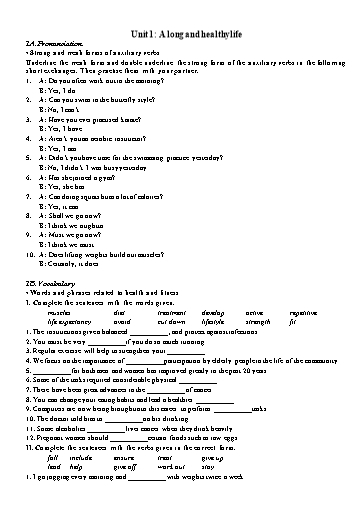
 2. Peter has decided to __________ football at the end of this season.
3. My father always __________ a very active life.
4. How do you make this change and __________ a balanced diet?
5. A healthy lifestyle __________ taking exercise and not smoking.
6. The fire doesn’t seem to __________ much heat.
7. One in seven road accidents is caused by drivers __________ asleep at the wheel.
8. Eat right to __________ healthy.
9. It was difficult to __________ patients because of a shortage of medicine.
10. Herbal products can __________ you to relax and sleep well.
III. Fill in each blank in the following sentences with the correct word / phrase below.
 immune system life expectancy ageing workout
 longevity boosting meditation nutritious
1. __________ takes many forms, but its core is the ability to control the mind and quieten it down.
2. Learning is the most fundamental brain __________ - and the more you do it, the more you’ll benefit.
3. Research for more recent periods shows a surprising and continuing improvement in __________ among
those aged 80 or above.
4. Many individuals through the ages realised there was a very important link between health, exercise, fitness,
meditation, intelligence and __________ .
5. A research suggests that tai chi may also slow down __________ by boosting a certain type of stem cell.
6. Bird’s nest soup brings overall benefit to the __________ and it gives you glowing skin.
7. Widespread gardening provides an opportunity for exercise, sunlight and __________ food for people in
Okinawa, Japan.
8. The first step in __________ Nagano's life span was a campaign to reduce salt consumption and promote a
healthier diet and lifestyle.
IV. Complete the following famous sayings with the words below.
 cheerfulness nutrition basis fitness cures
 healthy cleanliness illness disease value
 Best Sayings About Health & Nutrition
1. “Early to bed and early to rise makes a man __________, wealthy and wise”, Benjamin Franklin.
2. “Physical __________ is not only one of the
most important keys to a healthy body, but it is also the basis of dynamic and creative intellectual activity”,
John F. Kennedy.
3. “Those who think they have no time for exercise will sooner or later have to find time for
________________,” Edward Stanley.
4. “Health is like money, we never have a true idea of its __________ until we lose it,” Josh Billings.
5. “The doctor of the future will no longer treat the human frame with drugs, but rather will cure and prevent
disease with __________ ,” Thomas Edison.
6. “A good laugh and a long sleep are the best __________ in the doctor’s book,”
an Irish proverb.
7. “To ensure good health: eat lightly, breathe deeply, live moderately, cultivate __________ , and maintain
an interest in life,” William Londen.
8. “Today, more than 95% of all chronic __________ is caused by food choice, toxic food ingredients,
nutritional deficiencies and lack of physical exercise,” Mike Adams.
9. “Water, air and __________ are the chief articles in my pharmacopoeia,” Napoleon I.
10. “By cleansing your body on a regular __________ and eliminating as many toxins as possible from your
environment, your body can begin to heal itself, prevent disease, and become stronger and more resilient than
you ever dreamed possible!” Dr. Edward. 7. It hasn’t rained / didn’t rain for a long time, so it’s very hot.
8. I have sent / sent an email to Jack last week, but he hasn’t replied.
III. Complete the sentences. Use the past simple in one sentence and the present perfect in the other.
1. a Italy __________ the World Cup in 2006. (win)
 b He’s happy because Manchester United __________ all their matches this year. (win)
2. a ‘Can you tidy your room?’ - ‘I __________ it this morning.’ (tidy)
 b ‘Can you tidy your room?’ - ‘I __________ it.’ (tidy)
3. a What time __________ you __________ home last night? (arrive)
 b ‘ __________ Ben __________ ?’ - ‘Yes, he’s in the living room.’ (arrive)
4. a Come on, let’s eat. Dad __________ dinner. (cook)
 b Who __________ this food? It’s delicious. (cook)
5. a I __________ lots of interesting people since I arrived. (meet)
 b __________ you __________ anyone interesting while you were on holiday? (meet)
IV. Complete the text using the present perfect or the past simple form of the verb in brackets.
 I 1 __________ (meet) Andy on a diving course when I was seventeen. We 2 __________ (be) together
since then and in the last six years we 3 __________ (visit) some awesome places on our holidays. Last month,
we 4 __________ (decide) to get married. The wedding 5 __________ (be) great, but exhausting because we
were underwater and I 6 __________ (have) a big wedding dress on. Since we got married, we 7__________
(not have) time to think or relax. These last few weeks 8 __________ (go) very fast. Time flies when you’re
in love.
V. Complete the dialogue using the present perfect or past simple form of the verbs in brackets, or an
auxiliary verb.
Nick: 1 __________ you ever __________ (visit) Disneyland Paris?
Ann: Yes, I 2 __________ . It’s fantastic.
Nick: When 3 __________ you __________ (go) there?
Ann: I 4 __________ (go) with my mum last weekend.
Nick: Really?
Ann: Yes, we 5 __________ (travel) there by train on Friday evening and we 6 __________ (leave) on
 Sunday morning. But my dad 7 __________ (not come) with us.
Nick: 8 __________ he __________ (be) there before?
Ann: No, he 9 __________ . He hates places like that. He 10 __________ (not visit) a theme park since 1995
 when he 11 __________ (be) fourteen years old.
Nick: And what 12 __________ you __________ (think) of the rides?
Ann: I really 13 __________ (like) them all - especially the Big Thunder Mountain ride. It’s terrifying.
 14__________ you ever __________ (see) a photo of it?
Nick: No, I 15__________ . But I 16__________ (hear) a lot about it. It sounds great.
VI. Complete the text about young adventurers with the correct form of the verbs in brackets.
 Young Adventurers
 Most people 1__________ (never visit) the North Pole, but Parker Wilson has. Last year, Parker
2__________ (ski) 130 km across the Arctic in freezing temperatures. In the same year, he also 3__________
(start) a Facebook page about climate change. It’s amazing because Parker is only sixteen years old and still
4__________ (not finish) school - he’s a very young adventurer.
 5__________ you __________ (ever be) to the South Pole? Maybe not, but in 2009, Katie Walter
6__________ (walk) there and back in twenty days. She was only seventeen years old and she 7__________
(make) a lot of money for charity.
 Parker and Katie 8__________ (achieve) great things, but they are both still teenagers. 9__________ they
__________ (do) too much, too young? Some people think so. Some psychologists say that it’s dangerous for
teens to take these risks because their brains 10__________ (not develop) enough. Katie and Parker probably
disagree. What do you think? D. Don’t I need to be fit to do tai chi?
 E. What are the health benefits of tai chi?
 F. Are there different styles of tai chi?
 G. Can tai chi help to prevent falls?
 H. What’s the basic technique?
1. __________________________________________________________
It combines deep breathing and relaxation with slow and gentle movements. Originally developed as a martial
art in the 13th century in China, it is today practised around the world as a health-promoting exercise.
2. __________________________________________________________
Yes, such as yang, chen and wu. Some teachers often practise a combination of styles. The main differences
between the different tai chi styles are in the speed of movement and the way the body holds the postures.
3. __________________________________________________________
Tai chi is characterised by its slow, graceful, continuous movements that are gentle on the joints and muscles.
Done correctly, you'll find that the tai chi poses flow smoothly from one into another.
4. __________________________________________________________
Studies have shown that tai chi can help people aged 65 and over to reduce stress, improve balance and general
mobility, and increase muscle strength in the legs.
5. __________________________________________________________
Tai chi is essentially a gentle activity that is unlikely to cause injury if done correctly. The exercises involve
lots of flowing, easy movements that don’t stress the joints or muscles.
6. __________________________________________________________
Some research suggests that tai chi can reduce the risk of falls among older adults who are at increased risk.
However, more research is needed.
7. __________________________________________________________
No, tai chi is for everyone. It is ideal for inactive older people wanting to raise their activity levels gently and
gradually.
8. __________________________________________________________
It’s a good idea to learn the basics of tai chi from an instructor to make sure your style is correct, effective and
won't cause injury. You can consider using a book or DVD once you’re familiar with the poses.
III. Read the passage, and then decide whether the statements are true (T) or false (F).
 No Pain, Big Gains
 In China, it is believed that tai chi can delay ageing and prolong life, increase flexibility, strengthen
muscles and tendons, and aid in the treatment of heart disease, high blood pressure, arthritis, skin diseases,
depression, cancer, and many other diseases.
 Most of the research on tai chi has been done in older individuals in the area of balance and fall prevention.
This area of research is important because fall-related injuries are the leading cause of death from injury and
disability among older adults. Because tai chi movements are slow and deliberate with shifts of body weight
from one leg to the other in coordination with upper body movements, it challenges balance and many have
long assumed it helps improve balance and reduce fall frequency.
 In a similar tai chi study of older adults, 54% of the subjects who practised tai chi attributed their improved
sense of confidence to improved balance. One study looked at adults in their 60s and 70s who practised tai chi
three times a week for 12 weeks (60-minute classes). After just six weeks, statistically significant
improvements were observed in balance, muscular strength, endurance, and flexibility measures.
Improvements in each of these areas increased further after another 12 weeks.
 The demands of living are stressful for adults of all ages. Although one cannot directly point to studies
showing a reduction in stress from practising tai chi, the breathing, movement, and mental concentration
required of individuals who practise tai chi may be just the distraction you need from your hectic lifestyle.
1. It is believed by many in the world that tai chi has many benefits in treatments of many illnesses and
diseases. ______
2. Injuries from falls are a big problem among elderly people. ______ 6. to share your feelings or secrets with someone __________________
IV. Read the text, and choose the correct answer A, B, C or D for each question.
 Discover How Laughter Can Work for You!
You’ve probably heard the expression “Laughter is the best medicine”. Scientists and medical doctors now
agree that laughter can help people to deal with stress and anger. Research has shown that people who feel
happy and relaxed are healthier and have better relationships.
Laughter Yoga is a series of exercises. Laughter Yoga teaches you to laugh for no reason. You don’t have to
have a sense of humour, or understand funny jokes. You just have to laugh.
When you do Laughter Yoga in a group, you laugh and do yoga breathing, so that you increase the amount of
oxygen in your body. Soon the laughter exercises turn into real laughter. After a laughter yoga class, you feel
calm and relaxed, but also full of energy and happy.
Laughter Yoga was developed by Dr. Kataria, a doctor from India. Laughter Yoga classes started in Mumbai
in 1995 with just five people, and now there are over 6,000 laughter clubs in sixty different countries.
Julie Whitehead was one of the first people in the UK to become a Laughter Yoga teacher with Dr. Kataria.
She says, “Yoga has been a part of my life for thirty years, but in 2002 my life changed when I discovered
Laughter Yoga. I am particularly interested in health and well-being.”
She is a member of Laughter Network, a group of professionals who want to bring more laughter, health, and
happiness into people’s lives. They run Laughter Yoga classes and workshops in the UK, and Julie runs
Laughter Yoga holidays in Turkey, Egypt, Spain, and Morocco.
Laughing is good for the body and the mind. When we laugh, we breathe more oxygen into our body, which
helps to keep us healthy. Endorphins, or happy chemicals, are released in the body, and you feel more relaxed
and happy. Laughter also brings people together to share some fun. Companies who have run Laughter Yoga
workshops find that they have advantages for both employers and employees. People who are happy at work
are more hard-working and make more money for the company. Also, people who laugh together communicate
more successfully. In general, people do better at work when they feel happy and relaxed.
If you’re not sure about Laughter Yoga, remember this, children laugh 300 - 400 times a day, but adults only
laugh around fifteen times a day.
Get more laughter in your life - you can feel the change in you, and when you change, the world changes.
Laughter is really the best medicine. You can get more information about Laughter Yoga on its website at
laughter_yoga@india.com.
1. Laughing is good for our body EXCEPT that ______.
 A. we feel more relaxed and happy B. we breathe in more oxygen
 C. it improves communication D. it helps release happy chemicals
2. It is good to laugh and do yoga breathing exercises at the same time because ______.
 A. you laugh very funnily a lot during the laughter yoga classes
 B. you join a group and meet professionals all around the world
 C. Laughter Yoga teaches you to have a sense of humour and understand funny jokes
 D. you not only feel calm and relaxed, but also have full of energy and happiness
3. Laughter Yoga _______.
 A. started in India with a small group of people
 B. was developed by a doctor as a treatment
 C. started in sixty countries with over 6,000 laughter clubs
 D. was developed by first students of Dr. Kataria
4. All of the following are true about Julie Whitehead EXCEPT that ______.
 A. she became one of the first British Laughter Yoga teachers with Dr. Kataria
 B. she is a member of Laughter Network which run Laughter Yoga classes and workshops in the UK
 C. she has practised Laughter Yoga for thirty years in her life
 D. she herself runs Laughter Yoga vacations in some foreign countries
5. The advantage for a company when their employees do Laughter Yoga is that ______.
File đính kèm:
- bai_tap_bo_tro_tieng_anh_lop_11_global_success_unit_1_a_long.docx
 0. KEY-GLOBAL-SUCCESS-11.pdf


