

Bài tập bổ trợ Tiếng Anh Lớp 11 Global Success - Unit 10: The ecosystem (Kèm đáp án)
 17 trang
11/11/2025
1760
17 trang
11/11/2025
1760
Bạn đang xem tài liệu "Bài tập bổ trợ Tiếng Anh Lớp 11 Global Success - Unit 10: The ecosystem (Kèm đáp án)", để tải tài liệu gốc về máy hãy click vào nút Download ở trên.
Tóm tắt nội dung tài liệu: Bài tập bổ trợ Tiếng Anh Lớp 11 Global Success - Unit 10: The ecosystem (Kèm đáp án)
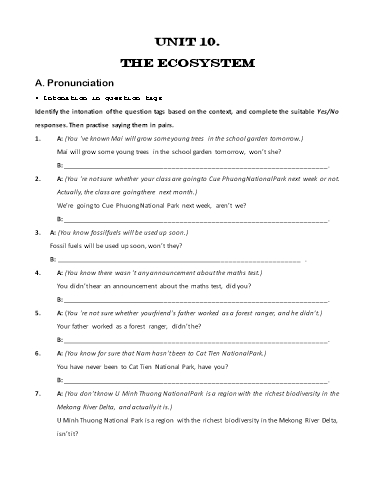
 B: __________________________________________________________________________.
8. A: (You don't know whether the leaders of the world have worked together to solve the problem
 of global warming or not, but actually they do.)
 The leaders of the world have worked together to solve the problem of global warming, haven’t
 they?
 B: __________________________________________________________________________.
B. Vocabulary
• Words and phrases related to ecosystems
I. Complete the sentences with the words given.
 ecosystem species organisms climate change non-living
 conservation tropical forest mammals flora and fauna biodiversity
1. It is important to encourage environmental __________________ and awareness.
2. The motivation for the control policy is to reduce the negative impacts of __________________.
3. Plants obviously do not have minds; nor __________________ do things like tables and rocks.
4. Humans, dogs, elephants, and dolphins are all __________________, but birds, fish, and crocodiles
are not.
5. Pollution can have disastrous effects on the delicately balanced __________________.
6. Many plant and animal __________________ are found only in the rainforests.
7. Tourism is damaging the __________________ of the island.
8. The country can undertake conservation measures to build up or maintain its __________________.
9. There are many examples of resource decline and low production, particularly in the humid
__________________.
10. All living __________________ have to adapt to changes in environmental conditions.
II. Complete the sentences with the adjectives given.
 rich raw tiny tropical non-living
 colorful native natural essential national
1. Bone is actually made up of living tissue and __________________ matter.
2. If we continue to deplete the earth’s __________________ resources, we will cause serious damage
to the environment.
3. The problem needs to be addressed both at a(n) __________________ and international level. 4. Water is essential __________________ living things.
5. That rainforest has been home __________________ many endangered species.
6. When the biodiversity of an ecosystem is interrupted or destroyed, the economic impact
__________________ the local community could be enormous.
7. Scientists have studied only a small percentage of rainforest species their search
__________________ cures.
8. The house is surrounded __________________ trees, so it’s not overlooked at all.
9. Rhinos, tigers, elephants, lions are __________________ the list of endangered species.
10. The man was described __________________ tall and dark, and aged about 20.
C. Grammar
• Compound nouns
I. Match each noun 1-10 with a noun a-j to make compound nouns. (Four of them are written as one
word.)
1. basket _______ a. teacher
2. swimming _______ b. work
3. week _______ c. tennis
4. home _______ d. pool
5. sweat _______ e. shirt
6. shopping _______ f. end
7. head _______ g. game
8. pop _______ h. ball
9. computer _______ i. centre
10. table _______ j. music
II. Complete the sentences with the compound nouns from Exercise I.
1. I never listen to ___________________ on the radio.
2. ‘Is Tom watching TV?’ - ‘No, he’s playing a ___________________ in his bedroom.’
3. There’s a really good ___________________ in the town centre. You can buy almost everything
there.
4. ‘Where did you learn to swim?’ - ‘I had lessons at the ___________________.’
5. Is the ___________________ of your school a man or a woman?
6. ‘What are you doing at the?’ - ‘I’m going to stay with my cousin.’ 1. solar ______ A. species
2. GM (genetically modified) ______ B. rain
3. carbon ______ C. effect
4. global ______ D. layer
5. endangered ______ E. disposal
6. greenhouse ______ F. emissions
7. acid ______ G. forest
8. waste ______ H. foods
9. ozone ______ I. power
10. rain ______ J. warming
VI. Complete the sentences with compound nouns from Exercise V.
1. Many forests have been damaged by __________________.
2. The __________________is causing the earth’s atmosphere to heat up.
3. __________________will cause the icebergs to melt.
4. The Amazon __________________is in the Amazon Basin of South America.
5. The __________________helps to protect the earth from harmful radiation from the sun.
6. Coal-burning power stations are a source of __________________.
7. Some __________________can only be seen in zoos.
8. __________________is a renewable source of energy.
VII. Complete the sentences with the compound nouns below.
 football pitch flood lights mountain range tower block
 tennis courts swimming pool safety net seashore
1. A __________________ is a tall building containing apartments or offices.
2. Many tennis players prefer __________________ with a grass surface.
3. The game will be played under __________________.
4. The two teams, will play a big match at the world-famous Wembley __________________.
5. She takes her inspiration from shells and stones she finds on the __________________.
6. A __________________ is the one that is put below people performing at a great height to catch
them if they fall.
7. The outdoor __________________ is open during the summer months.
8. They tried to climb up the great __________________ of the Alps. 5. Setting panda reserves in the mountains of China is a good way to save pandas. _________
II. Read the passage, and choose the correct answer A, B, C or D for each question.
Conservation is the sensible use and protection of natural resources including plants, animals, mineral
deposits, soils, clean water, clean air, and fossil fuels such as coal, petroleum, and natural gas to ensure
an adequate supply for future generations.
Natural resources are grouped into two categories, renewable and nonrenewable. A renewable
resource is one that may be replaced over time by natural processes, such as fish populations or natural
vegetation, or is inexhaustible, such as solar energy. The goal of renewable resource conservation is to
ensure that such resources are not consumed faster than they are replaced. Nonrenewable resources
are those in limited supply that cannot be replaced or can be replaced only over extremely long periods
of time. Nonrenewable resources include fossil fuels and mineral deposits, such as iron ore and gold
ore. Conservation activities for nonrenewable resources focus on maintaining an adequate supply of
these resources well into the future.
1. What is the purpose of conservation mentioned in the passage?
A. To make use of natural resources
B. To ensure an adequate supply of natural resources for future generations
C. To replace renewable resource
D. To maintain an adequate supply of water for future
2. The word ‘inexhaustible’ in paragraph 2 is similar in meaning to _________.
A. unlimited B. bottomless C. boundless D. never-ending
3. Natural vegetation is an example of _________.
A. nonrenewable resources
B. the resource to feed fish populations
C. the resource that may be replaced by natural processes
D. inexhaustible resources
4. Conservationists work to ensure that _________.
A. fish are consumed faster than fossil fuels
B. people consume resources more economically
C. nonrenewable resources are consumed faster
D. renewable resources are replaced
5. Gold ore is mentioned as _________. A. They roam in the park. B. They visit the park.
C. They graze in the park. D. They frequent the park.
3. Which kind of animal almost became extinct early in the 20th century?
A. bison B. bald eagles C. trumpeter swan D. wolves
4. What is the purpose of the passage?
A. To discuss the dangers the flora of the park has to face
B. To discuss the dangers the fauna of the park has to face
C. To show the bad condition of the park
D. To give information about the park
5. What is the word ‘encompasses’ in paragraph 2 closest in meaning to?
A. surrounds B. includes C. has D. contains
IV. Choose the item among A, B, C or D that best answers the question about the passage.
California has 8 national parks and 20 national forests, more than any other state. Yosemite National
Park is one of the most visited parks. It is famous for its waterfalls and granite cliffs. Many rock climbers
go to Yosemite to climb a rock wall named El Capitan. Point Reyes National Seashore is on a peninsula
north of San Francisco. It is a good place to see harbour seals, sea lions, and many kinds of birds.
Disneyland in Anaheim is another California tourist attraction. This large amusement park was created
by cartoonist Walt Disney. It features a fairyland castle, a haunted mansion, a jungle safari, and many
other attractions and rides.
San Diego has a world-famous zoo. As you wander through its Rain Forest Aviary, brightly coloured
tropical birds fly by. You will think you are on safari in its outdoor Wild Animal Park, north of San Diego.
Sea World in San Diego is a great place to watch whales and dolphins perform. California’s sunny
climate, long coastline, and natural beauty have made It the most popular tourist state in the United
States. depleting fish storage within the next few years. Sea resources are rapidly declining in many parts of
world, and the problem cannot be ignored.
We can predict that food supplies in the sea cannot last forever.
1. According to the author what was the attitude in the 19th century toward resources of the sea?
A. declined B. depleted C. limited D. unlimited
2. What is the range of the decline in fish supply?
A. Europe and Asia B. the whole world
C. America D. Asia and America
3. What purpose does the author mention the endangered species for?
A. environment protection B. the protection of African Elephant
C. the protection of Indian Tigers D. none of the above
4. What does the author believe about sea resources?
A. Sea resources can last forever.
B. None of the great sea fisheries is to be exhausted.
C. Fish supply has no effects on people.
D. Sea resources are important to people.
5. Which of the following titles best describes the purpose of the lecture?
A. Unlimited Sea Resources B. Threats to Animals and Birds
C. Sea Resources on the Decline D. Protection of Fish
VI. Read the following passage, and then choose the best answer.
The warming of the Pacific Ocean creates weather patterns that affect the world. When the waters
warm, the amount of rainfall in Indonesia and the surrounding regions decreases. Australia could even
experience a drought. On the other hand, Chile, which borders the Pacific Ocean, is preparing for severe
rainstorms. In Pakistan and northwestern India, the weather pattern makes the monsoon season
weaker and makes the area much drier.
This phenomenon is called El Nino and is used by weather forecasters to make long range weather
predictions. Forecasters know that El Nino will bring unusually heavy rains to southwestern part of the
United States and make the central part of the country drier.
El Nino itself used to be predictable. It would occur every two or seven years. But now, the weather
pattern is becoming more constant. Scientists are unsure of the reason of this change.
1. What would characterize the effects of El Nino? 8. A: More elephants work in circuses. B: a/ Entertainment is important to US.
 b/ It’s not a good deed to do so.
 9. A: Are those birds native to Viet Nam? B: a/ No, they only migrate here.
 b/ No, it’s their habitat here.
 10. A: We’re using up fossil fuels. B: a/ OK. They include petrol, coal, and so on.
 b/ Yes, we should use more alternative energy.
• Ways to protect local biodiversity
II. Complete the dialogue with the phrases below. There is one extra that you do not need.
 A. damage the ozone layer
 B. the overuse of natural resources
 C. have eco-labels
 D. energy conserving light bulbs
 E. without the use of chemicals and pesticidesF. eco-friendly appliances
 F. the percentage of the ingredients
Phong: Our team is going to present ways to protect our local biodiversity. Can you contribute your
ideas to the speech?
Nick: I think we can practise protecting biodiversity by being aware of the things we buy, consume and
use. We should buy products that 1 ____________________________________________ because
these labels allow consumers to learn exactly what products are made from and 2 ________________
_________________________________ in an item.
Mai: In my opinion, we should recycle all plastic and glass products. This process prevents 3 _________
_____________________________ in making them, as well as protects trees and forests used in paper
products.
Jane: Besides that, we should also reduce or eliminate the use of products that come in aerosol cans.
These products 4 ___________________________________, the environment and add to air pollution.
Nick: We should purchase 5 ___________________________________for our home and office. There
are many brands and types of appliances that are designed to use less energy and to reduce utility costs.
Phong: We use 6 ___________________________________around our house. It is possible to buy LED
light bulbs to improve efficiency and protect the environment. And I think that’s enough for our
presentation now.
• Expressing likes and dislikes B. the environmental problems, the poor management of our natural resources
 C. no longer available, industrial and daily activities will face a lot of difficulties
 D. dealing with the present problems on our Earth to keep on living here
 E. no wars, hunger, or social problems
 F. to live and new ways to exploit natural resources there
In the future it seems to be more difficult to live on the Earth. Some people think more money should
be spent on researching other planets to live on.
On the one hand, finding other planets to live on is a good idea. Firstly, there are limited natural
resources that we will use up soon. Once these resources are 1 _________________________________
__________________________________________________________________________________.
Secondly, setting a goal of settling down on a new planet will make sciences and space exploration
develop faster. Scientists will find out new places 2 __________________________________________
__________________________________________________________________________________.
and communicate with aliens to exchange universal knowledge.
On the other hand, the discovery of new planets should not be the only solution for our future. The
Earth is facing 3 ______________________________________________________________________.
We still have enough time to take action now to solve these problems. Moreover, the cost for discovery
and settling on new planets is much higher than protecting and regenerating our planet. Spaceships,
research projects, space exploration programmes will 4 ______________________________________
__________________________________________________________________________________.
In conclusion, it is necessary to research for new planets to live on in the future, but 5 _______________
______________________________________is a promising answer to the question.
II. Complete the essay about how to protect oceans with appropriate supporting ideas below. There
is one extra sentence that you do not need.
 A. Over 90% of the additional heat caused by global warming is stored in the oceans.
 B. We should carry out campaigns to prevent pollution of the coastal environment and reduce
 the use of plastics so that less of it ends up in our oceans.
 C. They host 80 percent of the planet’s biodiversity, and they are the largest ecosystem on
 Earth.
 D. Scientists have discovered that marine life, such as horseshoe crabs, seaweeds, provide many
 herbs and medicines.
File đính kèm:
- bai_tap_bo_tro_tieng_anh_lop_11_global_success_unit_10_the_e.docx
 0. KEY-GLOBAL-SUCCESS-11.pdf


