

Bài tập bổ trợ Tiếng Anh Lớp 11 Global Success - Unit 2: The generation gap (Có đáp án)
 23 trang
11/11/2025
1810
23 trang
11/11/2025
1810
Bạn đang xem tài liệu "Bài tập bổ trợ Tiếng Anh Lớp 11 Global Success - Unit 2: The generation gap (Có đáp án)", để tải tài liệu gốc về máy hãy click vào nút Download ở trên.
Tóm tắt nội dung tài liệu: Bài tập bổ trợ Tiếng Anh Lớp 11 Global Success - Unit 2: The generation gap (Có đáp án)
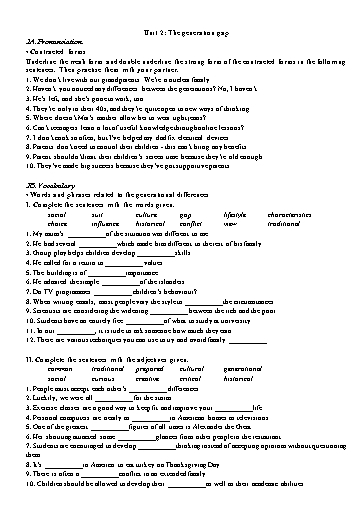
 III. Complete the sentences with the correct form of the verbs given.
 suit rely on force accept experiment influence
 achieve share hire grow up practise try out
1. Businesses may only __________ foreign workers while an American cannot be found.
2. He wanted to __________ more with different textures in his paintings.
3. Quang has __________ considerable success as an artist.
4. They are __________ a new sound system for the show.
5. The building has been adapted to __________ the needs of older people.
6. Several factors are likely to __________ this decision.
7. What do you want to be when you __________ ?
8. Many working women __________ relatives to help take care of their children.
9. He’s not going to change, and you just have to __________ it.
10. Do you __________ your religion in the new country?
11. Bad health __________ him into taking early retirement.
12. Think of this advertisement as an opportunity to __________ your experiences.
IV. Fill in each blank with the correct word from the box. There are two extra words.
 stressed behave fun safe easier
 encouragement skills closer precious values
The benefits of family management also include:
- bringing family members 1 __________ together
- making it2 __________ for grown-ups and children to talk
- making everyone more organised and less 3 __________
- making the most of4 __________ time and finances
- helping adults deal with the way children 5 __________
- providing a way of passing on your family 6 __________
- helping children develop important social7 __________ for life
- helping your family find more time to have 8 __________ together.
V. Fill in each blank in the following sentences with the correct word given.
 respectful babysitter burden siblings impose
 scene attitude values peacemaker mature
1. Research shows that rituals can strengthen your family’s __________ and help pass them on to your
children.
2. Children object to the fact that parents try to __________ curfews and set time aside for studying sessions.
3. A generation gap is usually defined as the difference in values, __________ and behavior between one
generation and the next.
4. No hurting anyone’s feelings or body, and asking permission to borrow other people’s belongings are
examples of __________ behavior.
5. As children get older and more __________ , the rules can develop with them.
6. If household chores are shared, the __________ is lighter on everyone.
7. Rap music appeared on the __________ in the early 1980s.
8. A __________ is a person who tries to persuade people to stop arguing or fighting.
9. A __________ is a person who takes care of babies or children while their parents are away from home.
10. I have three __________ : two brothers and a sister.
VI. Choose the correct words to complete the text.
 The Generation Gap 1. You __________ go to bed early when you go to school the next day.
2. You __________ eat a lot of fast food - it’s bad for you.
3. You __________ find someone to ask about your homework.
4. The teacher is annoyed with Quan — he __________ behave better in class.
5. I __________ really play these computer games - they are a waste of time.
6. We __________ make a reservation at the restaurant for your birthday dinner.
II. You are having dinner with people you don’t know well. Which of the things below should you do
and which shouldn’t you do in your culture?
1. You __________ speak with your mouth full.
2. You __________ wait for the others before you start eating.
3. You __________ eat with your fingers.
4. You __________ make a noise when you drink something.
5. You __________ use a spoon for soup.
6. You __________ put your chopsticks and spoons on the plate when you finish.
III. Choose the correct modal verb to complete the sentences.
1. In a park, you (must / mustn’t) __________ walk on the grass.
2. On a bus, you (must / mustn’t) __________ talk to the driver.
3. In a library, students (may / must) __________ borrow up to six books.
4. In an exam, students (must / mustn’t) __________ answer all the questions.
5. To ride a motorbike, students (must / have to) __________ be over 16 years old.
6. In a hotel, guests (must / have to) __________ use the exit only in an emergency.
IV. Complete the sentences with the correct form of must, have to or should. Use the information in
brackets to help you.
1. Phong __________ write three one-thousand-word essays for his course. (It’s necessary.)
2. We __________ tidy up the house. Mum will be home soon. (It’s a good idea.)
3. You __________ park here. You’ll get a fine. (obligation not to do this)
4. You __________ pay for children. They can come in for free. (It isn’t necessary.)
5. The sign says you __________ keep your dog on a lead. (It’s necessary.)
6. You __________ smoke anywhere in the building. It isn’t allowed. (obligation not to do this)
7. You __________ wear a helmet when you ride your motorbike. It’s the law. (It’s necessary.)
8. Do children __________ go to school on Saturdays? (Is it necessary?)
9. You __________ wear jeans to a job interview. (It isn’t a good idea.)
10. You __________ pay for the coffee. It’s free. (It isn’t necessary.)
V. Complete the sentences with the phrases below.
 must be must study must wear mustn’t eat
 mustn’t run mustn’t wear should arrive shouldn’t bring
 School Rules
1. Girls __________ skirts and black shoes.
2. Boys __________ long hair.
3. Morning classes start at 7.00 am. Students __________ at school by 6.50 am if possible.
4. You __________ inside school. It’s dangerous. Please walk everywhere.
5. You __________ anything in the classrooms. Please have your lunch in the canteen or outside.
6. Students __________ polite to teachers all the time.
7. All students __________ Vietnamese literature, maths and English. These subjects are compulsory. they don’t disagree with you. But there are a few of you who have grandparents who live in different towns,
or even abroad, and so you don’t see them very often.
Grandparents are special people and we love ours! Here's what you say.
Giuliana Ross, Canada
I love everyone in my family, but my grandma is really special for me. She lives a few streets away from us,
so when I want to be on my own, I usually walk to her house. She doesn’t ask questions. I love that. We do
lots of things together, too, like making food, which we enjoy. At the moment, she’s teaching me to make her
favourite dish, which her grandmother taught her. It’s quite hard to do, but I love sharing moments with her.
It’s special.
Andy Davidson, USA
I love my granddad! He’s just the best - he can keep a secret; he helps me and he’s usually funny. We have
lots of fun, and we have lots in common. We both enjoy going climbing. My granddad is really good at that -
no one realises that he’s in his sixties.
Boris Sanneh, UK
My grandparents live in another country. They visit us about every three years, but it’s hard because we don’t
really know what to talk about. They ask about school and things like that. That’s usually the first week. By
the second week though, things are a bit better and it’s more ‘natural’. When my sister and I were younger,
they visited more often and I remembered Grandpa doing silly things, like making faces when Mum wasn’t
looking. He still does that sometimes. But now that they are older, I’d like them to live closer.
Task 1. Are these sentences true (T) or false (F)?
1. All of the readers get on with their grandparents. _____
2. Giuliana’s grandmother lives in a different town. _____
3. Giuliana shares an interest with her grandmother. _____
4. Giuliana’s grandmother is teaching her to cook a dish she invented. _____
5. Andy’s granddad is good at sports. _____
6. Andy’s and Boris’s granddads make them laugh. _____
7. Boris’s grandfather is a serious man. _____
8. Boris’s grandparents don’t visit as often as they did. _____
Task 2. Match the words in bold in the text to their meanings.
1. _______________ small and not important
2. _______________ doing things with your face that make people laugh
3. _______________ in or to a foreign country
4. _______________ having a thing, experience or emotion at the time as someone else
5. _______________ notices or understand something
6. _______________ food prepared as part of a meal
Task 3. Complete the sentences with the correct form of the words from Task 2.
1. This __________ smells delicious! Yum!
2. Stop being __________ ! It’s not funny.
3. I love __________ music and videos on Facebook with my friends.
4. She’s so funny when she __________ .
5. David and his family always go __________ in the summer.
6. They didn’t __________ the train was at noon.
II. Read the blog, and do the tasks that follow.
 Teen Advice Blog: Share your worries and opinions with other teens.
Zoe: Posted yesterday at 17:10
 Madonna Fan Mother
 My problem is my mum! She’s really nice and I get on well with her. I sometimes argue with her about
 little things, but nothing important. All my friends love her - she’s great fun. When she was at my age, A One of the most important jobs parents have is to teach children about the world and how to live
 successfully. However, every generation grows up in a world different from their parents’. This often
 leads to young people feeling that their parents don’t understand them, and to parents feeling that their
 kids’ values are wrong. This difference in attitudes and lack of understanding is called the generation gap.
B The effect of the generation gap on families is obvious: parents and children frequently disagree about
 everything from clothes to music to careers. But the generation gap can also be felt in the workplace. As
 young employees enter companies, they may have completely different expectations from the older
 generation working in the company. Ideas about work-life balance, what makes a ‘good’ job, and how
 managers and employees should talk to each other may be very different. This can lead to frustration for
 everyone.
C But does it have to be this way? While it seems obvious to think of your own generation as ‘us’ and the
 other generations as ‘them’, if we redefine ‘us’ as ‘our family’ or ‘our company’, then we can see both
 generations as being on the same side - playing for the same team. And if we then truly listen to the people
 around us - older and younger - with empathy, we can begin to accept that our differences may make us
 stronger as a team. This means, of course, we also expect parents to learn from their children.
D That doesn’t mean that parents need to adopt their kids’ dress sense or listen to their music, but it does
 mean that parents may need to learn more about the role of technology - for example, social media - in
 their kids’ lives, and possibly even to try it for themselves before they criticize it.
E Here are three tips for bridging the generation gap:
 • Get to know other generations. Try to socialize with people who are both younger and older than you.
 • Learn to really listen and not just think about what you’re going to say next.
 • Remember: You can learn from anyone, whether they’re older or younger than you.
F The generation gap isn’t going to go away, because the world won’t stop changing. But if we start to think
 of it as a source of learning and growth rather than just a conflict, we may make the world a better place
 for everyone.
Task 1. Decide whether the sentences are true (T) or false (F), and correct the false ones.
1. The author wrote the text to explore the generation gap and problems it can cause, and to suggest a possible
solution.
_______________________________________________________________________________________
2. The main idea is that it is almost impossible for people from different generations to understand one another.
_______________________________________________________________________________________
3. The text doesn’t inform or teach us, because its purpose is to persuade and influence.
_______________________________________________________________________________________
Task 2. Read the text again. Match each statement 1-6 to the paragraphs A-F that gives the information.
1. The writer suggests a change in thinking: choosing to see other generations as working with you rather than
against you. ________
2. It’s a good idea to get to know people who aren’t your age, and to hear what they think. ________
3. The generation gap is the difference between the way older and younger people see the world. ________
4. The generation gap affects people in their job because it means that people of different ages working together
may have very different opinions. ________
5. The generation gap isn’t necessarily just a problem; it can also be a great opportunity for learning.
 ________
6. Parents should learn about their children’s world and not just say they don’t like it. ________
Task 3. Which statement gives the best conclusion of the text?
a. Learning and change are both easier for younger people.
b. Technology often causes conflict between young and old.
c. Differences can be good if we take time to understand them. 4. When does a teenager want to rebel?
_____________________________________________________________________________________
5. What are the ways to fix the problems between parents and their teens?
_____________________________________________________________________________________
III. Read the passage, and choose the correct answer A, B, C or D for each question.
 Dating Customs Around the World
 Dating is rare in Afghanistan because most marriages are arranged by parents, and schools are separate
for boys and girls. The opportunities to meet are rare. Girls have a 7:00 pm curfew, while boys have an 11:00
pm curfew.
 It is against the law to date in Iran. Teens are separated until they are of marrying age, then their families
introduce them to each other and sometimes a courtship follows.
 Most teens go out in large groups and don't pair off until they are 18 or 19 years old in Australia. Girls
often ask boys out and pay for the date, too. Couples often go to dinner parties, barbecues, or the beach.
 Dating is usually a group event in Europe. In Spain, teens join a pandilla, a club for a group of friends
with the same interests, like cycling or hiking. Dating is done one-to-one and both girls and boys ask each
other out and split the cost of the evening's entertainment.
 In Russia, dates take place at dances or at clubs where teens eat or chat with friends. As many as 30 teens
may come to a cinema to attend a movie together. In small towns, teens meet in the streets downtown or gather
around a fountain.
 In Japan and Korea, most high school students don't date or go to parties, but spend their time studying
instead. Dating begins in college, when only boys do the asking and pay for the dates.
1. In Muslim countries as Afghanistan and Iran, dating is ________.
 A. arranged by parents B. introduced by families
 C. after a courtship D. rare or prohibited
2. All of the following are true about dating in Australia EXCEPT that ________.
 A. they often go out in large groups
 B. only girls ask boys out and pay for the date
 C. they are not often in a relationship until the age of 18 or 19
 D. the most venues for dating are dinner parties, barbecues, or the beach
3. In Spain when having a date, teenagers ________.
 A. with the same interests often go to a club
 B. go cycling or hiking in pairs
 C. boys often pay for the cost of the entertainment
 D. join a pandilla to enjoy the evening’s entertainment
4. In Russia, teenagers ________.
 A. meet in the streets near their houses in small towns
 B. gather around in order to have a fountain
 C. have dating at cinemas, dances, or clubs
 D. may come to a cinema when the number of them is 30
5. In Japan and Korea, _______.
 A. female college students can ask boys for dating
 B. most college students concentrate on studying instead of dating
 C. dating is very rare for high school students
 D. high school students often go to parties and share the cost
VII. Read the passage, and then decide whether the statements are true (T) or false (F).
 Family rules help children understand which behaviors are acceptable and not acceptable. As children
grow, they will be in places where they have to follow rules. Following rules at home can help children learn
to follow rules in other places.
File đính kèm:
- bai_tap_bo_tro_tieng_anh_lop_11_global_success_unit_2_the_ge.docx
 0. KEY-GLOBAL-SUCCESS-11.pdf


