

Bài tập bổ trợ Tiếng Anh Lớp 11 Global Success - Unit 3: Cities of the future (Có đáp án)
 21 trang
11/11/2025
2720
21 trang
11/11/2025
2720
Bạn đang xem tài liệu "Bài tập bổ trợ Tiếng Anh Lớp 11 Global Success - Unit 3: Cities of the future (Có đáp án)", để tải tài liệu gốc về máy hãy click vào nút Download ở trên.
Tóm tắt nội dung tài liệu: Bài tập bổ trợ Tiếng Anh Lớp 11 Global Success - Unit 3: Cities of the future (Có đáp án)
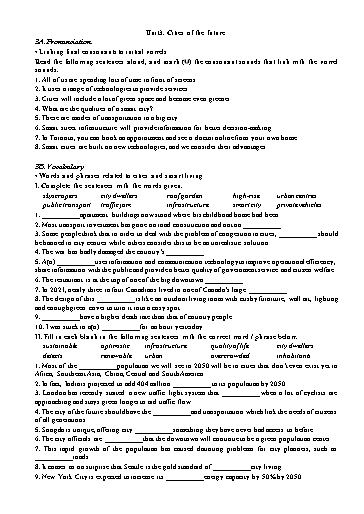
 10. Our communities will be cleaner and more sustainable, so be better.
III. Fill in each blank in the passage with the correct word / phrase below.
 classes dustbins qualities developers display
 appliances infrastructure tutors technologies underground
 Songdo, which means “Island of pine trees” in Korean, is called “The City of the Future” by many
1 __________ . Up to now, Songdo has completed about 60 percent of its planned 2__________ and
buildings, developers say, and reached a population of about 70,000 - a third of the number expected by
2028, when the city may be finished.
 One morning, we found ourselves at Songdo’s waste-management center where we watched a video
about the city’s garbage-removal system. Narrated like a Hollywood film, it explained that all of
Songdo’s trash is sucked into 3 __________ pipes, and is automatically sorted and recycled, buried, or
burned for fuel. These pipes connect all apartment buildings and offices; consequently, there are no
street-comer 4 __________ or garbage trucks.
 Next, at a nearby office building, we learned about Songdo’s so-called “telepresence” system, which
is currently being tested by 100 of the city’s residents. The system allows Songdo residents to sit in front
of custom television screens and chat with English 5 __________ in Hawaii or take fitness 6__________
from instructors elsewhere in Korea.
 Finally, we visited Cisco’s Global Innovation Lab, where more technologies-in- development were
on 7 __________ , including mobile phone-controlled home 8__________ and even micro-chip tracking
of Songdo’s children so they don’t get lost. These and other 9 __________ were being pitched to the
Songdo government by Cisco, but had not been adopted yet, meaning that for the time being at least, the
city’s children were free to sneak over to friend’s houses without fear of surveillance.
 Tourists often seek out history and natural beauty, but here is a history-less and especially unnatural
city. These 10 __________ , in many ways, actually make Songdo appealing.
IV. Complete the sentences, using the correct form of the words in brackets.
1. The information will be collected through the __________ . (detect)
2. Cities need to make full use of land in order to achieve urban __________ . (sustain)
3. Some of the other problems predicted for the near future include limited and diminishing
arable land, deforestation, __________ , and degradation of land and water. (urban)
4. For South Korea, Songdo is more than a hi-tech business district, but a template for future __________
. (develop)
5. Songdo is the prototype for the green __________ the Korean government wants to build the economy
on in the future. (invest)
6. The pace of __________ is happening fast in the United States. (innovate)
7. I think the cities of tomorrow also need to consider the __________ of open space. (available)
8. Cities at their best are social environments where __________ and human __________ go hand in
hand. (create - develop)
• Prepositions
V. Complete each sentence with the correct preposition.
1. There is a roof garden __________ top of the hotel.
2. There are no simple solutions __________ the problem of overpopulation.
3. The boy has impressed his doctors __________ his courage and determination.
4. Unemployment __________ urban areas is a big problem.
5. Customers under 25 are important, making __________ a quarter of the total.
6. What are the qualities that are needed __________ the job?
7. Industry has a huge impact __________ the environment we live in.
8. The forest is home __________ a wealth of wildlife. b She ____________________ (appear) in cosplay at the festival.
10 a ‘I’ve lost my handbag.’ - ‘What ________________ it _______________ (look) like?’
 b He ____________________ (look) for a job because he needs a promotion.
IV. Put the verbs in brackets into the present simple or the present continuous.
1. She __________ (go) to the doctor. She __________ (have) a headache.
2. He __________ (have) dinner now. He __________ (have) a very good appetite.
3. They __________ (live) in a rented house at the moment. They __________ (like) to live in one.
4. He __________ (mow) his lawn whenever I __________ (see) him.
5. He __________ (touch) the kettle. It __________ (feel) hot.
6. They __________ (smell) the coffee now. It __________ (smell) good.
7. The sun __________ (rise) now. It __________ (appear) over the horizon.
8. ‘What __________ he __________ (do) there now?’ - ‘He __________ (think) of his children. He
__________ (love) them very much.’
9. We __________ (look) at the streets in the sun. They __________ (appear) very hot.
10. I __________ (believe) you __________ (enjoy) your holiday now.
V. Use either the simple present or the present continuous of the verbs in brackets.
1. Peter __________ (have) a car. He __________ (have) trouble with his car, so he has to take the bus
to work these days.
2. This box __________ (weigh) a lot. It’s too heavy for me to lift.
3. I’ve just handed the box to the postal worker. Right now she __________ (weigh) it to see how much
postage it __________ (need).
4. I __________ (do) this practice at the moment. It __________ (consist) of both nonprogressive and
progressive verbs.
5. I __________ (think) about the verbs in this practice right now. I __________ (think) all of my
answers are correct, but I’ll compare my answers with my next partner’s when I finish to make sure.
6. Ms Hoa is at the market. Right now she __________ (look) at the apples.
7. Right now Mai is in the science lab. She __________ (not want) to spill any of the acid. She
__________ (always / be) careful when she does a chemistry experiment.
• Use of English
VI. Read the text below and think of the word which best fits each gap. Use only one word in each
gap.
 The City That Never Sleeps
With a population of over 8 million spread over 790 km2, New York has 1 __________ residents per
square kilometre than any other city in the US. The five boroughs that make up the city, Manhattan,
Queens, The Bronx, Brooklyn and Staten Island joined to become one city 2 __________ 1898. But New
York 3 __________ not always the name given to this part of the US. The first people to settle these
lands were Dutch colonists. In 1624, they set up a trading post here and gave it the name New
Amsterdam. The name changed, however, in 1664 4 __________ the English king took control of the
lands and gave them to his brother the Duke of York as a gift. This led 5 __________ its name being
changed in honour of the Duke. The name New York has been used ever 6 __________ . The Statue of
Liberty, 7 __________ is one of the many symbols of the city, arrived towards the end of the 19th century
and the beginning of the 20th century. But long before the Statue of Liberty arrived, the city 8__________
enjoyed a long history. Today the city is the biggest city in the US, but it also 9__________ to be the
capital. For five short years from 1785-1790, New Yorkers 10 __________ inhabitants of the country’s
centre of administration. Nowadays, it is a popular tourist destination and every year thousands of people
from all over the world flock to the City that Never Sleeps to visit famous places like Times Square, 3. ________________________________________________
Solar energy will be harvested from space and beamed down to Earth, providing clean, cheap and
efficient electricity to power our cities.
4. ________________________________________________
Homes and buildings will operate as living organisms, monitoring performance and adapting to our
needs in real time, saving us energy and money.
5. ________________________________________________
Homes will be equipped with solar panels, small-scale wind turbines and other sources of electrical
generation, allowing them to operate independently from the grid, when necessary.
6. ________________________________________________
Consumers and power sources will communicate in real time through fiber optic smart grids that will
reduce blackouts, maximize energy efficiency, and save money.
7. ________________________________________________
People will travel hundreds of miles in just minutes through solar-powered pods that travel through
elevated, depressurized tubes.
8. ________________________________________________
Buildings will be equipped with comprehensive water management systems, allowing them to collect
rainwater, monitor water use, and efficiently recycle dirty water.
III. Read the passage, and then decide whether the statements are true (T) or false (F).
The cities of the future will see a large number of intelligent homes that can interact with their owners.
In fact, things that were earlier considered science fiction are already coming to life in smart cities such
as Masdar in the United Arab Emirates, where an automated underground transport network fully fuelled
by solar power is already running circuits.
With smart technology, the possibility of having huge savings on electricity and power is within our
reach. Sensors are being developed so that street lights of the future will switch on only when you are
close by. The smart technology in self-driven cars will enable you to save on gas and other non-
renewable energy sources. In fact, smart cities will aim to neutralize the use of fossil fuels completely.
The cities of the future will have to adapt quickly to rapid technological advancements in IT and
engineering. The gap between technological leaps is going to decrease over time. Technology will help
bridge the current gap between the government and public in the cities of the future, given that IT and
digitization will make these cities more open and social.
Another thing that we can all agree on is that the cost of building in these smart cities is going to be
considerable. An estimate can be derived based on the latest smart city developments in India. With the
booming population, the Indian Prime Minister Narendra Modi is pushing to attract investments to fuel
rapid development projects in the country.
1. Intelligent homes can have effect on their owners. _________
2. Some predictions made about smart cities have been put in practice. _________
3. The transport network in Masdar has run on a renewable source of energy. _________
4. Street lights will switch on after sensors are developed. _________
5. We will save energy with driverless cars. _________
6. Smart cities in the future will aim to make fossil fuels completely neutral. _________
7. New technological advancements make the cities in the future change so rapidly in order to become
more open and social. _________
8. Building a smart city costs a lot of money, so a country like India has to call for investment to supply
fuel for the project of smart cities. _________
IV. Read the passage about green cities, and then answer the questions.
 What makes a city green? Factors such as recycling, renewable energy, transportation options,
building construction, air quality and emissions make green cities great. Here are some cities that are
doing their part to lead us on the global path to a greener future. __________________________________________________________________________________
2. How will our kitchen gadgets help us?
__________________________________________________________________________________
3. What can you do with the fridge with a built-in camera?
__________________________________________________________________________________
4. How can our bodies be checked for signs of ill health and any abnormalities?
__________________________________________________________________________________
5. What are the benefits of the immediate treatment?
__________________________________________________________________________________
Task 2. Match the underlined words in the text with the definitions.
1. hoover ____ A. finished and there is none left
2. used up ____ B. change something in order to improve it
3. stock up on ____ C. being made extremely tired
4. modify ____ D. clean a carpet, floor with a vacuum cleaner
5. wiped out ____ E. buy a lot of something
VI. Read the text, and do the tasks that follow.
 2040 VISION
Smartphones are museum pieces and cable TV - what was that? The world will be very different in the
future but what will everyday life in 2040?
06.45
You’re gently woken up in your sleep pod - you don’t sleep in a bed; they’ve developed dramatically
into sleep pods. 1 __________ Meanwhile, your artificially intelligent personal assistant (AIPA) has
started work monitoring your body functions and making sure you’re fit and well for the day ahead.
07.50
You’re ready for work but you don’t need to go anywhere. 2 __________ You enter your virtual office
and greet co-workers from around the world in your virtual work environment. You and your colleague
in Singapore look at the Live data feeds and make real-time decisions about your work. Then a workmate
nearby asks for a face-to-face meeting over lunch. You decide what to wear and an army of nanobots
make the clothes for you.
12.30
Your journey is still by car - but you don’t drive it. It drives. 3 __________ They talk to the smart road
which is regulating the flow of traffic so that cars are travelling at maximum speed and efficiency. You
know there won’t be a delay because of a car accident - there hasn’t been a car crash for ten years now.
12.45
You arrive for your meal. Your car has already suggested a menu - beef goulash. 4 __________ During
the meal, your workmate mentions her new smart glasses and this reminds you that a drone will deliver
yours later today.
15.30
Work’s finished. You have a lot more leisure time now because AIPAs can do a lot of the work for us
and a lot quicker. 5 __________ Not all AIPA’s have human form, some are simply computer
programmes with human-like intelligence and understanding. Right on time the drone arrives with your
smart glasses.
19.00
In the evening, you see what your new smart glasses can do. Smart glasses have replaced the smartphone
because they are a lot easier to use and have a lot more functions.6 __________ Even better, they record
every minute of your day for you so that you can watch your day again - speeded up this time.
22.00 businesses and services. This will ensure that people will live locally, can work and earn their living
 locally. As a result, the town will be financially sustainable.
C Most importantly of all, however, Sherford - like all eco towns - will be environmentally sustainable.
 Green cities must reduce or eliminate the use of fossil fuels, adopt sustainable building practice,
 create green spaces and ensure good air quality. It is hoped that this attractive town will discourage
 people from writing graffiti on the buildings and so not allowing the gritty side of a town to emerge.
 It will also be a safe place for people to live. One of the developers commented, ‘No one will get
 mugged in Sherford.’ Sherford will be a walkable city. Local schools, shops, parks and other
 facilities will be within walking distances of housing.
 There will also be an energy-efficient transport system that residents will be encouraged to use to
 travel within the town and cars will be banned from parts of the town centre. But one of the biggest
 bonuses for all future residents is that they will be provided with their own free bicycle so that they
 will have another alternative to private cars for getting from A to B. Furthermore, 50% of the town’s
 energy will be supplied using clean, renewable sources such as solar and wind power. 170 acres of
 woodland and 500 acres of parkland will also help to improve the quality of air in the town and
 surrounding area. They will also create recreational areas for residents and be home to local species
 of plants and animals.
D So when can you move in? If all goes according to plan, building will begin on Sherford in 2030.
 During the first phase, 2,750 homes will be constructed within five years. The completed project,
 which will include 5,500 homes divided between the four neighbourhoods and the town centre, will
 take between 12-15 years to complete. For the majority of the locals, it will have been a long time
 in coming, but well worth waiting for.
Which section says:
1. the proposed location for the new town is Devon? ___________
2. building will begin in 2030? ___________
3. cheaper homes will be alongside more expensive ones? ___________
4. local architectural designs will be used to keep the Devon character? ___________
5. facilities in the town will be within walking distance of housing? ___________
6. future residents will be provided with their own free bicycle? ___________
7. 50% of the town’s energy will be supplied by renewable sources? ___________
8. Sherford will be organized into four neighbourhoods? ___________
9. it will take 12-15 years to complete? ___________
10. people will live locally and can work and earn their living locally? ___________
3E. Speaking
• Everyday English
I. Choose the correct response. Then practise the short exchanges in pairs.
 1. A: What’s life in cities in the future like? B: a/ We can enjoy the highest quality of life.
 b/ We used to deal with climate change.
 2. A: Tokyo is a big city. What’s it like in 2050? B: a/ We can see overcrowded trains there.
 b/ I think it’s the most livable city.
 3. A: Have you heard of the plan for the future B: a/ It tries to make our city an eco-city.
 transportation in our city? b/ It promotes self-driving cars and public
 transport.
 4. A: How can we make our city green? B: a/ We try to use wind and sun energy more.
 b/ We make an effort to provide more jobs.
 5. A: With the metro railway in big cities, there B: a/ Sounds great. Is it unbelievable?
 are no longer traffic jams. b/ I hope it can come true.
 6. A: What’s the purpose of the project? B: a/ It tries to supply enough drinking water.
File đính kèm:
- bai_tap_bo_tro_tieng_anh_lop_11_global_success_unit_3_cities.docx
 0. KEY-GLOBAL-SUCCESS-11.pdf


