

Bài tập bổ trợ Tiếng Anh Lớp 11 Global Success - Unit 4: Asean and Viet Nam (Có đáp án)
 19 trang
11/11/2025
13472
19 trang
11/11/2025
13472
Bạn đang xem tài liệu "Bài tập bổ trợ Tiếng Anh Lớp 11 Global Success - Unit 4: Asean and Viet Nam (Có đáp án)", để tải tài liệu gốc về máy hãy click vào nút Download ở trên.
Tóm tắt nội dung tài liệu: Bài tập bổ trợ Tiếng Anh Lớp 11 Global Success - Unit 4: Asean and Viet Nam (Có đáp án)
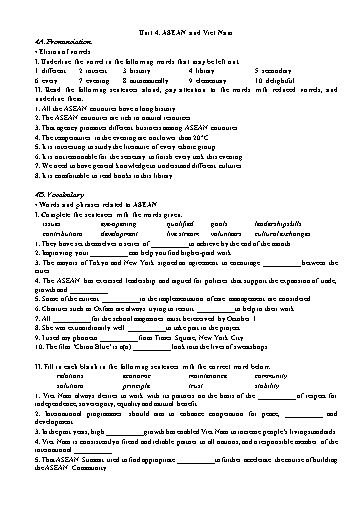
 6. Viet Nam always desires to work with its partners to build and reinforce strategic __________ for
peace, cooperation and development.
7. We are glad to see the strong development of __________ between ASEAN and its partners.
8. Regular dialogue and cooperation contribute to the __________ of peace and security in the region.
III. Choose the correct words.
1. Education is one of the basic human rights written into the United Nations Charter / Constitution.
2. Lifetime employment gives employees greater career solidarity / stability.
3. We focus / maintain contact with old school friends when we have left school.
4. Some Central Asian countries used to belong to the former Soviet bloc / region.
5. His mother is an active member of our school’s parent-teacher community / association, and she
tried to arrange activities to raise money for it.
6. The meetings stated the need to strengthen regional principle / co-operation in ASEAN.
7. Local people expressed solidarity / stability with the government’s measures to fight against the
COVID-19 pandemic.
8. The right to speak freely is written into the rules / constitution of many countries.
9. Manchester City dominated / focused throughout the football match.
10. There are three fundamental principals / principles of teamwork.
IV. Fill in each blank in the passage with the correct word below.
 frequently affecting bloc host relations
 issues pressure consequently annually heads
 ASEAN Summit
The organization holds meetings, known as the ASEAN Summit, where 1__________ of government of
each member meet to discuss and resolve regional 2__________ , as well as to conduct other meetings
with other countries outside the 3__________ with the intention of promoting external 4__________ .
 The ASEAN Leaders’ Formal Summit was first held in Bali, Indonesia in 1976. Its third meeting
was held in Manila in 1987 and during this meeting, it was decided that the leaders would meet every
five years. 5__________ , the fourth meeting was held in Singapore in 1992 where the leaders again
agreed to meet more 6__________ , deciding to hold the summit every three years. In 2001, it was
decided to meet 7__________ to address urgent issues 8__________ the region. Member nations were
assigned to be the summit 9__________ in alphabetical order except in the case of Myanmar which
dropped its 2006 hosting rights in 2004 due to 10__________ from the United States and the European
Union.
V. Fill in each blank in the passage with the correct word / phrase below.
 process road map role prioritise income
 connectivity diverse community pillars region
 ASEAN Turns Diversity into an Advantage
 ASEAN is the most 1__________ organisation in the world. The richest member has an average
2__________ per capita 76 times higher than that of the poorest country. The biggest member has a
population 600 times larger than the smallest. ASEAN has turned diversity into an advantage in the
development and integration 3__________ of each country and the entire 4__________ . Together with
the European Union, ASEAN is evaluated as one of the most successful regional organisations.
 In the 2025 ASEAN Community’s Vision, along with a new co-operation 5 __________ on boosting
internal 6__________ , the bloc will 7__________ institutional improvements and elevation of co-
operation effectiveness among the three 8__________ of politics-security, economics and socio-culture.
The vision’s important emphasis is bringing ASEAN into a(n) 9__________ working for people and
taking people as the central 10__________ .
VI. Fill in each blank in the text with ONE suitable word. 1. We talked __________ (go) to Hoi An for our holiday.
2. I look forward __________ (see) you again next year.
3. She is tired __________ (work) for that company.
4. __________ (open) the front door I walked slowly through it.
5. We got into the house __________ (climb) through a window.
6. Are you interested __________ (join) the school club?
7. He is very keen __________ (swim) at the moment.
8. She is very good __________ (listen) to what people say.
9. This is used __________ (cut) metal.
10. I’m tired __________ (come) to the same place every week.
11. She is worried __________ (not get) to the airport in time.
12. The car drove off __________ (stop)
III. Complete the sentences with the gerund form of the verbs in brackets, and a suitable
preposition if necessary.
1. Were you successful __________ (see) the manager?
2. Is Mai fond __________ (swim)?
3. He needs more practice __________ (spell).
4. There’s no use __________ (phone) Mr. Nam. He’s not at home now.
5. There is little chance __________ (see) him today.
6. This book is well worth __________ (read).
7. He was prevented __________ (finish) his work by his illness.
8. They are thinking __________ (move) to the countryside.
9. She has had little experience __________ (teach).
10. He insisted __________ (help) me with the report.
IV. Rewrite the sentences starting with a gerund. You may need to change some words.
1. A good way of keeping fit is to swim every day.
_________________________________________________________________________________
2. It takes a long time to learn a foreign language.
_________________________________________________________________________________
3. Clean the machine more often - that will solve your problems.
_________________________________________________________________________________
4. Grow your own food. It’s less expensive.
_________________________________________________________________________________
5. It is cheaper to go by train than by plane.
_________________________________________________________________________________
6. It’s not pleasant to be in hospital.
_________________________________________________________________________________
7. It is forbidden to walk on the grass.
_________________________________________________________________________________
8. It is difficult to be polite to someone you don’t like.
_________________________________________________________________________________
9. One thing I can’t do is swim on my back.
_________________________________________________________________________________
10. It is impossible to park your car during office hours.
_________________________________________________________________________________
V. Complete the sentences with the gerund structures in your own words.
1. She is not interested in ____________________________________. 2. What does the SEAMEO Council comprise?
_________________________________________________________________________________
3. When did SEAMEO RETRAC start its first operations in Viet Nam?
_________________________________________________________________________________
4. What are the functions of SEAMEO RETRAC?
_________________________________________________________________________________
5. What services does SEAMEO RETRAC offer?
_________________________________________________________________________________
II. Read the passage, and then decide whether the statements are true (T) or false (F).
 Batik Skirts in the South
Although there is disagreement on the origins of batik, most agree the colorful cloth reached Java in
Indonesia by the 7th century. Its production technique spread throughout the island, then over the
centuries batik spread to Sumatra and north into Malaysia’s coastal areas and southern Thailand.
Javanese batik displays the peoples’ view of the universe. Three traditional, easy-to-obtain colours are
used - indigo, brown, and white - which represent the three major Hindu Gods: Brahma, Vishnu and
Siva. The nobility have special patterns, with wider stripes or wavy lines indicating a higher rank.
Sumatra’s batik dates to the 13th century. Sumatra’s ethnic groups have their own styles of batik, which
use clay for the dye. Other Indonesian islands have batik similar to those found in Java and Sumatra.
The first introduction of Malaysian batik is in the 17th century. Today, tourists can find Malaysian batik
on the east coast in Johor, Kelantan, Terengganu, and Pahang. Motifs tend to be of plants but geometric
shapes as human and animal images are taboo.
Batik finally made its way to southern Thailand, and locals still wear it as their daily clothes or as
uniforms at work. Themes vary from the islands landscape and important parts of island culture such as
coconut shells, palm trees, tropical flowers, and fishing boats.
Batik has made a significant contribution to Singapore’s arts scene, with traditional and contemporary
presentations.
So critical is batik to the Javanese and all of Indonesia that in 2009, UNESCO designated Indonesian
batik as a Masterpiece of Oral and Intangible Heritage of Humanity.
1. People don’t know exactly the origins of batik. ________
2. Batik has got its way to several countries in Southeast Asia. ________
3. Designs of batik may express the religious views. ________
4. People have used the dyes that are available in their region. ________
5. Based on the colours of batik, people can guess how senior the person is in Indonesia. ________
6. Sumatra’s ethnic groups have their own styles of batik, and use the same material for the dye as people
in Java. ________
7. Today batik is very popular throughout Malaysia. ________
8. Designs for batik tend to be human and animal images in Malaysia or Thailand. ________
9. Local people in southern Thailand still wear batik in their daily life. ________
10. Batik is of great importance to Indonesia and its people. ________
III. Read the text, and then do the tasks that follow.
 The Association of Southeast Asian Nations, or ASEAN, was established on 8th August 1967 in
Bangkok, Thailand, with the signing of the ASEAN Declaration by the Founding Members of ASEAN,
namely Indonesia, Malaysia, the Philippines, Singapore and Thailand.
 Brunei Darussalam then joined in 1984, Viet Nam in 1995, Lao PDR and Myanmar in 1997, and
Cambodia in 1999, making up what is today the ten Member States of ASEAN. _________________________________________________________________________________
3. What can visitors see at Penguin Coast and Pelican Cove?
_________________________________________________________________________________
4. What has the park been successful in?
_________________________________________________________________________________
5. What is the role of the Bird Discovery Centre of Jurong Bird Park?
_________________________________________________________________________________
6. What educational programmes for students does the park offer?
_________________________________________________________________________________
Task 2. Match the underlined words in the text with the definitions.
1. haven (n) ______ A. a large cage or building for keeping birds in
2. enhance (v) ______ B. including all that may be concerned
3. avian (adj) ______ C. represent something honestly
4. aviary (n) ______ D. improve
5. mirror (v) ______ E. control or power of something
6. house (v) ______ F. a safe or peaceful place
7. comprehensive (adj) ______ G. of or connected with birds
8. mastery (n) ______ H. give a person or animal a place to live
V. Choose the word or phrase among A, B, C or D that best fits the blank space in the following
passage.
 ASEAN’s diversity presents hundreds of traditional dances with interesting histories.
 Cambodia’s 1 _______ Apsara dance dates back more than 1,000 years, and has its roots in animism
with Hindu forms introduced during the time of Indian 2 _______ beginning in the 1st century. However,
between the 12th and the 15th centuries, the Apsara dance took on a more Khmer identity by 3 _______
movements and meaning during the early Angkor era.
 Due to its size and varying influences, Indonesia is 4 _______ to dozens of traditional dances, though
a few are more well-known than others. Traditional Indonesian dance 5 _______ the people’s rich
diversity. Bali’s three most famous dances - the Sanghyang (Trance), Kecak (Monkey Dance) and the
Fire Dance - each tells stories of bringing 6 _______ to the villages.
 Anyone visiting an ethnic village in Laos will find themselves learning the basics of some form of
local dance. In Lamvong, a circle of men is surrounded by a(n) 7 _______ circle of women. Different
ethnic groups have their distinct dances 8 _______ their beliefs and legends.
 Traditional dance forms an 9 _______ part of the culture and history of Viet Nam. The movements
are graceful, elegant, and smooth, and many of the motions depict nature such as flowing rivers, swaying
trees, blooming flowers, and flying birds. Others 10_______ daily activities, such as harvesting, boat
rowing, or washing silk. Among the most popular dances are the conical hat dance, the fan dance, the
royal lotus dance, and the ancient drum dance.
1. A. modem B. traditional C. ancient D. prehistoric
2. A. power B. behaviour C. influence D. affect
3. A. adding B. putting C. making D. developing
4. A. village B. family C. house D. home
5. A. returns B. increases C. reflects D. affects
6. A. problem B. peace C. quiet D. easiness
7. A. inner B. small C. round D. outer
8. A. combined at B. consisted of C. based on D. separated from
9. A. excited B. available C. easy D. integral
10. A. perform B. describe C. do D. make will be preferred for engagement.
Mai: Anything else, Nick?
Nick: Yes. Second, young individuals can incorporate personal experiences into their activities, and
 they 5 _____________________________________________________________________.
Mai: Thank you, Nick.
• Giving and responding to compliments
III. Choose the correct responses.
1. “How lovely your pets are!”
 - “_________”
 A. Thank you. It’s nice of you to say so. B. Really? They are always very nice.
 C. Can you say that again? D. I love them, too.
2. Daisy: “What an attractive hair style you have got, Mary!”
 - Mary: “_______”
 A. Thank you very much. I’m afraid. B. You’re telling a lie.
 C. Thank you for your compliment! D. I don’t like your sayings.
3. “_______”
 - “Thank you. We are proud of him.”
 A. Your kid is naughty. B. Your child is just a genius.
 C. I can give him a lift to school. D. Can we ask your child to take a photo?
4. “You’re so patient with us.”
 - “_________”
 A. Thanks. Have a nice trip.
 B. I’m fine. Thanks.
 C. I know. I have trouble controlling my temper.
 D. Thanks. That’s nice of you to say so.
5. Mai: “Wow, I’ve never seen such a nice cell phone, Nam.”
 Nam: “_______”
 A. Oh, I don’t know. B. Thank you. I’m glad you like it.
 C. You’re welcome. D. I agree with you.
6. Ann: “How well you are playing, Peter!”
 - Peter: “_______”
 A. Say it again. I like to hear your words. B. Thank you too much.
 C. Many thanks, that’s a nice compliment. D. I think so. I’m too proud of myself.
7. Mike: “Your parents must be proud of your result at school.”
 John: “_______”
 A. Sorry to hear that. B. I am glad you like it.
 C. Thanks. It's certainly encouraging. D. Of course.
8. Son: “I got 100 for TOEFL iBT.”
 Mother: “_______”
 A. Good for you. Thank you. B. I’m glad you say so.
 C. Well done, son! I’m very proud of you. D. You can do it.
9. Diana: “The reference book you lent me last week is so helpful for my science report, Ann.”
 Ann: “_______”
 A. Keep your nose out of my business. B. Well, mind your words.
 C. I’m happy to hear that. D. You can’t believe it.
10. Ms. Hoa: “You did a really good job on your mid-term test. Keep going.”
 Nick: “_______”
File đính kèm:
- bai_tap_bo_tro_tieng_anh_lop_11_global_success_unit_4_asean.docx
 0. KEY-GLOBAL-SUCCESS-11.pdf


