

Bài tập bổ trợ Tiếng Anh Lớp 11 Global Success - Unit 6: Preserving our heritage (Kèm đáp án)
 26 trang
11/11/2025
2871
26 trang
11/11/2025
2871
Bạn đang xem tài liệu "Bài tập bổ trợ Tiếng Anh Lớp 11 Global Success - Unit 6: Preserving our heritage (Kèm đáp án)", để tải tài liệu gốc về máy hãy click vào nút Download ở trên.
Tóm tắt nội dung tài liệu: Bài tập bổ trợ Tiếng Anh Lớp 11 Global Success - Unit 6: Preserving our heritage (Kèm đáp án)
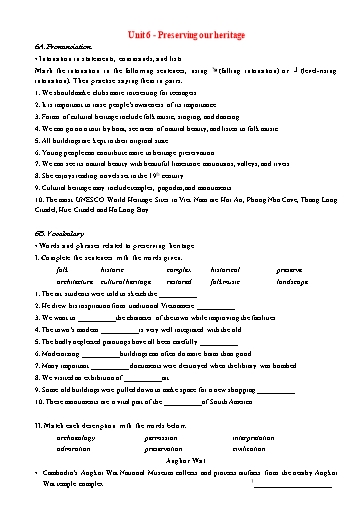
 • The architects and builders who created Angkor Wat in Cambodia did amazing work. It impresses
 everyone who sees it. 2_____________________
• Archaeologists digging at Angkor Wat recently discovered a large statue buried beneath the ground.
 3_____________________
• Angkor was the capital city of the Khmer Empire, which ruled the area from the 9th to the 15th
 centuries. 4_____________________
• The museum gives a lot of explanation about the history of Angkor Wat and the people who built it.
 5_____________________
• Sometimes, parts of Angkor Wat are closed to the public, and only workers are allowed to enter them.
 6_____________________
III. Fill in each blank in the passage with the correct word / phrase below.
 temples community designs merchant pillars
 merchant ships attractions trading port destination objects
 The ancient town of Hoi An lies on the Thu Bon River, 30 km south of Da Nang. It was formerly a
major 1 __________ in Southeast Asia between the 16th and the 17th centuries. Hoi An was also an
important centre for Dutch, Portuguese, Italian, Chinese, Japanese and other 2 __________ from the Far
East.
 Hoi An is famous for its old 3 __________ , pagodas, ancient homes and narrow streets. All the
houses were made of wood and their 4 __________ were carved with ornamental 5 __________ .
 One of the main 6 __________ of Hoi An is the Japanese Bridge, which was built in the 16th century
and is still well-preserved. All visitors to Hoi An are recommended a visit to the Assembly Hall of
Cantonese Chinese Congregation. This house was built in 1855 and still keeps many precious
7__________ that belonged to the Chinese 8 __________ of Hoi An. Another attractive address to
tourists is Tan Ky House, which was constructed nearly two centuries ago as a house for a Vietnamese
9 __________ . The house now looks almost exactly as it did in the early 19th century.
 In recent years, Hoi An has become a popular tourist 10 __________ in Viet Nam. In 1999, it was
certified by UNESCO as a World Cultural Heritage Site.
IV. Complete the following sentences with the correct form of the words in brackets.
1. In 1805, King Gia Long requested the building of a new, smaller citadel called Ha Noi Citadel with a
new __________ style. (architecture)
2. The Complex of Hue Monuments is a __________ of many royal monuments from the Nguyen
Dynasty. (combine)
3. As for me, the Citadel of the Ho Dynasty is one of the most __________ destinations in Viet Nam
because of its value. (attract)
4. Homestay has become __________ when historic travel is on the rise. (trend)
5. __________ of Cultural Heritage is an international degree programme at University of Bologna in
Italy. (restore)
6. Cat Ba Archipelago bears the exceptionally natural values with its __________ forests which cover
the limestone system and the mangrove wetlands. (tropic)
7. Besides the __________ value of geology, Phong Nha - Ke Bang is also favoured with the mysterious
and majestic landscapes by nature. (history) ____ I. to learn some useful Japanese phrases.
____ J. to be ready for her piano competition next month.
II. Combine the suitable sentences in each group to form new meaningful ones using to-infinitive
phrases.
1. I shouted. ____ A. I want to keep warm.
2. I had to go to the bank. ____ B. I want to report that my bike had been stolen.
3. I’m saving money. ____ C. I want to go to Singapore.
4. I went into hospital. ____ D. I had to have an operation.
5. I’m wearing two pullovers. ____ E. I needed to get some money.
6. I phoned the police station. ____ F. I want to warn people of the danger.
1. I shouted to ____________________________________________________________________.
2. ______________________________________________________________________________.
3. ______________________________________________________________________________.
4. ______________________________________________________________________________.
5. ______________________________________________________________________________.
6. ______________________________________________________________________________.
III. Complete the sentences using a suitable verb.
1. I didn’t have enough time __________ the newspaper today.
2. He came home by taxi. He didn’t have enough energy __________ home.
3. ‘Would you like something __________ ?’ - ‘Yes, please. A cup of coffee.’
4. We need a bag __________ these things in.
5. There will be a meeting next week __________ the problem.
6. I wish I had enough money __________ a new bike.
7. I saw Hoa at the party but we didn’t have a chance __________ to each other.
8. I need some new clothes. I haven’t got anything nice __________ .
9. They’ve just passed their exams. They’re having a party __________ .
10. I can’t do all this work alone. I need someone __________ me.
IV. Rewrite the answers in the short exchanges using to-infinitive phrases.
Example: Why did you come here?
 - Because I wanted to see my friends.
 → I came here to see my friends.
1. Q: Why do you go to the beach every weekend?
 A: Because I like swimming.
 → She ________________________________________________________________________
2. Q: Why did you move to Ha Noi?
 A: I wanted to find work.
 → He_________________________________________________________________________
3. Q: Why are you leaving home?
 A: I’m going to university in Tokyo. 6. Imperial Citadel of Thang _____ F. It dates back to the 14th century. It was built according to
Long-Ha Noi the Feng Shui principles in a plain between the Ma and Buoi
 Rivers in Thanh Hoa Province.
7. Citadel of the Ho Dynasty _____ G. Gathering more than 1,600 limestone islets in the Gulf of
 Tonkin, it is an iconic seascape of verticals cliffs. The site’s
 beauty is famous around the world, and it is also a haven for
 biodiversity.
8. Trang An Landscape _____ H. With 65 km of caves and underground rivers, it hosts a very
Complex complex limestone landscape with significant geological
 features.
II. Read the text, and decide whether the statements are true (T), or false (F), or not given (NG).
 The Area of Old Carved Stones in Sa Pa
 The area of old carved stones in Sa Pa lies mainly in the Muong Hoa Valley, where there are
settlements of ethnic minority people in Sa Pa District, Lao Cai Province. Carved stones here have been
discovered since a long time ago. In 1925, a French scholar coming here discovered more than 30 pieces
of stone that had been carved with various images, scattered along the Hoa Spring bank. Later, other
scientists have come here to study the carved pieces of stone. Until now, researchers have discovered
more than 200 pieces of stone carved with different images, among them are the big ones which have
complicated designs.
 The most common patterns are images of mountains, hills and fields. In some pieces of stone, we
can find images of houses, following the pattern of house on stilts with the form of boat, with curved
roof, reminding the image of houses on the Dong Son bronze drums.
 Particularly, a number of researchers have raised the hypothesis of traces of 3 kinds of writing
system, following the pattern of pictorial writing with straight and curved lines. There are writing
systems almost similar to the writing systems found on amulets of Tay ethnic group and Dao ethnic
group, but they are not Tay characters. The discovery of the 3 above kinds of writing system on carved
pieces of stone makes more complicated the determination of the author of those works. Maybe those
authors belong to many different ethnic minorities and have achieved their works in different times.
 There are opinions underlining that those pieces of stone have been carved by the old Viet people,
or ethnic groups near to the old Viet people. At present, there remain a number of legends about the
"Father piece" and "Mother piece" of stone related to inhabitants of the areas lying at the mountain foot
coming here to find new settlements. However, the problem of determination of the real authors of those
works is still to be solved.
1. Scientists discovered a number of old carved stones in Sa Pa, which dated back to Dong Son Bronze
Age. ___________
2. Hundreds of stone pieces have been found with various images, some of which have big, complex
patterns. ___________
3. The most common topic for the patterns is nature. ___________
4. Images of stilt houses on these pieces of stone were the same as those on the Dong Son bronze drums.
 ___________
5. The three kinds of writing system on the carved pieces of stone might share the similar pattern of
pictorial writing with straight and curved lines. ___________ IV. Read the text, and then do the tasks that follow.
 My Son Sanctuary
 Hidden away in the tropical forest near the port city of Da Nang and the very popular World Heritage
town of Hoi An is the Champa civilization’s sacred valley of My Son, or “Beautiful Mountain”. I joined
the full day package tour from Hoi An, which was quite very convenient as it included all transportation,
ticket fee, lunch and guide. I arrived in My Son around 10 o’clock. After walking for a while, I found
the complex of tourist facilities, and one of them is the performance hall. Our guide insisted us keeping
going into the forest. Within few minutes, I started to see the complex of ancient Hindu temples made
from brick.
 At first, the dilapidated state of the complex was quite shocking, and almost nothing was left to
see. I decided to discover the site by myself, and I started to be impressed by the amazing quality of
brick carving details. The image of Hinduism guardians and angels are truly beautiful and reminded me
about Angkor in Cambodia. For me, My Son is the great evidence of how Southern Indian art expanded
to Southeast Asia since ancient Cham people came from Java where Indian art flourished, and later
expand to modern day Viet Nam and later Cambodia and Thailand. The construction method of My Son
is also very unique: Cham people built a whole block of bricks then burned them to make the whole
brick block very solid and strong, then chiseled into the temple. I walked around the complex many
times to enjoy its intricate motifs until the guide informed that there are more complex to see.
 I went to see another complex, this one is located on the hill and recently partial rebuilt by a group
of Italian archaeologists, and they are planning to rebuild more, which is a very good news for My Son
preservation. The rebuilt complex is very lovely and illustrates the original layout very well even though
the new brick really contrasts with the old ones. After that, the guide took me back to the bus and back
to Hoi An, it was exactly 3 hours inside My Son. Despite the bad state of preservation, I really enjoyed
my visit to My Son, the place has exceeded my expectation and even small complex can clearly show
its value as a bridge of cultural exchange between India - Java and mainland Southeast Asia.
Task 1. Answer the following questions.
1. Why was the writer’s tour from Hoi An to My Son very convenient?
_________________________________________________________________________________
2. What was his first impression of My Son? Why?
_________________________________________________________________________________
3. What first made him change his opinion about My Son?
_________________________________________________________________________________
4. Which feature does he find unique about My Son?
_________________________________________________________________________________
5. Why is the writer optimistic about the preservation of My Son in the near future?
_________________________________________________________________________________
6. Why did he enjoy his visit to My Son?
_________________________________________________________________________________
Task 2. Match the underlined words in the text with the definitions.
 1. sacred _____ A. a person that protects something VI. Read the article about the Moai, and do the tasks that follow.
 THE MYSTERIOUS MOAI
1 ______________________________________
The Moai are beautiful stone statues that you can see on the Chilean island of Rapa Nui (Easter Island),
in the Pacific Ocean. There are 887 statues, and we know that the first ones were made about 1,00 years
ago. However, we don’t know very much about the people who made them, or the reasons why they
made them. The stones are a beautiful mystery.
2 ______________________________________
The Moai are statues of men with very large heads, and smaller bodies and arms. Only one has legs and
feet.
3 ______________________________________
We know that people used hand tools to make the stones because archeologists have found examples of
many old tools all over the island. They believed it must have taken about a year to make each statue,
with five or six people working on each one.
4 ______________________________________
This is a more difficult question! Some of the statues are huge, and people can’t have carried them using
just their hands. The largest stones are nearly ten metres long, and weigh about 18,000 kilograms.
Professor Carla Lopez says, ‘The people must have had some way of moving these stones. Some
archeologists think they might have pulled the stones across the island using ropes. But the stones were
so heavy, it must have taken between 180 and 250 men to pull each one.’
5 ______________________________________
We don’t know. Most people believe that the statues represent people who had died. However, according
to Professor Lopez, ‘We can’t explain why the ancient islanders put so much work into creating these
statues, and why so many of the statues are looking away from the ocean. Perhaps the artists believed
they were looking towards the villages on the island, to protect them.’
6 ______________________________________
Today Easter Island is a World Heritage site. Thousands of visitors come to study and admire the statues
every year. Most people just take photos, but there have been some problems. In 2008, a tourist tried to
take a piece of a statue’s ear home as a souvenir. He had to pay $17,000, and he couldn’t go back to the
island for three years.
Task 1. Complete the headings with the questions below.
 A. How did people make the Moai?
 B. How did people move the Moai?
 C. What about the Moai today?
 D. What are the Moai?
 E. What do the Moai look like?
 F. Why did people make the Moai?
Task 2. Read the article again. Are the sentences true (T) or false (F)?
1. There are 887 statues. _________
2. There aren’t any statues of women. _________
3. The tools that people used to make the statues have all disappeared. _________
File đính kèm:
- bai_tap_bo_tro_tieng_anh_lop_11_global_success_unit_6_preser.docx
 0. KEY-GLOBAL-SUCCESS-11.pdf


