

Bài tập bổ trợ Tiếng Anh Lớp 11 Global Success - Unit 7: Education options for school leavers (Có đáp án)
 26 trang
06/11/2025
195110
26 trang
06/11/2025
195110
Bạn đang xem tài liệu "Bài tập bổ trợ Tiếng Anh Lớp 11 Global Success - Unit 7: Education options for school leavers (Có đáp án)", để tải tài liệu gốc về máy hãy click vào nút Download ở trên.
Tóm tắt nội dung tài liệu: Bài tập bổ trợ Tiếng Anh Lớp 11 Global Success - Unit 7: Education options for school leavers (Có đáp án)
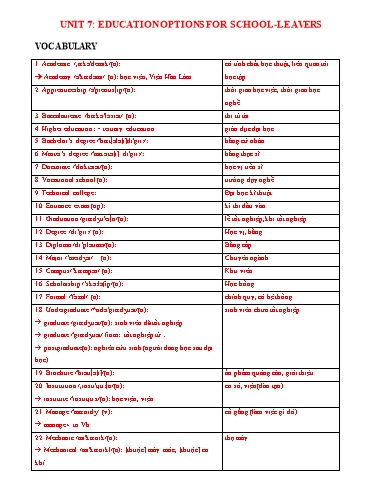
 24. Qualification /kwɒlifi'kei∫n/ (n): trình độ chuyên mơn, văn bằng
25. School-leaver (n): học sinh tốt nghiệp trung học phổ
 thơng
26. Specific skills: kỹ năng đặc biệt
27. Hands-on /'hỉndsɒn/(a): [về] thực hành
28. Mandatory/’mỉndətəri/(a) =required (a) = obligatory (a) = Bắt buộc
compulsory (a)
29. Eligible/’elidʒəbl/(a) for: Đủ tư cách
30. Enroll/in’rəʊl/(v): Ghi danh
31. CV /sivi/(n): Lí lịch
32. Accommodation/ə’kɔmə’deiʃn/(n): Chỗ ở
33. Transcript /’trỉnskrip/(n): Học bạ
34. Tuition /’tjʊ:iʃn/(n): Học phí
35. Tutor /’tjʊ:tər/(n): Gia sư
36. Formality /fɔ:'mỉləti/(n): Sự đúng quy cách, sự đúng thủ tục
# informal /in'fɔ:ml/ (a): Khơng chính thức
 informality /,infɔ:'mỉləti/(n): Sự khơng chính thức
37. Sixth-form college (n): Trường dành cho học sinh từ 16-19
 tuổi và tạp trung vào các trình độ A-
 levels nhằm chuẩn bị cho sinh viên
 vào các trường đại học
38. education fair /ˌedʒ.ʊˈkeɪ.ʃən feər/(n) hội chợ giáo dục
39.sensible /ˈsensəbl/ (adj) hợp lý
40. pursue /pəˈsjuː/(v) theo đuổi
41. independently /ˌɪn.dɪˈpen.dənt.li/(adv) độc lập
42. practical skill /ˈprỉk.tɪ.kəl skɪl/ (n) kỹ năng thực tế
GRAMMAR
1. Chức năng:
 Là chủ ngữ của câu: Dancing bored him.
 Bổ ngữ của động từ: Her hobby is painting.
 Là bổ ngữ: Seeing is believing.
 Sau giới từ: He is interested in watching films on TV.
 Sau một vài động từ: avoid, mind, enjoy
2. Một số cách dùng đặc biệt:
A. Verb + V-ing: Danh động từ theo sau một số động từ: – waste + time/money + V-ing:
– sit + Danh từ nơi chốn + V-ing: she sat at her desk writing a letter
– stand + danh từ nơi chốn + V-ing
– lie + danh từ nơi chốn + Ving
– can’t help = can’t bear = can’t stand = can’t resist (khơng thể chịu được)
E.x: 1. I can’t bear hearing his lies.
 2. I can’t stand seeing him here.
– It is no good / It is no use (vơ ích / khơng cĩ ích)
– There’s no point in
– What’s the point of
– to be busy: bận rộn
- to be worth
E.X: My mother is busy cooking in the kitchen.
 E.x: This book is worth reading.
 – be used to = get used to = be accustomed to: quen với
 – S + prefer + V-ing + to + V-ing: thích làm gì hơn làm gì
 = S + would rather Vinf than Vinf
D. Go + gerund để chỉ một hoạt động đặc biệt nào đĩ: (Present participle)
* Cụm giới từ theo sau bởi V-ing:
* Preposition +gerund (giới từ +gerund):
be interested in (thích thú) think about (nghĩ về) apologize for (xin lỗi về)
insist on (khăng khăng về) talk about (nĩi về) instead of (thay vì)
be accustomed to= be / get used to= be familiar with : quen /thích nghi với forward to ( mong đợi )
PRACTICE
1. Nam suggested ________ (talk) the children to school yesterday.
2. Before ________ (go) to bed, my mother turned off the lights.
3. Minh is interested in ________ (listen) to music before ________ (go) to bed.
4. This robber admitted ________ (steal) the red mobile phone last week.
5. Shyn spends a lot of money ________ (repair) her car.
6. Don’t waste her time ___________(complain) about her salary.
7. That questions need ________ (reply).
8. Viet is used to ________ (cry) when he faces his difficulties.
9. It’s time they stopped ________ (work) here.
10. Jim forgot ________ (send) this message last night.
11. Can you imagine (live) ________ without internet?
12. I anticipate (arrive) ________ on Saturday. – Dùng như một tình từ (mang nghĩa chủ động và thường miêu tả vật)
e.g: + The film is interesting. (Đây là bộ phim thú vị.)
+ It’s an exciting journey. (Đây là một chuyến đi thú vị.)
– Thay cho một mệnh đề
* Mệnh đề độc lập trong câu ghép:
Hai sự kiện xảy ra đồng thời cùng một chủ từ thì một trong hai mệnh đề cĩ thể được thay bằng hiện tại
phân từ.
e.g: He washed his car and sang happily.
(Ơng ấy đã rửa chiếc xe của mình và hát vui vẻ.)
—> Washing his car, he sang happily. (Rửa xe của mình, ơng ấy hát vui vẻ.)
 —> He washed his car, singing happily. (Ơng ấy đã rửa chiếc xe của mình, ca hát vui vẻ.)
Hai sự kiện xảy ra kể tiếp nhau: sự kiện xảy ra trước được thay bằng hiện tại phân từ.
e.g: She put on her coat and went out. (Cơ ấy mặc áo khốc vào và rồi ra ngồi.)
—> Putting on her coat, she went out. (Mặc áo khốc vào, cơ ấy đi ra ngồi)
Mệnh đề phụ trong câu:
+ Mệnh đề quan hệ: khi đại từ quan hệ làm chủ từ và mệnh đề quan hệ là mệnh đề chủ động thì được thay
bằng hiện tại phân từ.
e.g: The girl who lent me this book is my best friend.
(Cơ gái đã cho tơi mượn cuốn sách này là người bạn tốt nhất của tỏi)
—> The girl lending me this book is my best friend.
(Cơ gái cho tơi mượn cuốn sách này là người bạn tốt nhất của tơi.)
+ Mệnh đề trạng ngữ chỉ thời gian:
e.g: Since he left school, he has worked in a restaurant.
(Kể từ khi ơng rời trường học, ơng đã làm việc trong nhà hàng.)
—> Leaving school, he has worked in a restaurant.
(Rời trường học, ơng đi làm việc trong nhà hàng.)
+ Mệnh đề trạng ngữ chỉ lý do: hai mệnh đề phải cùng chủ từ
e.g: Because he drove carelessly, he had an accident.
(Bởi vì anh ta lái xe bất cẩn, anh ta đã bị tai nạn.)
—> Driving carelessly, he had an accident.
(Lái xe bất cẩn, anh ta đã bị tai nạn.)
Cấu trúc câu: S + sit/stand/lie /come/ run (cụm từ chi nơi chốn) + present participle.
e.g: He sat on the chair reading a book.
(Ơng ta ngồi trên ghế đọc quyển sách.)
Cấu trúc: There + be + Noun + present participle.
e.g: There are many people waiting for Tom who is writing Global Success 11 book. Ex: Having repaired the car, Tom took it out for a road test. (Sửa xe xong, Tom đánh xe ra đường chạy
thử.) [NOT Repairing the car]
- việc dùng hiện tại phân từ cĩ thể gây nhầm lẫn.
Ex: Reading the instructions, he snatched up the fire extinguisher. (Đọc chỉ dẫn, anh ta chụp lấy bình
chữa cháy.) → cĩ thể làm cho người đọc hiểu rằng hai hành động này xảy ra đồng thời. Trường hợp này,
chúng ta nên dùng phân từ hồn thành.
Ex: Having read the instructions, he snatched up the fire extinguisher. (Đọc xong chỉ dẫn, anh ta chụp lấy
bình chữa cháy.)
- Nếu một hành động xảy ra gần như cùng một lúc (ranh giới thời gian khơng rõ rệt), thay vì dùng
Perfect gerund thì chúng ta cĩ thể dùng Present participle cho hành động đầu tiên.
Ex: Taking a key out of his pocket, he opened the door
VERB + OBJECT + PREPOSITION + PERFECT GERUND (Danh động từ hồn thành)
-apologise for : xin lỗi về
-accuse someone of : buộc tội ai về
-admire someone for : ngưỡng mộ ai về
-blame someone/something for : đổ lỗi cho ai, cái gì về
-congratulate someone on : chúc mừng ai về
-criticise someone/something for : phê bình/chỉ trích ai/cái gì
-punish someone for : phạt ai về
-praise someone for : khen ngợi ai về
-thank someone for : cảm ơn ai về
-suspect someone of : nghi ngờ ai về
Ex: He blamed me for not having cooked dinner.
He apologised for having made us wait so long.
VERB + PERFECT GERUND (Danh động từ hồn thành)
Admit Deny Forget Mention
Remember Recall Regret
Ex: 1. I regret not having met him earlier in my life.
 2. She denied having broken the flower vase.
PRACTICE
Giving the correct form of PERFECT GERUND AND PERFECT PARTICIPLE
1. Tom hated _________ (climb) the mountain because there was nothing to see there.
2. I remember _________ (watch) that movie before.
3. The murderer admitted ________ (kill) the old lady.
4. Sally regretted _________ (forget) their wedding annivesary.
5. One of the security guards was accused of ________ (help) the robbers during the robbery. 2. A. studious B. dependent C. critical D. cultural
3. A. psychology B. achievement C. academy D. kindergarten
4. A. admission B. history C. nursery D. difference
5. A. mechanic B. chemistry C. cinema D. faculty
6. A. biology B. geography C. education D. relationship
7. A. broaden B. provide C. pursue D. succeed
8. A. college B. degree C. language D. subject
9. A. undergraduate B. opportunity C. qualification D. university
10. A. bachelor B. diploma C. internship D. scholarship
VOCABULARY
Mark the letter A, B, C, or D to indicate the word(s) CLOSEST in meaning to the underlined
word(s) in each of the following questions.
1. Don't play down John’s contribution to the development of country’s education.
A. pretend B. estimate C. undervalue D. cooperate
2. If the examiner can't make sense of what your essay is about, you'll get the low mark.
A. declare B. estimate C. communicate D. understand
3. If you want to get a high mark on a test, review the material carefully beforehand.
A. performance B. score C. figure D. note
4. Some students only cram for tests when there is little time left, so their results are not satisfactory.
A. prepare in a short period B. prepare in a long time
C. prepare well D. prepare badly
5. My application for the scholarship was turned down because the grade transcript was insufficient.
A. cancelled B. postponed C. reduced D. rejected
6. School uniform is compulsory in most of Vietnamese schools.
A. depended B. required C. divided D. paid
7. In Scotland, students transfer from primary to secondary education at approximately age 12.
A. compound B. base C. change D. move
8. At the time, I didn't believe his remarks regarding our pupils' employment options were really
appropriate.
A. correct B. right C. exact D. suitable
9. Primary in the U.S is required for all children regardless of race, religion, sex, or family background.
A. obligatory B. excellent C. free of charge D. easy
10. A woman can never be respected if she has no education or a good job.
A. looked up to B. looked down on C. kept up with D. come up with
Mark the letter A, B, C, or D to indicate the word(s) OPPOSITE in meanin the underlined word(s)
in each of the following questions. 8. He did not do well at school and left with few _________ qualifications.
A. academic B. academy C. academician D. academically
9. You have to be highly _________ to do well in these subjects.
A. competitive B. competitor C. competition D. competing
10. Last night, to __________ his new strategy, the minister of the Department of Education and Training
appeared on television.
A. public B. publicly C. publicize D. publicizing
11. He owed his success not to privilege but to self-education and a driving desire for _______.
A. achieve B. achiever C. achievement D. achievable
12. __________ and professional qualifications are available from the institution of higher learning.
A. Government B. Experience C. Requirement D. Academic
13. Fee-paying schools, often called "independent schools", "private schools" or “_______ schools".
A. college B. primary C. secondary D. public
14. You'll find plenty of books on the ________ of business studies in the library.
A. lesson B. subject C. curriculum D. schedule
15. I wonder if you could tell me who was awarded the ________.
A. scholar B. scholastic C. scholarship D. scholarly
16. Although ________ education is compulsory in England; parents are not required to send their
children to state schools.
A. higher B. further C. secondary D. formal
17. Journalists sometimes wear ________ clothes to fit in well with the situation in which they are
working.
A. ordinary B. common C. habitual D. casual
18. My job now is not _________ to what I was majored in at university.
A. devoted B. related C. supposed D. belonging
19. My dad said that I'd better spend more time on my _________.
A. student B. studied C. studious D. studies
20. There are not many __________ courses in the last two years at university. Most of them are
compulsory.
A. required B. optional C. preferred D. additional
21. It is _________ to wear uniform to most high school nowadays.
A. obliged B. obliging C. obligational D. obligatory
22. When it comes to children's schooling problems, both parents have to ________ responsibility.
A. get B. respond C. compel D. take
23. Students who want to continue their _________ education in the UK are expected to take A-level
course. A. grants B. fees C. fares D. scholarships
39. Peter is trying his best to study in hope that he will _______ fame and fortune in the near future.
A. lose B. run C. move D. achieve
40.___________ is the study of the events of the past.
A. Geography B. History C. Arts D. Literature
41. She was the first in her family to enjoy the privilege of a university _________.
A. schedule B. education C. science D. technology
42. Next year, I have to decide which area of medicine I want to _________ in.
A. come B. focus C. hand D. specialise
43. I got a diploma in business administration, but still sometimes wish I had been able to go to university
and get a _________.
A. certificate B. diploma C. degree D. scholarship
44. In the UK, _________ schools refer to government-funded schools which provide education free of
charge to pupils.
A. state B. secondary C. independent D. primary
45. He didn't get the job he wanted because he didn't have the right___________.
A. knowledge B. qualifications C. relationship D. fame
46. More and more young people prefer __________education because they like to learn practical skills.
A. university B. college C. vocational D. higher
47. Many young people find it hard to get a job immediately after__________.
A. university B. school C. class D. graduation
48. Higher education is really for people who want formal learning in order to get an _________degree
A. academic B. university C. vocational D. college
49. This type of training not only provides students with hands-on__________, but also gives them wages
to cover their living costs.
A. knowledge B. practice C. experience D. salary
50. This month, Teen Talk magazine has received many letters from secondary school students asking
about the different _________ for school-leavers.
A. questions B. options C. opinions D. choices
51. ___________ only three hours, I can hardly focus on my work.
A. Having slept B. was slept C. slept D. sleeping
52. ___________ this movie last week, I still wanted to see it again.
A. Having seen B. Had seen C. Was seen D. Seeing
53.Tom was accused ___________ some top secret document.
A. to steal B. of having stolen C. for stealing D. to have stolen
54. But after ___________ it over, I decided to laugh at myself and just join anyway.
File đính kèm:
- bai_tap_bo_tro_tieng_anh_lop_11_global_success_unit_7_educat.docx
- 02. UNIT 7 - GV.docx


