

Bài tập bổ trợ Tiếng Anh Lớp 11 Global Success - Unit 7: Education options for school leavers (Kèm đáp án)
 21 trang
11/11/2025
1661
21 trang
11/11/2025
1661
Bạn đang xem tài liệu "Bài tập bổ trợ Tiếng Anh Lớp 11 Global Success - Unit 7: Education options for school leavers (Kèm đáp án)", để tải tài liệu gốc về máy hãy click vào nút Download ở trên.
Tóm tắt nội dung tài liệu: Bài tập bổ trợ Tiếng Anh Lớp 11 Global Success - Unit 7: Education options for school leavers (Kèm đáp án)
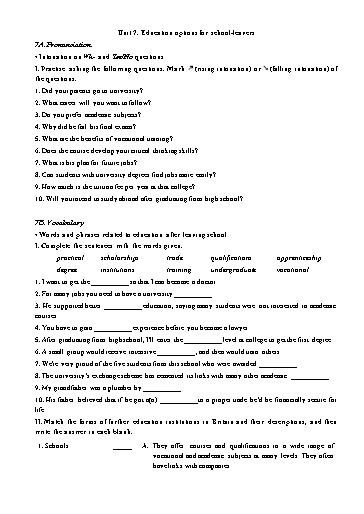
 2. Sixth form colleges _____ B. They mainly offer higher education courses, but many also
 offer a range of further education courses.
 3. Further and higher _____ C. The UK offers a wide range of work-based training for students
 education colleges seeking to build careers in specific industries. Private training
 companies work with colleges and employers to provide
 practical training and internationally-respected qualifications.
 4. Private training _____ D. They offer further education qualifications such as the A-levels,
 providers the IB, and vocational qualifications.
 5. Universities _____ E. These colleges mainly cater for students aged 16-18 and
 specialise in academic courses to prepare students for higher
 education.
III. Fill in each blank in the following sentences with the correct word below.
 experience degree institutions scholarship compulsory
 qualifications reports campus academic counsellor
1. She wasn’t __________ and hated school.
2. In the USA, private colleges and universities are usually smaller than public __________
3. A Bachelor’s degree is usually __________ for higher-level positions.
4. Just like American students, you will have to submit your academic __________ as part of your
application for admission to any American university or college.
5. A __________ provides you with information, advice and support with your application.
6. They will participate in workshops and get hands-on __________ leading classes.
7. A foreign student can apply directly to an American university for aid, a __________ or work-study
option.
8. International Baccalaureate (IB) and other international __________ taught at International Schools
in Viet Nam are equivalent to A-levels.
9. On __________ , students usually live in residence halls or dormitories that are often called “dorms”.
10. A major at university is the specific field of study in which your __________ is focused.
IV. Fill in each blank in the passage with the correct words below.
 requirement prepare academic year pursue proceed
 lasts undertake pre-university compulsory degrees
 School System of Singapore
 Education in Singapore is 1 __________ for ten years, although universitybound students study for
thirteen. Classes are taught in English and the 2 __________ runs from July to April.
 Primary and secondary education 3 __________ for ten years and is compulsory. At the end of
Grade 10, students sit the GCE O-level examinations. Students who complete secondary education may
4 __________ to pre-university education at the Junior Colleges, 5 __________ certificate or diploma
studies at one of the Polytechnics, or leave school and enter the workforce. In the Singaporean education
system, 6 __________ education lasts for three years. These three years will 7 __________ students for
the GCE A-level examinations. One of the boys admitted __________________________________________________________
II. Combine each pair of sentences using present participles or perfect participles.
1. I knew that he was a student. I offered to pay his train ticket.
__________________________________________________________________________________
2. She became tired of my complaints about the programme. She turned it off.
__________________________________________________________________________________
3. He had found no one at home. He left the house in a bad temper.
__________________________________________________________________________________
4. The criminal had removed all traces of his crime. He left the building.
__________________________________________________________________________________
5. Tom had missed the last bus. He began to walk.
__________________________________________________________________________________
6. He had spent all his money. He decided to go home and ask his father for a job.
__________________________________________________________________________________
7. She didn’t want to hear the story again. She had heard it all before.
__________________________________________________________________________________
8. We visited the museum. We decided to have lunch in the park.
__________________________________________________________________________________
9. The tree fell across the road. It had been uprooted by the strong wind.
__________________________________________________________________________________
10. The guests were sleeping in the next room. They were woken by the sound of breaking glass.
__________________________________________________________________________________
III. Combine each pair of sentences using present participles or perfect participles.
1. He offered to show us the way home. He thought we were lost.
__________________________________________________________________________________
2. He had fed the cat. He sat down to his own dinner.
__________________________________________________________________________________
3. She had looked through the fashion magazines. She didn’t find the style that she liked.
__________________________________________________________________________________
4. I sat in the front row in the theatre. I saw everything beautifully.
__________________________________________________________________________________
5. The lion found his cage door open. He left the cage and walked slowly towards the zoo entrance.
__________________________________________________________________________________
6. I had heard that the caves were dangerous. I didn’t want to go any further without a torch.
__________________________________________________________________________________
7. The film star wore extremely fashionable clothes. She was surrounded by photographers and reporters.
__________________________________________________________________________________ The top destinations for Vietnamese students are Australia, the US, China, Singapore and the UK.
English has become the dominant foreign language in Viet Nam, with 98% of students choosing to study
it over French, Japanese and German. So many students seek English-speaking countries for their higher
education.
Australia is the destination of choice because Australian qualifications are recognised across the world,
and transferable to Vietnamese qualifications, and many Australian universities offer scholarships to
international students. Living costs in Australia compare favourably with the United States and UK, and
it is closer to Viet Nam than other English- speaking countries, making visits home easier.
The USA has the second largest number of Vietnamese students. The majority of Vietnamese students,
both at home and abroad, consider the American education the best in the world. They believe that the
USA is the most scientifically and technologically advanced country in the world. Four out of 10
Vietnamese students in the US are studying business administration, and finance. Engineering, maths,
computer science, and health professions are also common choices.
1. What do a growing youth population and an increasing prosperous middle class in Viet Nam lead to?
__________________________________________________________________________________
2. What are the top destinations for Vietnamese students?
__________________________________________________________________________________
3. Why do so many Vietnamese students seek English-speaking countries for their higher education?
__________________________________________________________________________________
4. What advantages do Australian universities offer to international students?
__________________________________________________________________________________
5. Why does studying in Australia favourable to Vietnamese students?
__________________________________________________________________________________
6. What is the American education considered by most of Vietnamese students?
__________________________________________________________________________________
7. What popular majors do Vietnamese students study in the US?
__________________________________________________________________________________
III. Read the passage about international students in Viet Nam, and then answer the questions.
 Viet Nam: Struggling to Attract International Students
 Viet Nam is changing university enrolment requirements to make it easier for foreign students to
study at its universities. Previously, foreign students were required to take university entrance
examinations in Vietnamese, making it difficult if not almost impossible for non- Vietnamese-speaking
foreign students to apply.
 International student enrolment is one of the criteria to rank Vietnamese universities. Attracting
foreign students is also a way for Viet Nam to promote Viet Nam's education to the world.
 The leading universities in Viet Nam enrol undergraduate and graduate international students every
year. Most are from the Asia Pacific region including China, Japan, Korea, Australia, Laos, Cambodia
and Thailand, while a few come from the United States and Europe. Most of the international students
study Vietnamese studies, Vietnamese literature or Southeast Asian studies, which makes Viet Nam the
best destination for them. 7. The IB is not suitable for students who may meet some challenges at the university environment.
8. Parents and teachers can decide whether the student should follow the IB or not. _________
III. Choose the word or phrase among A, B, C or D that best fits the blank space in the following
passage.
Like any other universities, the Open University can give you a degree. However, you don’t have to 1
__________ working to study. It can also open up a whole variety 2 __________ interest. If you have 3
__________ studied before, you will enjoy the special, new pleasure of 4 __________ your knowledge.
You will make friends of 5 __________ kinds. You may also 6 __________ that your qualification
provides new career opportunities.
 You don’t actually 7 __________ to the Open University for lectures, but study at home, using
television, radio and computer software. You can 8 __________ one class a month if you wish at an
Open University centre. Of course, there are exams to take, as in 9 __________ university. If you
10__________ like to know more, all you have to do is complete the form below. It could be the start of
a wonderful new period in your life.
1. A. stop B. end C. break D. leave
2. A. from B. of C. in D. for
3. A. ever B. never C. often D. always
4. A. growing B. changing C. adding D. increasing
5. A. all B. each C. both D. every
6. A. suggest B. find C. wish D. want
7. A. join B. enter C. arrive D. go
8. A. give B. learn C. attend D. study
9. A. any B. some C. many D. most
10. A. did B. will C. would D. can
VI. Read the passage, and choose the correct answer A, B, C or D for each question.
British further education qualifications are respected by employers and academics worldwide. There are
two main types: academic courses, and vocational and professional courses. Academic courses help you
prepare for higher education at a university or college. They aim to develop your analytical skills, critical
thinking and knowledge. Vocational and professional courses give you the skills and qualifications you
need to enter and succeed in your chosen career. They offer technical training and skills for the
workplace.
British further education providers invest heavily in facilities - from libraries, computer centres and
science laboratories to sports centres, theatres and arts studios. Class sizes are restricted to ensure that
you have access to equipment and enough time to talk to your tutors and lecturers.
British qualifications are a great boost to your CV and to your earnings. Employers are increasingly
looking for graduates with multicultural experience. Moreover, British colleges and universities have
strong links with industry - many courses are designed in partnership with, and taught by, industry
professionals. Many include the option of a year in industry or a work placement, giving you real
professional experience. 3. A: I’ll go to college after high school. B: a/ Good for you. I go to a technical college.
 b/ Do you want to get a job soon?
 4. A: How about a credit-based course? B: a/ It takes more time to complete the course.
 b/ It’s the best choice for us now.
 5. A: I’d like to join in the student exchange B: a/ Wow. You can travel to several countries.
 programme. b/ Does your school have such a programme?
 6. A: Have you ever used the cloud? B: a/ Yes, I used it when I forgot my USB.
 b/ Yes, it was a day of nice weather.
 7. A: My uncle is a worker, but he wants to B: a/ He can work on his own at home.
 follow higher education. b/ I think he can take distance education.
 8. A: Do you like cloud learning? B: a/ I prefer campus life with social activities.
 b/ Yes, face-to-face teaching and learning is the
 best choice.
 9. A: My brother follows postgraduate education B: a/ He should study them at the same time.
 when he gets a BA degree. b/ He should gain some experience first.
 10. A: Nam tries to get seven credits this year B: a/ I think he shouldn’t push himself hard.
 b/ I think he tries to pass the entrance exam.
• Vocational training vs. academic study
II. Complete the dialogue with the phrases below. There is one extra that you do not need.
 A. What do you think is the second benefit?
 B. Vocational schools attract students from many regions and countries.
 C. There are several benefits for those who want to become qualified manual labourers in the
 future.
 D. Why do workers with vocational training get a job easily?
 E. Why do you think so?
 F. Some of the young people cannot afford to pursue their university.
Phong: Nowadays many people go to university for academic study.
Nick: But in fact more people should be encouraged to do vocational training because there is a lack
 of qualified workers such as electricians or plumbers.
Phong: 1___________________________________________?
Nick: First, nowadays employers place more emphasis on experience than knowledge at university.
 In order to get well-paid jobs, students should study practical courses and work as part-time
 workers besides studying subjects at school.
Phong: 2___________________________________________?
Nick: Second, many people after graduating from college cannot make a living, or even do not have
 a job. By encouraging people to take vocational courses, there would be less unemployed
 workers, and fewer crime cases.
File đính kèm:
- bai_tap_bo_tro_tieng_anh_lop_11_global_success_unit_7_educat.docx
 0. KEY-GLOBAL-SUCCESS-11.pdf


