

Bài tập bổ trợ Tiếng Anh Lớp 11 Global Success - Unit 9: Social issues (Có file nghe và đáp án)
 15 trang
06/11/2025
1660
15 trang
06/11/2025
1660
Bạn đang xem tài liệu "Bài tập bổ trợ Tiếng Anh Lớp 11 Global Success - Unit 9: Social issues (Có file nghe và đáp án)", để tải tài liệu gốc về máy hãy click vào nút Download ở trên.
Tóm tắt nội dung tài liệu: Bài tập bổ trợ Tiếng Anh Lớp 11 Global Success - Unit 9: Social issues (Có file nghe và đáp án)
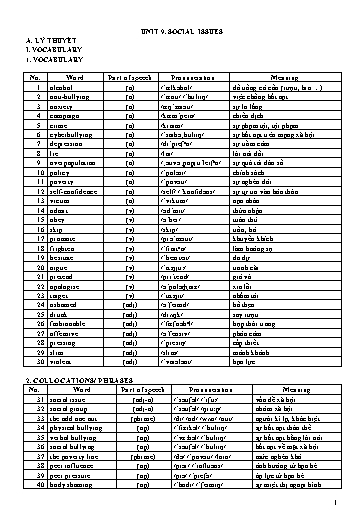
41. school performance (np) /skuːl/ /pəˈfɔːməns/ thành tớch ở trường 42. draw attention to (phrase) /drɔː/ /əˈtenʃᵊn/ /tuː/ thu hỳt sự chỳ ý tới 43. control anger (v-n) /kənˈtrəʊl/ /ˈổŋɡə/ kiểm soỏt sự tức giận 44. have an influence/ (phrase) /hổv/ /ən/ /ˈɪnfluəns/ / cú ảnh hưởng đến impact on /ˈɪmpổkt/ /ɒn/ 45. live in poverty (phrase) /lɪv/ /ɪn/ /ˈpɒvəti/ sống trong nghốo đúi 46. raise awareness of (phrase) /reɪz/ /əˈweənəs/ /ɒv/ tăng nhận thức 47. skip class (v-n) /skɪp/ /klɑːs/ trốn học 48. suffer from (vp) /ˈsʌfə/ /frɒm/ chịu đựng 49. struggle with (v, prep) /ˈstrʌɡl/ /wɪð/ đấu tranh với 50. stand up to (vp) /stổnd/ /ʌp/ /tuː/ bảo vệ, chống lại 51. fit in (vp) /fɪt/ /ɪn/ phự hợp, hoà nhập với 52. make fun of (phrase) /meɪk/ /fʌn/ /ɒv/ trờu chọc, chế giễu 53. hang out (vp) /hổŋ/ /aʊt/ đi chơi 54. approve of (v, prep) /əˈpruːv/ /ɒv/ đồng tỡnh với 3. WORD FORMATION No. Word Part of speech Pronunciation Meaning 55. bully (v,n) /ˈbʊli/ bắt nạt/ kẻ bắt nạt 56. bullying (n) /ˈbʊliɪŋ/ sự bắt nạt 57. aware (adj) /əˈweə/ nhận thức 58. awareness (n) /əˈweənəs/ sự nhận thức 59. depression (n) /dɪˈpreʃᵊn/ trầm cảm 60. depressed (adj) /dɪˈprest/ buồn 61. embarrassed (adj) /ɪmˈbổrəst/ xấu hổ 62. embarrass (v) /ɪmˈbổrəs/ làm cho xấu hổ 63. sympathise (v) /ˈsɪmpəθaɪz/ thụng cảm 64. sympathy (n) /ˈsɪmpəθi/ sự đồng cảm II. PRONUNCIATION TễNG GIỌNG TRONG CÂU HỎI LỰA CHỌN Trong cõu hỏi lựa chọn, mỗi lựa chọn đứng trước từ or sẽ được lờn giọng. Chỳng ta sẽ xuống giọng ở lựa chọn cuối cựng. Vớ dụ: - Is peer pressure good or bad? - Is this a social or environmental issue? III. GRAMMAR LIấN TỪ - Chỳng ta dựng cỏc cụm từ và từ nối để nối ý, mệnh đề và cõu. - Một số cụm từ và từ nối thụng dụng: STT Mục đớch Từ nối Vớ dụ 1 Để thờm Moreover - Alcohol is unhealthy for people’s health. Moreover, it affects thụng tin, Additionally people’s behaviour negatively. ý tưởng Besides Rượu bia khụng tốt cho sức khỏe con người. Hơn nữa, nú cũn In addition (to) ảnh hưởng tiờu cực đến hành vi của con người. - Regular exercise is essential for maintaining physical fitness. In addition, it can help improve mental health. Tập thể dục thường xuyờn là điều cần thiết để duy trỡ thể lực. Ngoài ra, nú cú thể giỳp cải thiện sức khỏe tinh thần. 2 3. A. pretend B. frighten C. victim D. social 4. A. influence B. struggle C. campaign D. anger 5. A. approve B. pressing C. obey D. admit 6. A. sympathise B. attention C. embarrass D. performance 7. A. poverty B. physical C. violent D. permission 8. A. policy B. confidence C. offensive D. alcohol 9. A. hesitate B. depression C. bullying D. sympathy 10. A. argue B. body C. pressure D. promote II. VOCABULARY Task 1. Mark the letter A, B, C or D to indicate the correct answer to each of the following questions. 1. Bullying is considered a __________ in many places and can lead to legal consequences. A. poverty B. crime C. anxiety D. campaign 2. __________ is a serious mental health concern that can result from bullying or peer pressure. A. Victim B. Lie C. Depression D. Alcohol 3. __________ is a growing concern as technology becomes more common in students’ lives. A. Overpopulation B. Policy C. Self-confidence D. Cyberbullying 4. Schools often have __________ actions to protect students and maintain a positive learning environment. A. anti-bullying B. case C. distance D. awareness 5. __________ can sometimes lead students to do bad behaviours such as drinking alcohol, but it can also encourage positive choices. A. Peer influence B. Social group C. School performance D. Body shaming 6. He is not scared to be the __________. He can say no to the bad things his friends do. A. poverty line B. odd-one-out C. social issue D. cyberbullying 7. __________ often involves spreading rumours, or cyberbullying through social media. A. Social bullying B. Verbal bullying C. Peer pressure D. Physical bullying 8. Students should be encouraged to speak out against __________ when they see it happening. A. social group B. presentation skill C. school performance D. body shaming Task 2. Choose the correct word to complete each sentence. 1. Building self-confidence can help students stand up to / approve of bullies. 2. Bullying involves hurtful actions, such as fitting in / making fun of others’ appearance. 3. Parents and teachers can have an influence on / ask permission students’ attitudes toward bullying and peer pressure. 4. Students who suffer from /fit in bullying may experience long-lasting emotional changes. 5. Students often struggle / hang out with friends who share their interests and values. 6. Some students control anger / live in poverty, which can make them easier to be the target of bullying. Task 3. Complete each following sentence with a suitable verb (The form of the verb can be changed if necessary) admit obey skip promote frighten hesitate argue pretend apologise target 1. She had to _______________________ to Minh as she bullied him in the past. 2. Bullying can _______________________ students and affect their mental health. 3. She decided to _______________________ that she had been a victim of bullying. 4. Some students _______________________ to be someone they’re not to fit in with their peers. 4 4. ____________________ to feeling pressured to smoke, I started hanging out with a new group of friends. 5. ____________________ I didn’t like the idea, I wore the same trendy clothes as my friends to fit in. 6. I did not do well in the test ____________________ staying up late. 7. ____________________ the school rules, many students painted their nails when going to school. 8. My friends wanted me to participate in the school talent show. ____________________, they encouraged me to sing in front of everyone. Task 3. Combine each pair of sentences, beginning with the given word(s). 1. Verbal bullying is a common issue at school but many students are not aware of it. (HOWEVER) _____________________________________________________________________________________ _____________________________________________________________________________________ 2. Cyberbullying can negatively impact students’ academic performance and it can cause depression as well. (MOREOVER) _____________________________________________________________________________________ _____________________________________________________________________________________ 3. Students often want to be liked by their peers so they may sometimes do things they normally don’t. (AS A RESULT) _____________________________________________________________________________________ _____________________________________________________________________________________ 4. Bullying at school can have serious effects on the victims so it’s essential to prevent bullying. (THEREFORE) _____________________________________________________________________________________ _____________________________________________________________________________________ 5. While some students stand up to bullying, others remain silent for the fear of the consequences. (BY CONTRAST) _____________________________________________________________________________________ _____________________________________________________________________________________ IV. READING Task 1. Read the following passage and mark the letter A, B, C or D to indicate the correct word or phrase that best fits each of the numbered blanks. Sometimes, (1) ________, the stresses in your life can actually come from your peers. They may pressure you (2) ________ doing something you’re uncomfortable with, such as drinking or smoking. The pressure to conform to do what others are doing can be powerful and hard (3) ________. A person might feel pressure to do something just because others are doing it. Peer pressure can influence a person to do something that is relatively harmless or something that has more serious consequences. (4) ________ in to the pressure to dress (5) ________ certain way is one thing - going along with the crowd to drink or smoke is another. People may feel pressure to conform so they fit (6) ________ or are accepted, or so they don’t feel awkward or uncomfortable. When people are (7) ________ of what to do in a social situation, they naturally look to others about what is and isn’t acceptable. The people who are most easily influenced will (8) ________ someone else’s lead first. Then others (9) ________ go along, too - so it can be easy to think, “It must be OK. Everyone else is doing it. They must know (10) ________ they’re doing.” Before you know it, many people are going along with the crowd - perhaps on something they might not otherwise do. Adapted from: https://kidshealth.org/en/teens/peer-pressure.html 1. A. therefore B. though C. neither D. as 2. A. on B. of C. into D. through 3. A. to resist B. resist C. resisting D. being resisted 4. A. Given B. Give C. Gave D. Giving 6 5. The word “widespread” in paragraph 2 is closest in meaning to _________. A. common B. pressing C. central D. sustainable 6. The word “it” in paragraph 2 refers to _________. A. negative peer pressure B. positive peer pressure C. loop D. success 7. According to the passage, what can be an effect of positive peer pressure? A. It can lead to more addictive behaviours. B. It often results in criticism from others. C. It can encourage confidence and have positive long-term effects. D. It is less likely to be promoted and passed on. 8. What is one specific consequence of starting drinking alcohol before age 15? A. They are 10 times more likely to be in a physical fight after drinking. B. They are 7 times more likely to engage in popular positive events. C. They are 12 times more likely to have better brain growth. D. They are more likely to join the debate team. 9. According to the passage, what is an example of negative peer pressure mentioned? A. convincing a friend to start drinking alcohol B. promoting participation in popular positive events C. encouraging friends to join the debate team D. making peers study harder 10. Which of the following is NOT true according to the passage? A. Young people often look towards other people who are in the same situation as them. B. Students drinking before age 15 are 10 times more likely to be in a motor vehicle crash after drinking. C. Positive peer pressure encourages people to do good things. D. Negative peer pressure can lead to highly addictive behaviours. Task 3. Read the passage and decide whether the following statements are true (T), false (F) or not given (NG). The most common type of harassment youth encounter online is name-calling. Some 42% of teens say they have been called offensive names online or via their cell phones. Additionally, about a third (32%) of teens say someone has spread false rumours about them on the internet, while smaller shares have had someone other than a parent constantly ask where they are, who they’re with or what they’re doing (21%) or have been the target of physical threats online (16%). While texting and digital messaging are a central way teens build and maintain relationships, this level of connectivity may lead to potential problems. One-quarter of teens say they have been sent offensive images they didn’t ask for, while 7% say someone has shared their offensive images without their knowing. These experiences are particularly concerning to parents. Fully 57% of parents of teens say they worry about their teen receiving or sending offensive images, including about one-quarter who say this worries them a lot, according to a separate Center survey of parents. The vast majority of teens (90% in this case) believe online harassment is a problem that affects people of their age, and 63% say this is a major problem. But majorities of young people think key groups, such as teachers, social media companies and politicians are failing to tackle this issue. By contrast, teens have a more positive assessment of the way parents are addressing cyberbullying. Adapted from: https://www.pewresearch.org/internet/2018/09/27/a-majority-of-teens-have-experienced- some-form-of-cyberbullying/ __________ 1. The most common type of online harassment among youth is spreading false rumours. __________ 2. Approximately 42% of teens have experienced name-calling before. __________ 3. About 21% of teens have been the target of physical threats online. __________ 4. One-third of teens have received offensive images they didn’t request. 8 VI. LISTENING Task 1. Listen to a talk about peer pressure and complete the table with NO MORE THAN 2 words. You can listen to each recording TWICE. POSITIVE PEER PRESSURE NEGATIVE PEER PRESSURE Good behaviours and healthy habits Bullying - Students are motivated to do well as friends are - Victims can suffer from mental issues high (1) _____________________. such as anxiety and (4) _____________________ - Students eat healthily as their friends do so. - Victims find it hard to concentrate on their studies. (2) _____________________ Risky behaviours Building a network of friends and Drinking alcohol and smoking for fear of not (5) encouraging (3) _____________________ _____________________ and appearing unpopular Task 2. Listen to the recording and decide if the statements are TRUE (T) or FALSE (F). You can listen to the recording TWICE. ___________ 1. Amber felt like there was no one she could trust at school. ___________ 2. Amber told her mother about being called “fat” at school. ___________ 3. Amber finally could open up with someone at school. ___________ 4. Words cannot badly affect how someone thinks of themselves. ___________ 5. Students are encouraged to always tell the bully to stop. VII. SPEAKING Task 1. Answer the following questions 1. Do you experience peer pressure at school? Why do you experience it? _____________________________________________________________________________________ _____________________________________________________________________________________ _____________________________________________________________________________________ _____________________________________________________________________________________ _____________________________________________________________________________________ _____________________________________________________________________________________ _____________________________________________________________________________________ _____________________________________________________________________________________ 2. In your opinion, how does body shaming affect students? _____________________________________________________________________________________ _____________________________________________________________________________________ _____________________________________________________________________________________ _____________________________________________________________________________________ _____________________________________________________________________________________ _____________________________________________________________________________________ _____________________________________________________________________________________ _____________________________________________________________________________________ Task 2. Describe a time when you encountered or witnessed cyberbullying in 2-3 minutes. _____________________________________________________________________________________ _____________________________________________________________________________________ _____________________________________________________________________________________ _____________________________________________________________________________________ _____________________________________________________________________________________ _____________________________________________________________________________________ 10
File đính kèm:
- bai_tap_bo_tro_tieng_anh_lop_11_global_success_unit_9_social.doc
 GS11_L_Unit 9 Task 1.mp3
- GS11_L_Unit 9 Task 2.mp3
- GS11_S_Unit 9 Task 1.mp3
- GS11_S_Unit 9 Task 2.mp3
- UNIT 9 - GV.doc


