

Bài tập bổ trợ Tiếng Anh Lớp 9 Global Success - Unit 10 - Phần: Listening (Có file nghe và đáp án)
 2 trang
13/10/2025
2800
2 trang
13/10/2025
2800
Bạn đang xem tài liệu "Bài tập bổ trợ Tiếng Anh Lớp 9 Global Success - Unit 10 - Phần: Listening (Có file nghe và đáp án)", để tải tài liệu gốc về máy hãy click vào nút Download ở trên.
Tóm tắt nội dung tài liệu: Bài tập bổ trợ Tiếng Anh Lớp 9 Global Success - Unit 10 - Phần: Listening (Có file nghe và đáp án)
 ANSWER KEY
Task 1.
 1 B 2 A 3 C 4 B
Exercise 2.
 1 D 2 B 3 D
AUDIO SCRIPT (Recording PPP GSE 43_50)
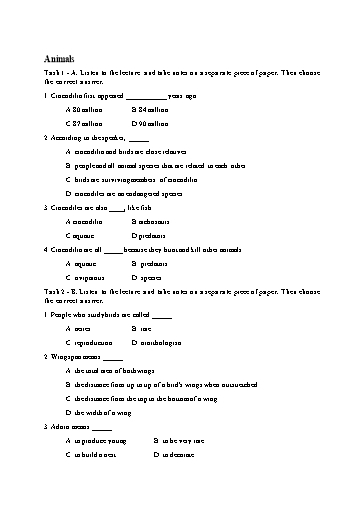
Animals
Task 1 - A
Crocodiles and alligators are both examples of reptiles—cold-blooded animals covered in
scales and can breathe air using their lungs, just like mammals. They both belong to the group
of large reptiles known as crocodilia which appeared 84 million years ago. You might not
believe it, but crocodilia are the closest living relatives, or family members, of birds! This is
because birds and crocodilia are the only surviving members of the archosaurs, a group of
dinosaurs. There are 23 species of crocodilia and all of them are oviparous, which is the
scientific term for animals that lay eggs. All 23 species are aquatic, meaning they live in water,
and all are dangerous predators, hunting and killing their prey with great speed and skill. But
even predators that have been around for millions of years can be in danger of extinction these
days. Several species of crocodilia are on the list of endangered animals.
Task 2 - B
Ornithologists, or people who study birds, are very concerned about the fate of the Philippine
Eagle. This beautiful bird is one of the largest, most powerful and rarest, or least common,
eagles in the world. It is the national bird of the Philippines but sadly, it is an endangered
species. The Philippine Eagle is a very attractive bird, its head adorned or decorated with long
brown feathers that give it the appearance of a lion’s mane. The male birds are slightly smaller
than the females, which have a wingspan – the distance from wingtip to wingtip – of around 2
meters! Like most eagles, the Philippine Eagle is monogamous, meaning that a couple of birds
will mate for life. Philippine eagles’ nests, or aeries, as eagles’ nests are known, are built in
rainforest trees about 30 meters above the ground and only one egg is laid every two years.
This slow rate of reproduction – producing young – is one of the reasons they are endangered.
File đính kèm:
- bai_tap_bo_tro_tieng_anh_lop_9_global_success_unit_10_phan_l.docx
 Listening audio.mp3

