

Bài tập bổ trợ Tiếng Anh Lớp 9 Global Success - Unit 6 - Phần: Listening (Có file nghe và đáp án)
 4 trang
12/10/2025
3935
4 trang
12/10/2025
3935
Bạn đang xem tài liệu "Bài tập bổ trợ Tiếng Anh Lớp 9 Global Success - Unit 6 - Phần: Listening (Có file nghe và đáp án)", để tải tài liệu gốc về máy hãy click vào nút Download ở trên.
Tóm tắt nội dung tài liệu: Bài tập bổ trợ Tiếng Anh Lớp 9 Global Success - Unit 6 - Phần: Listening (Có file nghe và đáp án)
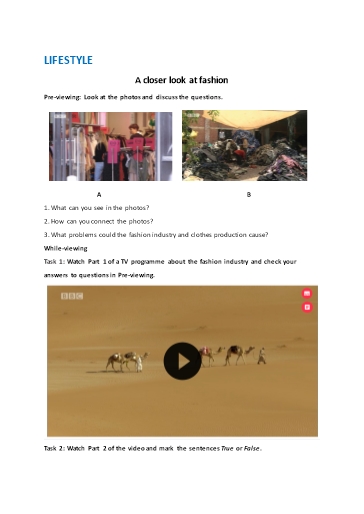
 1. People have started producing cotton very recently. True False
2. People are generally aware how much water is needed to
 True False
produce clothes.
3. The Aral Sea is in Asia. True False
4. The Aral Sea was important for the fishing and tourist industry. True False
Post-viewing
1. Is fast-fashion popular in Vietnam? Does it cause any problems?
2. How does the documentary suggest we should change the way we think about clothes?
Do you agree?
 ANSWER KEY
Pre-viewing
1. In photo A, people are shopping in a sale. In photo B, people are looking at clothes in a
place with a lot of old/thrown away/unwanted clothes.
2. People buy a lot of clothes and then throw them away. We can see a lot of old clothes like
this in photo B.
3. children working, using animal products
While-viewing
Task 1
1. In photo A, people are shopping in a sale, in a high street clothes shop. In photo B people
are bringing clothes to a place with thrown away/unwanted clothes.
2. People buy a lot of new clothes and then throw many of them away. days we produce around 25 million tons of it every year. Growing and producing cotton uses
a lot of water. It’s difficult to believe how much as this survey in the city centre shows. To
make just one pair of jeans you need  how many litres?
‘One thousand, two thousand, three thousand, four thousand, five thousand, fifteen
thousand 5 hundred and twenty tree.’
‘No way!’
And for a pair of jeans and a shirt you need
‘Nineteen, twenty, twenty thousand five hundred litres.’
‘What?’
We all love to shop, but how often do we think of fashion’s effect on the environment?
‘How many pairs of jeans do you have?’
‘Probably about six or eight.’
‘Six or eight. You know, to put it frankly, cotton is responsible for one of the biggest
environmental catastrophes that we’ve seen today on planet earth.’
This is the catastrophe that Lucy is talking about. This area was once the Aral Sea on the
border of Kazakhstan and Uzbekistan. Sixty-eight thousand square kilometres of water. The
Aral Sea had an important fishing industry and was popular with tourists too, but in the
1960s people began growing cotton in this region. They changed the direction of some
rivers so that the water went to the cotton farms and not into the sea. Ninety per cent of
the Aral Sea gradually disappeared and became desert like this. Cotton farming and the
clothes industry have caused the problems of this region.
Perhaps it’s time for all of us to change our shopping habits. We need to stop and think
about what fast fashion is doing to the planet.
File đính kèm:
- bai_tap_bo_tro_tieng_anh_lop_9_global_success_unit_6_phan_li.docx
 Listening Task 1.mp4
- Listening Task 2.mp4

