

Bài tập chuyên sâu ngữ pháp Tiếng Anh Lớp 8 Global Success - Chương trình học kì 1 (Có đáp án)
 132 trang
08/10/2025
79325
132 trang
08/10/2025
79325
Bạn đang xem 30 trang mẫu của tài liệu "Bài tập chuyên sâu ngữ pháp Tiếng Anh Lớp 8 Global Success - Chương trình học kì 1 (Có đáp án)", để tải tài liệu gốc về máy hãy click vào nút Download ở trên.
Tóm tắt nội dung tài liệu: Bài tập chuyên sâu ngữ pháp Tiếng Anh Lớp 8 Global Success - Chương trình học kì 1 (Có đáp án)
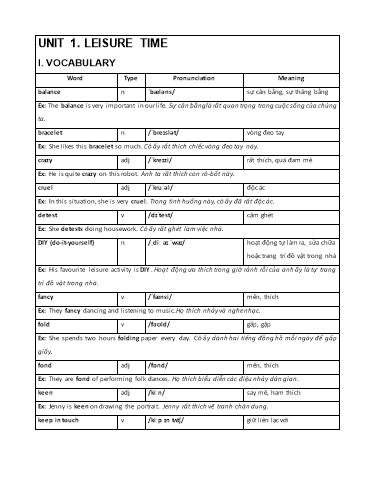
Ex: We always keep in touch together although we are away together. Chúng tôi luôn giữ liên lạc với nhau mặc dù chúng tôi ở xa nhau. kit n /kɪt/ bộ đồ nghề Ex: He wants to find a craft kit. Anh ta muon tìm 1 bộ đồ nghề thủ công. leisure time n /ˈleʒə(r) taɪm/ thời gian rảnh rỗi Ex: He always helps the homeless people in his leisure time. Anh ta luôn giúp đỡ những người vô gia cư trong thời gian rảnh rỗi của anh ấy. message v /ˈmesɪdʒ/ gửi tin nhắn Ex: They always message about their situation together. Họ luôn gửi tin nhắn về tình hình của họ cho nhau biết. muscle n /ˈmʌsl/ cơ bắp Ex: They always do exercise to develop their muscle. Họ luôn tập thể dục để phát triển cơ bắp của họ. origami n /ˌɒrɪˈɡɑːmi/ nghệ thuật gấp giấy Nhật Bản Ex: Mary often spends her free time practising origami. Mary thường xuyên dành thời giản rảnh của cô ấy luyện gấp giấy. outdoor adj /ˌaʊtˈdɔːr/ ngoài trời Ex: Tom and Peter always play outdoor sports. Tom và Peter luôn luôn chơi các môn thể thao ngoài trời. prefer v /prɪˈfɜːr/ thích hơn Ex: They prefer folk dances. Họ thích các điệu nhảy dân gian hơn. puzzle n /ˈpʌzl/ trò chơi câu đố, giải đố Ex: Her students always play puzzle games at break time. Học sinh của cô ấy thường chơi trò giải đố trong giờ nghi giải lao. resort n /rɪˈzɔːt/ khu nghỉ dưỡng Ex: Their parents spent their holiday in Ninh Binh resort. Bố mẹ họ đã dành thời gian nghỉ của họ tại khu nghỉ dưỡng Ninh Bình. snowboarding n /ˈsnəʊbɔːdɪŋ/ sự trượt tuyết bằng ván Ex: He likes snowboarding in the winter. Anh ta thích trượt tuyết vào mùa đông. stay in shape v /steɪ ɪn ʃeɪp/ giữ dáng giao tiếp để tạo mối socialite (n) /ˈsəʊʃəlaɪt/ người có vai vế trong xã hội, quan hệ người giao thiệp rộng socialist (n) /ˈsəʊʃəlɪst/ người theo chủ nghĩa xã hội III. GRAMMAR 1. Verbs of liking - các động từ chỉ sở thích Dưới đây là một số động từ chỉ sở thích, xếp theo mức độ yêu thích giảm dần. Adore (v): yêu thích, say mê Dislike/ don't like (v): không thích Love (v): yêu Hate (v): ghét Like/ enjoy/ fancy (v): thích Detest (v): ghét cay ghét đắng Don't mind (v): không phiền 2. Verbs of liking + Ving - các động từ chỉ sở thích theo sau bởi Ving. Verbs of liking Examples Adore My sister adores dancing. (Chị gái tôi say mê khiêu vũ.) Enjoy Do you enjoy listening to music? (Cậu có thích nghe nhạc không?) Fancy She fancies doing the gardening. (Cô ấy yêu thích làm vườn.) Don't mind I don't mind cleaning. (Tôi không ngại lau dọn.) Detest I detest staying at home alone. (Tôi cực kỳ ghét ở nhà một mình.) 3. Verbs of liking Ving/ to Vinf - Động từ theo sau bởi cả Ving và to Vinf. - Like: Ex: He likes reading books/ He likes to read books. (Anh ấy thích đọc sách.) - Love: Ex: I love walking to school/I love to walk to school. (Tôi thích đi bộ tới trường.) - Hate: Ex: I hate eating out/I hate to eat out. (Tôi ghét đi ăn ngoài hàng.) - Prefer: Ex: I prefer going to cinema/I prefer to go to the cinema. - /u:/ là nguyên âm dài. Dây thanh rung, luồng hơi đi từ phía trong miệng ra tự do không bị cản, có thể kéo dài. Các em tập phát âm các ví dụ sau: shoe /ʃu:/ giày blue /blu:/ màu xanh lam too /tu:/ cũng fool /fu:l/ ngớ ngẩn pool /pu:l/ ao, bể bơi choose /tʃu:z/ chọn two /tu:/ số hai you /ju:/ bạn b. Dấu hiệu nhận biết âm /u:/ Dấu hiệu 1: “o” được phát âm là /u:/ trong một vài từ thông dụng có tận cùng bằng o hoặc o + phụ âm. do /du:/ làm move /mu:v/ cử động lose /lu:z/ mất, đánh mất prove /pru:v/ chứng minh tomb /tu:m/ mộ, mồ remove /rɪ'mu:v/ xóa bỏ, loại bỏ Dấu hiệu 2: “u” được phát âm là /u:/ blue /blu:/ màu xanh lam flute /flu:t/ ống sáo brutal /bru:tl/ thô bạo, dã man lunar /ˈluːnər/ thuộc về Mặt trăng salute /sə’lu:t/ sự chào mừng lunacy /'lu:nəsɪ/ sự điên rồ Dấu hiệu 3: “oo” được phát âm là /u:/ food /fu:d/ đồ ăn, thực phẩm too /tu:/ cũng Các em tập phát âm các ví dụ sau: sugar /ˈʃʊɡər/ /'jo gar/ woman /'wʊmən/ /'woman/ should /ʃʊd/ /Jbd/ good /gʊd/ /god/ wolf /wʊlf/ /wolf/ foot /fʊt/ /fot/ cushion /'kʊʃn/ /'kojh/ put /pʊt/ /pot/ Dấu hiệu 1: “o” được phát âm là /ʊ/. wolf /wʊlf/ chó sói woman /'wʊman/ phụ nữ Dấu hiệu 2: “oo” được phát âm là /ʊ/ book /bʊk/ sách good /gʊd/ tốt look /lʊk/ nhìn wool /wʊl/ len cook /kʊk/ nấu ăn foot /fʊt/ chân wood /wʊd/ gỗ took /tʊk/ quá khứ của take Dấu hiệu 3: “ou” được phát âm là /ʊ/. could /kʊd/ có thể should /ʃʊd/ phải, nên would /wʊd/ sẽ, muốn V. PRACTICE Exercise 1a. Use single underline with the word containing /u:/ sound and double underline with the word containing /ʊ/ sound. 1. He put salt into the sugar bowl by mistake. 6. We always _____________ in touch together although we are away together. 7. They always message about their situation _____________. 8. Mary often spends her _____________ practising origami. 9. Their parents _____________ their holiday in Ninh Binh resort. 10. Nowadays, almost girls want to stay _____________. Exercise 4. Look at the photos and put the correct words/ phrases under them. playing games making crafts watching TV reading books playing chess playing sports texting hanging out with friends 1. 2. 3. 4. 5. 6. 7. 8. Exercise 5. Put the nouns into the correct columns. origami magazines movies DIY computer games sports crafts cakes the Internet badminton waves books novels crafts TV sports do watch play surf read make 4. Are you _____________ about the new Gears of War games? (excite) 5. She listens to classical music for _____________. (relax) 6. The Internet has changed the English language _____________. (consider) 7. She was _____________ with her job and decided to look for a new one. (satisfy) 8. Face to face _____________ is better than video calls. (communicate) Exercise 9. Give the correct form of the verbs in brackets. 1. My mother likes (cook) _____________ when she is free. 2. I am a little busy. Would you mind (wait) _____________ a little longer? 3. I have enjoyed (meet) _____________ you. Hope (see) _____________ you again soon. 4. Linda wants (learn) _____________ Vietnamese because she is interested in (visit) _____________ Viet Nam. 5. Tonight I'd like (go) _____________ out, but I have to do my homework. 6. My brother enjoys (visit) _____________ the zoo. 7. I hate (tell) _____________ lies because it's very bad. 8. Mobile games are great, but I don't like (play) _____________ them for too long. 9. He started (surf) _____________ the net hours ago. Has he stopped (surf) _____________ yet? 10. John detests (drink) _____________ beer. 11. Do you like (listen) _____________ to music? 12. Does Anna fancy (watch) _____________ horrible movies? 13. I prefer (make) _____________ crafts to (draw) _____________ a picture. 14. Kate loves (hang out) _____________ with her friends on her birthday. 15. I detest (eat) _____________ fish. Exercise 10. Choose the correct answer among A, B, C, D. 1. Does she fancy _____________ a book to the younger children? A. reads B. reading C. to read D. read 2. They enjoy _____________ on Sundays. A. garden B. gardening C. gardened D. gardens 3. They love _____________ with their friends. A. eating out B. ate out C. having eaten D. to eating out C. do gardening D. to do garden 18. You should avoid _____________ too much TV. It's not good for your eyes. A. seeing B. looking C. watching D. glancing 19. Nga likes _____________ with her close friend on Saturday evenings. A. window shop B. window to shop C. window shops D. window shopping 20. Lan used to love _____________ in front of the computer for hours but now she doesn't. She takes part in a judo club. A. using B. sitting C. doing D. having Exercise 11. Choose the underlined part A, B, C or D that needs correcting. 1. Having leisure activities are truly important to the elderly. A. Having B. are C. to D. elderly 2. Although she wanted to go to the museum, she decided staying at home. A. Although B. wanted to go C. decided D. staying 3. Parents are concerned that their kids may be spending too many time on screens. A. concerned B. spending C. too many D. on screens 4. Collecting coins is exciting, but it can also be relaxed. A. Collecting B. is C. exciting D. relaxed 5. Cloud watching sound weird, but Hang adores it. A. Cloud watching B. sound C. but D. it 6. For some young people, enjoyment involves sitting in front a computer playing games. A. For some B. involves C. in front D. playing games 7. His parents are thinking of banning him on using the computer. A. thinking B. banning C. on D. using 8. When you play games online, be carefully when making friends with strangers. A. games B. carefully C. making D. with Exercise 12. Read the following text about jogging and answer the questions. Jogging Jogging not only is a popular outdoor leisure activity but also a daily exercise bringing us health benefits. First, jogging is good for your circulatory. Many studies have shown that those who jog regularly have healthier hearts than those who don't. This means they seldom get diseases involved in the heart. Second, jogging is great for those who want to lose weight. When you jog, your body will use such as a festival, fair, or show. Young people especially go to clubs and discos, while people of all ages go to the theatre, the cinema, art exhibitions, and concerts. A. Decide whether the following sentences are true (T) or false (F). No. Statements T or F 1. Many British people use their free time to help people in need. 2. In the summer, the British prefer indoor activities. 3. All free time activities are individual activities. 4. Most British people watch or do sports at the weekend. 5. Sometimes people go with their friends to a pub or a restaurant. 6. British young people don't like going to the movies. B. Answer the questions. 1. What's the most popular free time activity in the UK? ___________________________________________________________________________________ 2. How many hours a week do the British watch TV? ___________________________________________________________________________________ 3. In winter, what do the British often do in their spare time? ___________________________________________________________________________________ 4. Which sports do many British people enjoy watching? ___________________________________________________________________________________ Exercise 14. Using the organizing ideas clues to reorder the recipe to make a pancake. How to Make a Pancake A. Firstly, mix the batter ingredients with a whisk until smooth and lump free. B. Remember, don't add too much batter if you want the pancakes to be nice and thin. C. Next, pour about half a spoon of batter into the pan and swirl around as soon as the batter hits the pan, this will distribute the mix evenly. D. Yum! It's time for a special breakfast! Or perhaps you want to surprise a special someone. What could be easier, yummier, and more fun with pancakes? E. Secondly, put a non-stick frying pan on the heat and add a small amount of oil. F. To cook the other side either, flip it over and leave it for another 30 seconds or so to finish cooking. G. Then, leave the pancake to cook for about 1 minute or until it's just starting to pull away from the sides of the pan and is golden brown underneath. 2. I love to watch cartoons on TV. I love 3. Does Trung hate to do morning exercises? Does 4. They love sunbathing and swimming. They love 5. Does she prefer to watch TV during her meals? Does she 6. We love to skateboard in the park after school. We love Exercise 16b. Rewrite the sentence without changing its meaning. 1. I am interested in learning English. I like 2. Lan likes using the computer best in her free time. Lan's favorite 3. I am interested in going camping with my close friends. I fancy 4. Mr. Pike is a big fan of water polo. Mr. Pike is fond 5. It is not a problem to me whether I have to pick her up to the cinema or not. I don't mind
File đính kèm:
- bai_tap_chuyen_sau_ngu_phap_tieng_anh_lop_8_global_success_c.docx
- Luyên chuyen sâu ngữ pháp từ vựng đáp án.docx

