

Bài tập chuyên sâu về ngữ pháp Tiếng Anh Lớp 8 Global Success - Chương trình học kì 2 (Có đáp án)
 83 trang
08/10/2025
55024
83 trang
08/10/2025
55024
Bạn đang xem 30 trang mẫu của tài liệu "Bài tập chuyên sâu về ngữ pháp Tiếng Anh Lớp 8 Global Success - Chương trình học kì 2 (Có đáp án)", để tải tài liệu gốc về máy hãy click vào nút Download ở trên.
Tóm tắt nội dung tài liệu: Bài tập chuyên sâu về ngữ pháp Tiếng Anh Lớp 8 Global Success - Chương trình học kì 2 (Có đáp án)
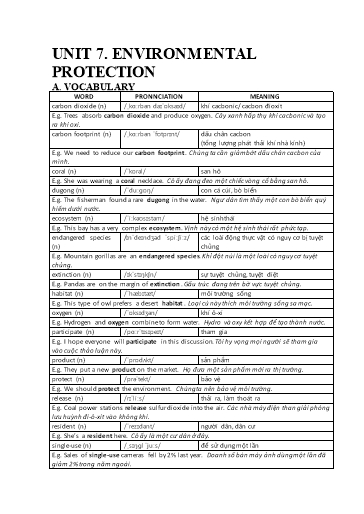
 species (n) /ˈspiːʃiːz/ giống, lồi động thực vật
E.g. Many species disappeared during the Ice Age. Nhiều lồi đã biến mất trong Kỷ băng hà.
substance (n) /ˈsʌbstəns/ chất
E.g. Some frogs produce toxic substances in their skin. Một số lồi ếch sản sinh ra các chất
độc hại trong da của chúng
toxic (n) /ˈtɒksɪk/ độc hại
E.g. Many pesticides are highly toxic. Nhiều loại thuốc trừ sâu cĩ độc tính cao.
B. WORD FORMATION
 Word Related words Transcription Meaning
endangered (adj) /ɪnˈdeɪndʒəd/ trong tình trạng bị đe doạ
 endanger(v) /ɪnˈdeɪndʒər/ gây nguy hiểm
 endangerment (n) /ɪnˈdeɪndʒərmənt/ tình trạng bị đe doạ
 người hoặc vật gây ra mối đe
 endangerer (n) /ɪnˈdeɪndʒərər/
 doạ
 endangering (adj) /ɪnˈdeɪndʒərɪŋ/ tình trạng bị de dọa
extinction (n) /ɪkˈstɪŋkʃn/ sự tuyệt chủng, tuyệt diệt
 extinct (adj) /ɪkˈstɪŋkt/ tuyệt chủng
habitat (n) /ˈhỉbɪtỉt/ mơi trường sống
 habitable (adj) /ˈhỉbɪtəbl/ cĩ thể sống được
 habitation (n) /ˌhỉbɪˈteɪʃn/ sự cư trú, nơi cư trú
 inhabitant (n) /ɪnˈhỉbɪtənt cư dân, người cư ngụ
product (n) /ˈprɒdʌkt/ sản phẩm
 production (n) /prəˈdʌkʃn/ sự sản xuất
 produce (n) /prəˈdjuːs/ sản lượng
 produce (v) /prəˈdjuːs/ sản xuất, chế tạo
 producer (n) /prəˈduːsər/ nhà sản xuất
protect (v) /prəˈtekt/ bảo vệ
 protection (n) /prəˈtekʃn/ sự bảo vệ
toxic (adj) /ˈtɒksɪk/ độc hại
 non-toxic (adj) /ˌnɒn ˈtɒksɪk khơng độc hại
 toxicity (n) /tɒkˈsɪsəti/ độc tố, độc tính
C. GRAMMAR
Complex sentences with adverb clauses of time (Câu phức với mệnh đề trạng ngữ chỉ thời
gian)
1. Complex sentences
- Câu phức là câu bao gồm 1 mệnh đề độc lập (independent clause) và ít nhất 1 mệnh đề phụ
thuộc (dependent clause) liên kết với nhau. Hai mệnh đề thường được nối với nhau bởi dấu
phẩy hoặc các liên từ phụ thuộc (subordinating conjunctions).
E.g. My father always takes time to play with me even though he is very busy.
 Mệnh đề độc lập Mệnh đề phụ thuộc
(Bố của tơi luơn dành thời gian để chơi với tơi mặc dù ơng rất bận rộn.)
Hoặc:
Even though my father is very busy, he always takes time to play with me. E.g. I haven’t met her since she left school.
 (Tơi đã khơng gặp cơ ấy từ khi cơ ấy nghỉ học ở trường.)
 She has played the piano since she was a child.
 (Cơ ấy đã chơi piano từ khi cơ ấy cịn nhỏ.)
d. Hành động hồn thành trước hành động khác trong quá khứ
 Main clause Conjunction Adverb clause of time
S + V-ed after S+ had + PII
(quá khứ đơn) as soon as (quá khứ hồn thành)
S+ had + PII before S + V-ed
(quá khứ hồn thành) by the time (quá khứ đơn)
E.g. By the time we arrived, he had already left.
 (Khi chúng tơi đến, anh ấy đã rời đi rồi.)
 She got a job after she had graduated from university.
 (Cơ ấy đi làm sau khi đã tốt nghiệp đại học.)
e. Nối các hành động xảy ra trong tưomg lai
 Main clause Conjunction Adverb clause of time
S + will + V when S + V-s/es
S + be going to + V as soon as S + have/has + PII
(Tương lai đơn/ tương lai gần) after (hiện tại đơn/ hiện tại hồn thành)
 before
 until
E.g. I’ll go to bed after I have finished my homework.
 (Tơi sẽ đi ngủ sau khi tơi làm xong bài tập về nhà.)
 When John comes, we will give him your letter.
 (Khi John đến, chúng tơi sẽ gửi cho anh ta bức thư của cậu.)
D. PRONUNCIATION
Clusters: /bl/ and /kl/
1. /bl/
/bl/ = /b/ + /l/
/b/: mím nhẹ hai mơi lại và nâng phần ngạc
mềm để chặn luồng hơi trong khoang miệng, rồi
mở miệng bật hơi từ phía trong ra. Khi phát âm,
dây thanh sẽ rung lên. circle clause classic
3. Sự khác nhau giữa /bl/ và /kl/
Về mặt âm thanh: sự khác biệt của cụm phụ âm /bl/ và /kl/ xuất phát từ sự khác biệt của vị
trí mơi và lưỡi khi bật hơi phát âm âm /b/ và /k/.
- Khi phát âm âm /b/ chúng ta mím nhẹ mơi, cịn âm /k/ chúng ta cần mở miệng.
- Với âm /b/ các em để lưỡi thả lỏng như bình thường trong khi với âm /k/ các em co cuống
lưỡi lại, chạm vào phần ngạc mềm để chặn luồng khí trong miệng.
- Phát âm âm /b/ làm rung dây thanh trong cổ họng nhưng âm /k/ thì khơng.
 /bl/ /kl/
 blue clue
 block clock
 blink clink
E. PRACTICE
Exercise 1. Look and put the word under the correct photo. Then pronounce it correctly.
blow clown classroom blossom
cliff blanket clean blind
1. 2. 3. 4.
________________ ________________ ________________ ________________ noise pollution thermal pollution
 radioactive pollution light pollution
 water pollution soil pollution
 visual pollution air pollution
 Description Type of pollution
1. Too much use of electric lights
2. Caused by the smoke and harmful gases from vehicles and
factories.
3. The noise which is harmful to humans and animals. This
includes the sound of vehicles, loud speakers...
4. Telephone towers, power lines, advertising billboards obstruct
people from enjoying a view
5. The deposition of radiation in land, air, water
6. Lakes, rivers, oceans, groundwater are contaminated by
substances, making the water unusable for drinking, cooking,...
7. The water temperature in streams, rivers, lakes, or oceans
change.
8. Earth’s surface is destroyed by pesticides
Exercise 5. Give the correct form of the words in brackets.
1. We need to ________________ (protection) our oceans by reducing plastic waste and
overfishing.
2. Pesticides and chemical fertilizers can be ________________ (toxicity) to both the
environment and human health.
3. Her younger sister can be ________________ (annoy) when she behaves naughtily.
4. You must read the ________________ (instruct) carefully before you use the new oven.
5. We were taken aback at the ________________ (drama) changes in our village; each
home owns a computer now.
6. It is always ________________ (interest) to watch the cubs at play.
7. My mother advised me to be careful in my ________________ (choose) of friends.
8. The ________________ (hot) makes everybody very drowsy during the lesson in class.
9. The couple came here at the special ________________ (invite) of the prime minister.
10. Please ________________ (low) the volume of your voice. I can even hear you from next
door.
11. These men are armed and ________________ (dangerous), and should not be
approached.
12. The latest ________________ (edit) of this book contains many illustrative pictures.
13. The giant panda is an ________________ (danger) species due to habitat loss and
poaching.
14. The dodo bird went into ________________ (extinct) in the 17th century due to hunting
and habitat destruction.
15. The rainforest is the ________________ (habitation) of many species of animals and
plants.
Exercise 6. Fill in the blanks with the correct prepositions.
It is now almost certain that global warming has been directly caused (1) ________________
man’s use of fossil fuels. This has led (2) ________________ an international debate about
what we should do to reduce the negative effects (3) ________________ our actions and 2. I learned a lot of Japanese while I am in Tokyo.
A. I B. a lot of C. Japanese D. am
3. I have not been well since I return home.
A. have not been B. well C. return D. home
4. I’ll stay here until will you get back.
A. I’ll B. here C. until D. will you
5. When Sam was in New York, he stays with his cousins.
A. in New York B. he C. stays D. his cousins
6. Last night. I had gone to bed after I had finished my homework.
A. Last night B. had gone C. after D. my homework
7. I will call you before I will come over.
A, will call B. you C. before D. will come
8. Ever since I was a child, I had been afraid of dogs.
A. Ever since B. was C. had been D. afraid of
9. By the time I left my apartment this morning, someone looked for me.
A. left B. this morning C. someone D. looked for
10. Whenever Mark will be angry, his nose gets red.
A. Whenever B. will be C. gets D. red
Exercise 10: Mark the letter A, B, C or D to complete the following sentences.
1. I will call you before I ________________ over.
A. come B. will come C. will be coming D. came
2. After she graduates, she ________________ a job.
A. got B. will get C. had got D. get
3. When I ________________ him tomorrow, I will ask him.
A. saw B. have seen C. will see D. see
4. As soon as it ________________ raining, we will leave.
A. stops B. stop C. had stopped D. stopped
5. By the time he comes, we will have ________________ already.
A. leave B. leaving C. left D. leaves
6. Whenever I ________________ her, I say hello.
A. see B. will see C. will have seen D. saw
7. The next time I go to New York, I am going ________________ a ballet.
A. seeing B. see C. saw D. to see
8. I will never speak to him again so long as I ________________.
A. lives B. will live C. am living D. live
9. By the time Bill ________________to bed tomorrow, he will have had a full day and will
be ready for sleep.
A. had gone B. will go C. goes D. went
10. As soon as I finish my report, I will call you and we ________________ out for dinner.
A. went B. will go C. will have gone D. go
11. By the time I return to my country, I ________________ away from home for more than
three years.
A. would be B. will have been C. will be D. am
12. After he ________________ breakfast tomorrow, he will get ready to go to work.
A. will have had B. has C. will be having D. have
13. As soon as he finishes dinner, he ________________ the children for a walk to a nearby
playground. warming and it is difficult to improve the air without the efforts of all countries around the
world.
1. According to the passage, where do a large amount of dust and poisonous air come from?
___________________________________________________________________________
________
2. Do developing countries take the air treatment process into careful consideration?
___________________________________________________________________________
________
3. Why is it difficult for us to breathe when travelling on the roads or streets?
___________________________________________________________________________
________
4. Which particular part of our body is seriously affected by smog and dust?
___________________________________________________________________________
________
5. What is the harmful effect of acid rain?
___________________________________________________________________________
________
6. According to the passage, if all countries in the world ignore the air pollution condition,
will it be easy to make the air fresher?
___________________________________________________________________________
________
Exercise 13. Read the passage, and choose the correct answer A, B, C or D for each
question.
 Saving the Environment: One Home at a Time
Pollution can be seen not only throughout the world, but also in our own homes. It comes
from household chemicals, the amount of water people use and the waste people produce
and throw away. What can be done to stop this pollution? Surprisingly, a person can help
save the environment by doing simple things.
First, we need to recycle, which allows products to be used over and over again. Recycling
can also reduce the number of trees cut down to produce paper products. It takes very little
effort. It is not hard to place plastic and glass bottles, aluminum cans and paper in a bin.
Anyone can do it.
Second, we need to watch the amount of water used in the home. It can be conserved by
taking short shower instead of baths, repairing leaky faucets, using the dishwasher or
washing machine only when fully loaded, or simply turning the faucet off while brushing
your teeth.
Third, we need to reduce waste. We need to recycle whenever possible, but should also try
to use this waste effectively. For example, grass clippings and food scraps can be made into
compost for plants. The average person produces 4.3 pounds of waste every day, but we can
reduce that amount by recycling and reusing.
If we do our part in our own homes, we can help keep the planet from becoming more
polluted.
1. Pollution can be caused from the following sources except _____________.
A. house chemicals B. water from household
C. wastes D. water in rivers
2. Recycling can help us _____________.
A. never cut down trees B. use products again and again
C. place garbage bins easily D. produce more paper product
File đính kèm:
- bai_tap_chuyen_sau_ve_ngu_phap_tieng_anh_lop_8_global_succes.docx
 Đáp án luyện chuyên sâu kì 2 - Đại Lợi.pdf

