

Bài tập luyện tập Tiếng Anh Lớp 12 Global Success - Test 1 (Có đáp án)
 10 trang
01/12/2025
1130
10 trang
01/12/2025
1130
Bạn đang xem tài liệu "Bài tập luyện tập Tiếng Anh Lớp 12 Global Success - Test 1 (Có đáp án)", để tải tài liệu gốc về máy hãy click vào nút Download ở trên.
Tóm tắt nội dung tài liệu: Bài tập luyện tập Tiếng Anh Lớp 12 Global Success - Test 1 (Có đáp án)
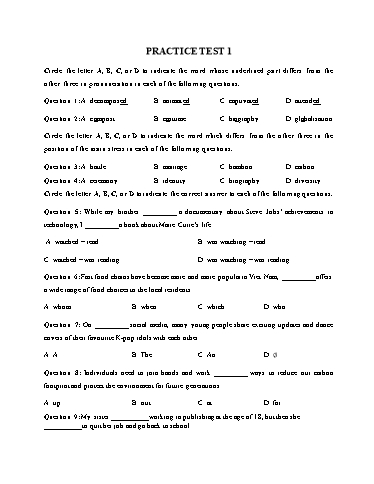
 A. started – decided B. started – was deciding
C. was starting – decided D. was starting – was deciding
Read the following notes and circle the letter A, B, C, or D to indicate the correct word that
best fits each other numbered blanks from 10-12.
 Trịnh Công Sơn’s life and contributions
• Born in 1939 in Hanoi, Viet Nam.
• Showed early interest in music and poetry, and his (10) __________ was recognised at young
age.
• Regarded as one of Viet Nam’s most famous singer-songwriters.
• Known (11) __________ his beautiful lyrics, often touching upon various themes of love, war,
and social justice.
• His musical legacy continues to (12) __________ generations and remains an important part of
Vietnamese culture and identity.
Question 10: A. family B. career C. talent D. prize
Question 11: A. as B. for C. in D. about
Question 12: A. inspire B. inspiration C. inspiring D. inspirational
 The School Youth Union proudly presents
 the Vietnamese and Japanese Cultural Exchange Fair!
 Date and Time: May 29th, 19:00
 All students are expected to attend.
Join us for a vibrant celebration of Vietnamese and Japanese culture at our school.
Dive into Diversity: Explore (13) __________ colourful traditions and customs of Viet Nam
and Japan through (14) __________ exhibits and engaging activities.
Savor the Flavors: Treat yourself with special cuisine including: authentic Vietnamese pho and
Japanese sushi available for tasting.
Get Hands-On: Participate in fun workshops where you can learn basic phrases in Vietnamese
and Japanese.
 Come and experience the cultures (15) __________ you were in both countries!
 Should you have any questions, please contact your class monitor. e. Overall, cultural diversity not only enhances the cultural aspects but also promotes empathy,
cooperation, and peace.
A. c – a – e – b – d
B. c – a – b – e – d
C. c – a – d – b – e
D. c – d – e – a – b
Read the following passage and circle the letter A, B, C, or D to indicate the correct option
that best fits each other numbered blanks below.
Experiencing culture shock can be challenging, especially when adapting to a new environment or
travelling to a foreign country. There are several strategies to minimise its effects.
Firstly, discovering the culture and customs of the destination beforehand can provide valuable
insights and prepare individuals for different situations. You should learn about social norms,
traditions as well as cultural taboos or sensitive topics, (18) __________ avoids misunderstanding.
Furthermore, maintaining (19) __________ flexible and open mindset is essential when
encountering new cultural experiences. Being willing to accept differences and (20) __________
can help you integrate into the new cultural environment soon. This also means you should be
patient with yourself and others, (21) __________ to become more familiar with cultural
differences.
Last but not least, actively (22) __________ opportunities for cultural interaction can foster greater
understanding and appreciation of the new culture. Engaging in local activities, participating in
community events, and forming relationships with locals can help bridge cultural gaps and create
meaningful connections.
By employing these strategies, individuals can navigate cultural differences more effectively and
minimize the impact of culture shock, (23) __________ a more enriching and rewarding cross-
cultural experience.
Question 18: A. that B. what C. which D. when people pack into Trafalgar Square, and the surrounding streets. People arrive (26) __________
possible to claim the best viewing spots. The towering Christmas tree, decorated with colorful lights
and festive decorations, serves as a symbol of joy and unity during the holiday season. The
atmosphere is filled (27) __________ excitement and cheer as visitors marvel at the tree's beauty
and join in the festival. The lighting ceremony, typically held in the evening, marks the official start
of the holiday season in Trafalgar Square. The entertainment includes music and dance
performances, and leads up to the main event. When the lights on the tree brighten up the square
and the nearby area, a sense of wonder fills the air and reminds people of a happy moment that (28)
__________ hope, love, and promise of a better future.
Question 24: A. hold B. organise C. celebrate D. take place
Question 25: A. who B. which C. whose D. where
Question 26: A. on time B. soon as C. so early D. as early as
Question 27: A. with B. by C. up D. down
Question 28: A. reflects B. continues C. enhances D. designs
Read the following passage and circle the letter A, B, C, or D to indicate the correct answer to
each of the questions from 29 to 33.
People may think that food choice is only important for keeping a healthy weight. However, the
way we eat and the food choices we make every day also have a big impact on the environment.
Food production is a major contributor to climate change. The process of growing, manufacturing,
and transporting food, especially meat and dairy products, involves the use of fossil fuels. We all
know that burning fossil fuels releases a huge amount of carbon dioxide into the atmosphere. All
the ingredients for our meals require land, water, and energy to produce, so the food we choose can
either increase or decrease our carbon footprint. In addition, transporting food over long distances
can create more greenhouse gas emissions.
So what should we do? We should start by eating local and organic food. This can not only limit
the amount of carbon dioxide produced during transportation, but can also help us avoid pesticides
that are harmful to the environment. We should also choose a healthier diet with less animal-based
foods and more vegetables. Raising livestock for food requires huge amounts of water and grain, Leonardo da Vinci was one of the greatest painters and thinkers in his era. His works have
influenced not only other artists and painters, but also people working in scientific fields.
He was born in 1452 in a small town near Vinci, Italy. Leonardo loved nature and spent a lot of
time drawing pictures of animals and plants. He received little formal education, but his uncle and
father soon discovered his talent, so they decided to send him to a workshop in Florence to
apprentice with the master artist Verrocchio. Da Vinci not only improved his skills in drawing,
painting, and sculpting, but he also picked up knowledge and technical skills in other areas
including mechanics, carpentry, and architecture.
In 1472, Leonardo qualified as a master artist and opened his own workshop. However, he still
continued to work together with Verrocchio until 1477. Then, he started working independently and
completed a painting for the Duke of Milan. His work made a huge impression on the Duke who
decided to offer him a position in his court. Da Vinci was invited to design innovative buildings,
machines, and weapons. He would draw up plans for several inventions of the future such as tanks,
submarines, and flying machines. He was also skilled at drawing detailed sketches of the human
body.
Unfortunately, his interests were so broad that he often changed his focus to a new project and rarely
finished the works he had started. The Last Supper and Mona Lisa were two of the masterpieces he
could finish during his lifetime. In 1495, he started The Last Supper, which took him nearly three
years to complete. In 1503, he began painting the Mona Lisa and worked on it over several years
until his death.
Da Vinci died in 1519, but he is still considered as one of the greatest geniuses. His paintings
changed the world of art, and many inventions were carried out based on his ideas and sketches.
His greatness lies in the depth and diversity of his knowledge, and 500 years after his death his
genius shines as bright as ever.
Question 34: What is the purpose of the writer?
A. To tell the story of Leonardo da Vinci’s life.
B. To describe the family of Leonardo da Vinci.
C. To explain how Leonardo’s achievements changed the world. KEY
1. A 2. D 3. C 4. A 5. D
6. C 7. D 8. B 9. A. 10. C
11. B 12. A 13. B 14. D 15. A
16. B 17. C 18. C 19. B 20. B
21. C 22. A 23. A 24. C 25. B
26. D 27. A 28. A 29. B 30. D
31. B 32. A 33. C 34. A 35. C
36. C 37. A 38. B 39. D 40. A
File đính kèm:
- bai_tap_luyen_tap_tieng_anh_lop_12_global_success_test_1_co.docx

