

Bài tập nâng cao Tiếng Anh Lớp 11 Global Success - Unit 2: The generation gap (Có đáp án)
 26 trang
12/11/2025
2071
26 trang
12/11/2025
2071
Bạn đang xem tài liệu "Bài tập nâng cao Tiếng Anh Lớp 11 Global Success - Unit 2: The generation gap (Có đáp án)", để tải tài liệu gốc về máy hãy click vào nút Download ở trên.
Tóm tắt nội dung tài liệu: Bài tập nâng cao Tiếng Anh Lớp 11 Global Success - Unit 2: The generation gap (Có đáp án)
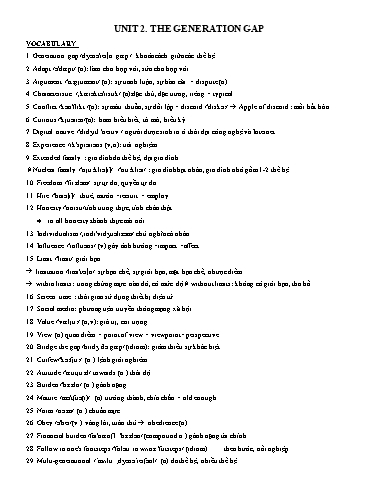
 30. Objection /əbˈdʒekʃən/ (n.) sự phản khỏng
 object to + ving.
31. Open-minded /ˈəʊpən ˈmaɪndɪd/(a) cởi mở
32. Impose ... (on sb) /ɪm'pəʊz/ (v. phr.) ỏp đặt cỏi gỡ vào ai
33. Elegant /'elɪgənt/ (a) thanh lịch, tao nhó
34. Flashy /'flổʃi/ (a) diện, hào nhoỏng
GRAMMAR REVIEW
Modal Verbs: Must vs. Have to, Should vs. Ought to
I. Giới thiệu chung về động từ khuyết thiếu
1. Cỏch sử dụng
Động từ khuyết thiếu được dựng để nờu lờn khả năng thực hiện hành động, sự bắt buộc, khả năng xảy ra của
sự việc, vv.
2. Hỡnh thức
- Theo sau chủ ngữ và đứng trước động từ nguyờn thể khụng cú “to”
- Khụng chia theo chủ ngữ (trừ trường hợp “have to”)
- Thờm “not” phớa sau khi ở dạng phủ định (trừ trường hợp “have to”)
Vớ dụ: I must go. (Tụi phải đi rồi.)
He should not disturb her now. (Anh ta khụng nờn làm phiền cụ ấy lỳc này.)
II. So sỏnh must và have to
1. Dạng khẳng định
 ➢ Must: Diễn tả sự cần thiết hay bắt buộc mang tớnh chủ quan (do người núi quyết định)
S+ must + V
Vớ dụ: I must finish the exercises. (Tụi phải hoàn thành bài tập.)
Tỡnh huống: I’m going to have a party. (Tụi cú ý định đi dự tiệc.)
 ➢ Have to: Diễn tả ý bắt buộc mang tớnh khỏch quan (do luật lệ, quy tắc hay người khỏc quyết định)
S+ have to/ has to/ had to/ ... + V
Vớ dụ: I have to finish the exercises. (Tụi phải hoàn thành bài tập.)
Tỡnh huống: Tomorrow is the deadline. (Ngày mai là hạn cuối.)
2. Dạng phủ định
 ➢ Must not: Diễn tả ý cấm đoỏn
 S+ must not (mustn't) + V
Vớ dụ: You must not eat that. (Bạn khụng được phộp ăn cỏi đú.)
Tỡnh huống: It's already stale. (Nú đó bị thiu rồi.)
 ➢ Not have to: Diễn tả ý khụng cần phải làm gỡ
S+ do not (don't)/ does not (doesn't) did not (didn't)/ will not (won't)/ ... + have to + V PHONETICS
Mark the letter A, B, C, or D to indicate the word that differs from the other three in the position of the
primary stress in each of the following questions.
1. A. value B. afford C. depend D. impose
2. A. influence B. attitude C. counselor D. decision
3. A. donate B. compare C. campaign D. limit
4. A. experience B. mobility C. independence D. priorities
5. A. romantic B. infectious C. protective D. elegant
6. A. limit B. obey C. forbid D. impose
7. A. experienced B. responsible C. sympathetic D. remarkable
8. A. generational B. interpersonal C. discriminative D. educational
9. A. studious B. illegal C. dependent D. respectful
10. A. protection B. charity C. impairment D. infection
Mark the letter A, B, C, or D to indicate the word whose underlined part differs from the other three in
pronunciation in each of the following questions.
1. A. focus B. open C. chore D. impose
2. A. generation B. advice C. typical D. elegant
3. A. manners B. conflicts C. objects D. viewpoints
4. A. decision B. impose C. arise D. organisation
5. A. restricted B. obliged C. respected D. beloved
6. A. chemist B. change C. child D. cheap
7. A. cooks B. loves C. joins D. spends
8. A. advises B. raises C. devises D. goes
9. A. teacher B. children C. chore D. school
10.A. hurry B. under C. pressure D. rush
Mark the letter A, B, C, or D to indicate the word(s) CLOSEST in meaning to the underlined word(s) in
each of the following questions.
1. Although Mark is 25 years old, he always assists his mother to do the chores every day.
A. homework B. works C. housework D. exercises
2. Your table manners are awful - don't you know how to use a knife and fork?
A. etiquette B. rules C. behavior D. attitudes
3. When their children are teenagers, many parents struggle to comprehend what's happening to them.
A. adults B. elders C. adolescents D. genders
4. Having a large extended family makes a number of problems inevitable.
A. profits B. issues C. views D. merits A. focus B. abandon C. neglect D. permit
6. Older people tend to be more conservative and a bit suspicious of anything new.
A. progressive B. customary C. Backward D. unexceptional
7. Eventually, I make the decision to follow in my father's footsteps and work for a state-owned enterprise.
A. private-owned B. public limited C. privately-owned D. government-owned
8. When my parents are away on business, my grandmother usually looks after us.
A. follows B. abandons C. concerns D. bothers
9. We respect our teacher for all of the wonderful things she has given us.
A. look up to B. look forwards to C. look back on D. look down on
10. I regretted not purchasing those trendy shoes due to a lack of funds.
A. insufficiency B. abundance C. scarcity D. inadequacy
11. We arrived home safe and sound.
A. healthy B. unsound C. insound D. Dissound
12. Never punish your children by hitting them. This might teach them to become hitters.
A. bring B. accept C. giveD.reward
13. She denied having stolen his mother's money.
A. refused B. admitted C. insisted on D. reminded
14. Satish’s point of view was correct but his behavior with his father was quite impertinent.
A. healthy B. smooth C. inadequate D. respectful
15. The power failure at dinnertime caused consternation among the city’s housewisves.
A. anxiety B. calm C. dismay D. deliberation
Mark the letter A, B, C, or D to indicate the correct answer to each of the following questions.
1. In Viet Nam, most parents expect their children to help them with the ____ chores.
A. domestic B. housework C. extended D. homework
("domestic chores” bằng nghĩa với “housework", mang nghĩa “việc nhà”)
2. Living in three- or four-generational families, commonly referred to as "___ families," has both benefits
and drawbacks.
A. single-parent B. extended C. nuclear D. crowded
(“extended family” là gia đỡnh nhiều thế hệ, so sỏnh với gia đỡnh 1 thế hệ là "nuclear family")
3. Many teenagers do not like it when their parents impose their decision ____ them.
A. in B. on C. at D. to
("impose something on somebody", mang nghĩa “ỏp đặt ai theo cỏi gỡ”)
4. The advantages of the new method really ____ the disadvantages.
A. outperform B. outdo C. outweigh D. outgrow
(“outweigh”, đọc là /ˌaʊt'weɪ/, cú nghĩa “cú nhiều hơn”, hay dựng với “advantages” và
“disadvantages”)
5. I have a 11 p.m ____. If I went back home after that, I'd be in trouble. 19. My father ____ me from going home after 9 p.m. at night.
A. forbids B. allows C. lets D. All are correct
20. Anna often dresses ____ when going to the parties in order to attract her friends' attention.
A. plainly B. properly C. flashily D. soberly
21. We're surprised by Joe's ____ every Monday. He does so at least four times per month.
A. hairstyle B. lifestyle C. viewpoint D. manner
22. I rarely eat ____ and drink ____ because they're not food for health.
A. snack/energy drink B. fast food/juice C. fruit/alcoholic drink D. junk food/soft drink
23. Generation ____ is the difference in the thoughts and viewpoints amongst generations living together.
A. distance B. gap C. space. D. All are correct
24. I was tired and couldn't ____ on doing my research project properly.
A. concentrate B. look C. focus D. Both A and C
25. My parents don't let me get married until I graduate from university and they never ____ their mind about
that.
A. keep B. impose C. focus D. change
26. The ____ arises when Jack and his parents have considerable disagreement on his choice of university.
A. discrimination B. conflict C. agreement D. gap
27. I do morning exercise and play volleyball regularly so as to keep ____ and be healthier.
A. fit B. good shape C. healthy D. strong
28. Since the family law was implemented, domestic violence has been a rare ____ in this area.
A. happen B. taking place C. occurrence D. happenstance
29. My father used to ____ a lot of challenges before establishing his own insurance company.
A. provide B. enjoy C. give D. face
30. I wish I could do something to reduce financial ____ on my parents.
A. capital B. burden C. limit D. gap
31. Parents often claim that ____ and soft drinks are not good for their children's health.
A. soft foods B. junk foods C. table foods D. school foods
(“junk foods” hoặc “fast foods” là “thức ăn nhanh”)
32. Open communication among parents and children can help create ____ trust.
A. dependent B. endless C. mutual D. conflicting
(“mutual trust” là cụm collocation, mang nghĩa “sự tin tưởng chung, lẫn nhau”)
33. Many children do not like it when their parents ____ them like little kids.
A. treat B. talk C. behave D. tell
(treat somebody like something”, đọc là /tri:t/, mang nghĩa "đối xử với ai đú theo cỏch nào đú”)
34. Conflicts may ____ when parents and children do not share the same interests in music or arts. A. have to B. must C. ought to D. don't have to
9. The children ____ spend too much time playing computer games.
 A. mustn't B. ought to not C . shouldn't D. Both B and C
10. In case you're suffered from the injury, you ____ see the doctor today.
 A. had better B. must C. ought D. have better
11. Water park is free for kids under 6 years old, so you ____ pay money for your son.
 A. have to B. mustn't C. should D. don't have to
12. You look totally exhausted. You ____ take a rest instead of working overtime.
 A. should B. ought C. must D. has better
13. Anyone ____ have a passport, even a visa when travelling all around the world.
 A. ought to B. must C. should D. has to
14. In the peak season, travellers ____ book their accommodation in advance.
 A. have to B. must C. should D. ought
15. My car broke down yesterday, so I ____ catch a taxi to the office.
 A. have to B. had better C. had to D. has to
16. We ____ eat as much fruit as possible in order to get enough vitamins for our bodies.
 A. had better B. should C. ought to D. All are correct
17. You ____ tell anyone what I've revealed to you. It's still a secret.
 A. mustn't B. had better not C. ought not to D. don't have to
18. If you still want to maintain this relationship, you ____ behave improperly like that.
 A. ought to not B. ought not to C. mustn't D. don't have to
19. When playing or swimming in the pool, children ____ be accompanied by their parents.
 A. should B. must C. don't have to D. have to
20. We ____ go to work by car. Sky train is a wise choice during rush hour.
 A. ought to B. mustn't C. shouldn't D. have to
21. Young people ______ obey their parents.
 A. must B. may C. will D. ought to
22. Laura, you and the kids just have dinner without waiting for me. I ______ work late today.
 A. can B. have to C. could D. would
23. I ______ be delighted to show you round the factory.
 A. ought to B. would C. might D. can
24. Leave early so that you ______ miss the bus.
 A. didn’t B. won’t C. shouldn’t D. mustn’t
25. Jenny’s engagement ring is enormous! It ______ have cost a fortune.
 A. must B. might C. will D. should 1. Nobody in the class is as tall as Mike.
 A. Everybody in the class is taller than Mike.
 B. Somebody in the class may be shorter than Mike.
 C. Mike is the tallest student in the class.
 D. Mike may be taller than most students in the class.
2. I haven't got enough money to buy a new car.
 A. I need more money to buy a new car.
 B. I don't want to spend more money on a new car.
 C. A new car is not something I really need.
 D. Money is not the most essential issue to buy a new car.
3. I am really keen on playing sports.
 A. I am a big fan of sports. B. Playing sports makes me sick.
 C. I am not really into sports. D. I can't stand sports.
4. “I will come back home soon,” he said.
 A. He advised to come back home soon.
 B. He offered to come back home soon.
 C. He promised to come back home soon.
 D. He suggested that he should come back home soon.
5. He prevented his close friend from telling the truth.
 A. He forbade his close friend to tell the truth.
 B. He allowed his close friend to tell the truth.
 C. He ordered his close friend to tell the truth.
 D. He paid his close friend to tell the truth.
6. It is not necessary for Alice to do all the housework.
 A. Alice must not do all the housework.
 B. Alice should not do all the housework.
 C. Alice doesn't have to do all the housework.
 D. Alice doesn't have to do the unnecessary housework.
7. It was wrong of you to scare your brother like that.
 A. You must not scare your brother like that.
 B. You ought not to have scared your brother like that.
 C. You should have scared your brother like that.
 D. You should not scare your brother like that.
8. It is against the school rules to cheat in the test.
 A. You don't have to cheat in the test. B. You must cheat in the test. B. Sue is not responsible enough to help her parents with the housework.
 C. Sue is so responsible a girl that she cannot help her parents with the housework.
 D. It is irresponsible of Sue not to help her parents with the housework.
("It is irresponsible of somebody not to do something", cấu trỳc này mang nghĩa “ại đú vụ trỏch nhiệm
khi khụng làm việc gỡ”)
6. My brother speaks too loud. It is really annoying.
 A. My brother is speaking too loud.
 B. My brother likes to speak too loud.
 C. My brother feels annoyed when he can't speak too loud.
 D. My brother is always speaking too loud.
7.She is an honest person. She is also a very friendly one.
 A. She is an honest but friendly person.
 B. She is not only an honest but also a very friendly person.
 C. Though she is a honest person, she is friendly.
 D. Being honest is necessary to become friendly.
8. Your parents will help you with the problem. You should tell them the story.
 A. Because your parents will help you with the problem, you should tell them the story.
 B. Your parents will help you with the problem since you should tell them the story.
 C. If your parents will help you with the problem, you should tell them the story.
 D. Your parents will help you with the problem because you should tell them the story.
9. Unemployment rate is high. This makes many children move back to their parents' house.
 A. Many children move back to their parents' house, which makes high unemployment rate.
 B. High unemployment rate forces many children to move back to their parents' house.
 C. Moving back to their parents' house suggests that the unemployment rate is high.
 D. It is necessary to move back to your parents' house if unemployment rate is high.
10. There is always conflict between parents and children. However, they still should talk and share things
with each other.
 A. Although there is always conflict between parents and children, they still should talk and
share things with each other.
 B. There is always conflict between parents and children, so they still should talk and share things with
each other.
 C. Unless there is always conflict between parents and children, they still should talk and share things
with each other.
 D. Not only there is always conflict between parents and children, but they still should talk and share
things with each other.
File đính kèm:
- bai_tap_nang_cao_tieng_anh_lop_11_global_success_theo_unit_u.docx


