

Bài tập Tiếng Anh Lớp 10 Global Success - Unit 2 - Listening (Có đáp án)
 5 trang
29/10/2025
3470
5 trang
29/10/2025
3470
Bạn đang xem tài liệu "Bài tập Tiếng Anh Lớp 10 Global Success - Unit 2 - Listening (Có đáp án)", để tải tài liệu gốc về máy hãy click vào nút Download ở trên.
Tóm tắt nội dung tài liệu: Bài tập Tiếng Anh Lớp 10 Global Success - Unit 2 - Listening (Có đáp án)
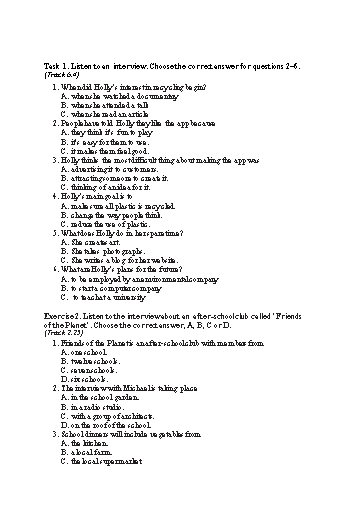
 D. the school garden.
 4. Science and Technology lessons will
 A. be the same as in other secondary schools.
 B. not focus on climate change.
 C. sometimes take place in the school grounds.
 D. concentrate more on environmental issues.
 5. The interviewer comes to the conclusion that
 A. Michael is probably not a typical teenager.
 B. Michael is like every other person of his age.
 C. Michael likes games and gadgets.
 D. Michael cares about the environment as much as his friends.
Exercise 3. Listen to the the interview about an after-school club called ‘Friends
of the Planet’ and choose the features which an eco-school have.
 1. solar panels
 2. no textbooks, only tablets
 3. Technology lessons on renewable energy
 4. low-energy light bulbs
 5. bicycle rack
 6. Science lessons on global warming
 7. a large car park
 8. recycling bins
 9. an organic vegetable garden There’s a Dutch guy called Boyan Slat who started a company to do that when he was just
nineteen. I’d love to go and work for him.
I: Thank you very much, Holly, and good luck!
Exercise 2.
P = Presenter M = Michael
P: Hello and welcome to The Future is Green. Today we’re talking about a special project
to make schools more environmentally friendly. We have a pupil from year twelve, Michael
James, to tell us about it. Hi Michael, and thanks for talking to us today.
M: That’s okay. I’m missing a few lessons, so I don’t mind at all.
P: Now, can you tell us about your project? How did it begin?
M: About a year and a half ago, one of our teachers started an after-school club called
‘Friends of the Planet’. At first, it was just for pupils from our school, but then we contacted
other schools in our area. Now our ‘Friends of the Planet’ group has members from six other
secondary schools. We meet once a week and for the last six months, we’ve been working on
this special project.
P: I see. What exactly is this special project?
M: Basically, we’ve designed an eco school of the future. We worked with a group
of architects who are planning to build a school that is more environmentally friendly. The
architects contacted our group because they wanted to involve young people and together,
we’ve made a model of how this eco school will look.
P: It sounds very exciting. Michael has brought the model of the eco school into the studio
with him. Can you explain it to our listeners, please Michael?
M: Sure. First of all, we have solar panels on the roof of the school – there are fifty panels
altogether.
P: And will they provide power for the whole school?
M: Yes, that’s the idea. It will save a lot of money on electricity.
P: Ah yes, I can imagine. Tell me about the garden.
M: Our eco school will grow vegetables, and we’ll use them for school dinners. So our school
dinners will be very organic and much cheaper than buying food from the local supermarket
or even from a local farm. We’ll also have chickens, rabbits and ducks.
P: And will they go into the school dinners too?
M: Ha ha, no. That would be terrible. They’ll be pets and hey’ll be useful. They’ll eat the
leftovers from the kitchen and the chickens will provide eggs.
P: Very good. So what other plans do you have to make the school more environmentally
friendly?
M: We’ll use low-energy light bulbs in all the classrooms. We’ll also have recycling bins
in every classroom and in the school grounds.
P: And what about your lessons – will they be different from non-eco schools?
M: Most of our lessons will be similar to lessons in any secondary school. But in our Science
lessons we’ll focus more on environmental issues like climate change and global warming.
Then, in our Technology lessons we’ll learn about things like renewable energy and even
how to make solar panels.
P: I see. Well, we’ve almost run out of time. Thank you for talking to us about your project.
It’s very nice to meet a teenager who is so concerned about the environment. In
my experience, most seventeen- and eighteen-year-olds are only interested in gadgets and
games.
File đính kèm:
- bai_tap_tieng_anh_lop_10_global_success_unit_2_listening_co.docx


