

Bài tập Tiếng Anh Lớp 11 Global Success - Review 1: Unit 1+2+3 (Có đáp án)
 8 trang
23/11/2025
1941
8 trang
23/11/2025
1941
Bạn đang xem tài liệu "Bài tập Tiếng Anh Lớp 11 Global Success - Review 1: Unit 1+2+3 (Có đáp án)", để tải tài liệu gốc về máy hãy click vào nút Download ở trên.
Tóm tắt nội dung tài liệu: Bài tập Tiếng Anh Lớp 11 Global Success - Review 1: Unit 1+2+3 (Có đáp án)
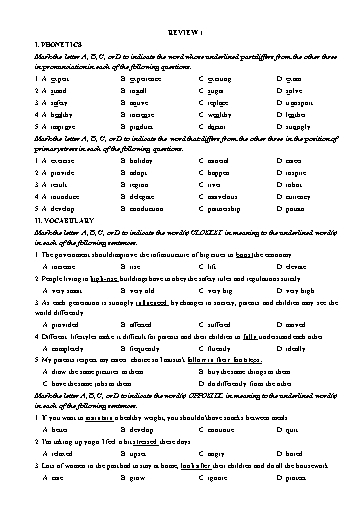
 4. This only makes the gap wider and causes their children to lose confidence in themselves.
 A. certainty B. courage C. weakness D. hesitation
5. After a hard-working day, parents feel exhausted and have little time with their children.
 A. energetic B. tired C. lazy D. weak
Give the correct forms of words in brackets.
1. They continue (HEALTH) ________ habits such as smoking and drinking.
2. Smart devices make our lives more (CONVENIENCE) ________ because we don't have to spend a
 lot of time on housework.
3. Using a mobile app, you can (LOCK) ________ bikes from one station and return them to any other
 station in the system.
4. Living in a big city has many (ADVANTAGE) ________ besides the benefits.
5. These features will make future cities more (LIVE) ________ and will provide a high quality of life
 to city dwellers.
Mark the letter A, B, C, or D to indicate the correct answer to each of the following sentences.
1. Having a balanced diet and ________ regularly are good ways to stay healthy.
 A. working out B. speaking out C. taking out D. hanging out
2. You should ________ sugar and eat more vegetables if you want to be healthy.
 A. take in B. keep on C. cope with D. cut down on
3. ________ transport system will help to solve traffic problems in big cities.
 A. Private B. Individual C. Public D. National
4. People are not worried about security in this area because ________ are installed everywhere.
 A. smart cities B. smart sensors C. smartphones D. smart cars
5. People of different generations often ________ conflict with one another.
 A. keep up with B. care about C. come into D. interact with
6. Young people now are true ________. They grow up with technology and start using a computer at
an early age.
 A. digital natives B. critical thinkers C. book lovers D. players
7. Some countries aim to replace old high-rise buildings with sustainable ________.
 A. mountains B. skyscrapers C. supermarkets D. houses
8. One of the problems for many city ________ is the high cost of living.
 A. villagers B. employers C. leaders D. dwellers
9. ________ the new technology, his health has improved quickly.
 A. Due to B. Provided that C. Thanks to D. Because
10. Many parents ________ their children’s screen time to less than two hours per day.
 A. limit B. lock C. manage D. keep
11. To build up the muscle ________ you need to lift weights.
 A. strong B. strength C. strengthen D. strongly
12. Cultural ________ are often different in each generation and make a gap between generations.
 A. jobs B. genders C. changes D. values A. tell B. told C. was tell D. was told
8. "Where is your uncle now?” - "He ________ in Heligoland, small islands near Germany.”
 A. already went B. has just arrived C. have been D. will have been
9. She ________ very tired so she ________ the dishes last night.
 A. feels / didn't wash B. didn’t feel / didn't washed
 C. felt / didn’t wash D. was felt / wasn't washed
10. It ________ rainy but she ________ an umbrella with her yesterday.
 A. was / brings B. is / isn't bring
 C. can / brought D. wasn’t / brought
11. "Would you like a cup of coffee?" - "Thank you. I ________ one.”
 A. am having B. have just had C. did have D. had
12. I am afraid she ________ typing the letters yet.
 A. didn't finish B. hasn't finished C. isn’t finished D. wasn’t finishing
11. The weather ________ nice so she ________ her kids to the park.
 A. were / takes B. did / did take
 C. was / took D. is / take
12. He usually ________ to school by his car but this morning he ________ because his car ________
broken.
 A. went / walked / did B. goes / walked / was
 C. go / walks / was D. did go / walked / was
13. The children ________ their homework, ________ some games, and then ________ to bed early.
 A. have finished / played / went B. finished / played / went
 C. had finished / were playing / went D. finished / played / were going
16. I ________ Paris recently, and it was an unforgettable experience.
 A. had visited B. have visited C. visited D. was visiting
17. The swimming pool ________ clean enough, so he ________.
 A. wasn’t / didn't swim B. weren’t / swam
 C. didn’t / swam D. was / wasn’t
18. John: ________ you ever ________ anywhere with him?
 Adam: Yes, last year, we ________ to China together.
 A. Did / visit / went B. Have / gone / gone
 C. Has / gone / go D. Have / travelled / went
19. He ________ his room for weeks.
 A. haven't tidied B. didn’t tidied C. hasn’t tidied D. wasn’t tidied
20. Arthur ________ London. He is still there.
 A. has gone to B. went C. did go to D. have gone to
Fill "should / shouldn’t / must / mustn't / have to / don’t have to” in the blanks.
1. All workers ________ wear uniforms at work because it is a rule.
2. I ________ finish my homework before I go to bed. Lan: Is it OK if you move right a bit?
 Minh: ________.
 A. Sure. B. I got it.
 C. No. That’s too bad. D. You made it.
5. Lan is talking to Minh.
 Lan: Do you think the entrance test is difficult?
 Minh: ________.
 A. I know it well. B. It’s a piece of cake.
 C. There’s no doubt about it. D. I think it’s good.
V. READING
Read the following passage and mark the letter A, B, C, or D to indicate the correct word or phrase
that best fits each of the numbered blanks from 1 to 10.
The generation gap, which refers to a significant difference between different generations, particularly
between young people and their parents, often (1) ________ to numerous conflicts. These family
conflicts can pose a serious threat to the relationship between parents and children.
It is a well-known fact (2) ________ parents tend to view their children as young and incapable of
protecting themselves or (3) ________ wise decisions, (4) ________ of their age. Consequently, parents
often make a great effort to expose their children to the outside world. (5) ________ , they fail to
recognize that as children grow up, they desire more independence and strive to develop their own
unique identity by forming their own opinions, thoughts, styles, and values in life.
One common issue that causes conflicts is the choice of clothing for teenagers. While teenagers are
enthusiastic (6) wearing trendy clothes that align with current youth fashion, parents, who value more
traditional attire, believe that such clothing (7) ________ societal rules and norms. Tensions escalate
further when the branded and expensive clothes preferred by teenagers exceed the parents’ financial (8)
________ .
 (9) ________ factor contributing to conflicts is the difference in career paths or educational choices
between parents and teenagers. Young people are often told that the world is their (10) ________ , with
numerous opportunities awaiting them. However, their parents may try to impose their own preferences
for university or career paths, disregarding their children's desires.
 (The Generation Gap in Antiquity)
1. A. turns B. gets C. directs D. leads
2. A. who B. that C. which D. where
3. A. making B. thinking C. doing D. getting
4. A. in terms B. instead C. regardless D. in place
5. A. But B. However C. Therefore D. Moreover
6. A. of B. with C. for D. about
7. A. violates B. involves C. inviolates D. invades
8. A. incomes B. salaries C. means D. modes
9. A. Another B. Other C. Others D. The others
10. A. ocean B. hand C. sky D. oyster B. Vacations to Mars will become a reality by 2050.
 C. The use of digital devices for health check-ups will eliminate the need for doctors.
 D. Human life will be improved in the future thanks to the development of technology.
17. What is the author's overall tone in the passage?
 A. Cynical and skeptical B. Critical and dismissive
 C. Indifferent and neutral D. Optimistic and enthusiastic
File đính kèm:
- bai_tap_tieng_anh_lop_11_global_success_review_1_unit_123_co.docx
- ANSWER KEYS.docx


