

Bài tập Tiếng Anh Lớp 11 Global Success - Unit 2: The generation gap (Có file nghe và đáp án)
 16 trang
09/11/2025
2070
16 trang
09/11/2025
2070
Bạn đang xem tài liệu "Bài tập Tiếng Anh Lớp 11 Global Success - Unit 2: The generation gap (Có file nghe và đáp án)", để tải tài liệu gốc về máy hãy click vào nút Download ở trên.
Tóm tắt nội dung tài liệu: Bài tập Tiếng Anh Lớp 11 Global Success - Unit 2: The generation gap (Có file nghe và đáp án)
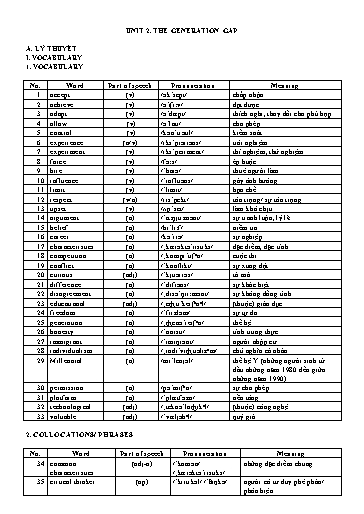
 36. cultural values (adj-n) /ˈkʌlʧərəl/ /ˈvổljuːz/ những giỏ trị văn hoỏ
 37. digital native (np) /ˈdɪʤɪtl/ /ˈneɪtɪv/ người được sinh ra ở thời đại
 cụng nghệ và Internet
 38. electronic device (adj-n) /ɪlɛkˈtrɒnɪk/ /dɪˈvaɪs/ thiết bị điện tử
 39. extended family (adj-n) /ɪksˈtɛndɪd/ /ˈfổmɪli/ đại gia đỡnh
 40. gender role (np) /ˈʤɛndə/ /rəʊl/ vai trũ giới
 41. generation gap (np) /ˌʤɛnəˈreɪʃᵊn/ /ɡổp/ khoảng cỏch thế hệ
 42. generational (adj-n) /ˌʤɛnəˈreɪʃᵊnᵊl/ sự xung đột thế hệ
 conflict /ˈkɒnflɪkt/
 43. male job (adj-n) /meɪl/ /ʤɒb/ cụng việc dành cho nam giới
 44. music taste (np) /ˈmjuːzɪk/ /teɪst/ gu õm nhạc
 45. nuclear family (adj-n) /ˈnjuːklɪə/ /ˈfổmɪli/ gia đỡnh hạt nhõn
 46. screen time (np) /skriːn/ /taɪm/ thời gian sử dụng thiết bị điện
 tử
 47. social media (np) /ˈsəʊʃəl/ /ˈmiːdiə/ phương tiện truyền thụng
 mạng xó hội
 48. weight gain (np) /weɪt/ /ɡeɪn/ sự tăng cõn
 49. adapt to (vp) /əˈdổpt/ /tuː/ thớch nghi với
 50. argue over (vp) /ˈɑːɡjuː/ /ˈəʊvə/ tranh luận về một cỏi gỡ đú
 something /ˈsʌmθɪŋ/
 51. colour the hair (v-n) /ˈkʌlə/ /ðə/ /heə/ nhuộm túc
 52. damage eyesight (v-n) /ˈdổmɪʤ/ /ˈaɪsaɪt/ ảnh hưởng tới thị lực
 53. express opinions (v-n) /ɪksˈprɛs/ /əˈpɪnjənz/ thể hiện ý kiến
 54. follow in (vp) /ˈfɒləʊ/ /ɪn/ theo chõn ai đú/giống ai đú
 somebody’s /ˈsʌmbədiz/
 footsteps /ˈfʊtstɛps/
 55. have fixed ideas (v-n) /hổv/ /fɪkst/ /aɪˈdɪəz/ cú định kiến
 56. hold traditional (v-n) /həʊld/ /trəˈdɪʃᵊnᵊl/ giữ quan điểm truyền thống
 view /vjuː/
 57. limit screen time (v-n) /ˈlɪmɪt/ /skriːn/ giới hạn thời gian sử dụng
 /taɪm/ thiết bị điện tử
 58. make decisions (v-n) /meɪk/ /dɪˈsɪʒənz/ đưa ra quyết định
 59. rely on (vp) /rɪˈlaɪ/ /ɒn/ dựa vào
 60. suit somebody’s (vp) /sjuːt/ /ˈsʌmbədiz/ phự hợp với nhu cầu của ai đú
 need /niːd/
 61. take away (vp) /teɪk/ /əˈweɪ/ lấy đi
 62. try something out (vp) /traɪ/ /ˈsʌmθɪŋ/ /aʊt/ dựng thử/ kiểm tra
3. WORD FORMATION
 No. Word Part of speech Pronunciation Meaning
 63. culture (n) /ˈkʌlʧə/ văn hoỏ
 64. cultural (adj) /ˈkʌlʧərəl/ (thuộc về) văn hoỏ
 65. difference (n) /ˈdɪfrəns/ sự khỏc biệt
 66. different (adj) /ˈdɪfrənt/ khỏc biệt
 67. generation (n) /ˌʤɛnəˈreɪʃᵊn/ thế hệ
 68. generational (adj) /ˌʤɛnəˈreɪʃᵊnᵊl/ (thuộc) thế hệ
 69. tradition (n) /trəˈdɪʃᵊn/ truyền thống
 70. traditional (adj) /trəˈdɪʃᵊnᵊl/ (thuộc) truyền thống
 71. value (n/v) /ˈvổljuː/ giỏ trị/coi trọng
 72. valuable (adj) /ˈvổljəbᵊl/ quý giỏ 1. A. belief B. express C. gender D. Millennial
2. A. nuclear B. critical C. curious D. accept
3. A. hire B. conflict C. limit D. influence
4. A. hold B. honesty C. housework D. historical
5. A. generation B. digital C. argue D. damage
6. A. take B. male C. native D. argument
7. A. job B. role C. follow D. electronic
8. A. family B. value C. media D. characteristic
9. A. suit B. screen C. social D. individualism
10. A. device B. difference C. thinker D. experience
Task 2. Find the word that differs from the other three in the position of stress in each of the
following questions.
1. A. argument B. nuclear C. belief D. gender
2. A. value B. experience C. thinker D. curious
3. A. millennial B. digital C. freedom D. honesty
4. A. express B. native C. media D. platform
5. A. influence B. limit C. damage D. opinion
6. A. conflict B. eyesight C. characteristic D. common
7. A. music B. social C. footstep D. extended
8. A. follow B. accept C. hire D. family
9. A. adapt B. difference C. parent D. children
10. A. generational B. individualism C. housework D. electronic
II. VOCABULARY
Task 1. Match the words on the left with their meanings on the right.
1. nuclear family a. people who are born between around 1981 and 1996
2. extended family b. jobs which are traditionally perceived to be in charge of by men
3. Millennial c. people who have grown up in the digital age and are familiar with
 using digital technologies from an early age.
4. conflict d. differences between older and younger people in terms of experiences,
 opinions, habits, and behaviour
5. generation gap e. a family consisting of two parents and their children
6. male jobs f. the feeling of being certain that something exists or is true
7. gender roles g. the belief in valuing personal freedom and independence over group
 interests.
8. digital natives h. an active disagreement between people with different opinions.
9. belief i. a family consisting of grandparents, aunts, and uncles, etc, in addition
 to parents and children
10. individualism j. behaviours, attitudes, and personality characteristics determined by an
 individual’s sex
Task 2. Complete the following sentences with suitable words from Task 1.
1. ___________________ is often highly valued in Western cultures, emphasising personal freedom and
independence.
2. ___________________ have changed significantly over time, with more women taking on traditionally
male roles in the workplace and at home.
3. There can be a significant ___________________ between parents and their children, especially in
terms of cultural values and technology use.
4. My brother was born in 1996 and is considered as a ___________________. Task 5. Complete the sentences using the correct form of the words in brackets.
 1. People from different generations may sometimes get into __________________ over viewpoints.
 (ARGUE)
 2. Hung is a __________________ thinker. He always tries to look into things from different aspects
 and contributes to work out a better solution. (CRITIC)
 3. Children nowadays can make use of __________________ media very easily. They learn things
 faster than their previous generations. (SOCIETY)
 4. People of the same generations often share common __________________.(BELIEVE)
 5. Parents often encourage their children to follow their native country’s __________________
 values. (CULTURE)
 6. Each generation has __________________ experiences, values, and perspectives.
 (DIFFERENCE)
 7. My father and I have a common __________________. We usually look at things on the bright
 side and never give up. (CHARACTER)
 8. Living in an __________________ family has several benefits. For example, children can play
 with their cousins, which is fun. (EXTEND)
 9. The younger generation brings __________________ opinions and innovative ideas to the
 company. (VALUE)
 10. The __________________ conflicts within the family can get worse if family members do not
 spend quality time with each other. (GENERATION)
Task 6. Choose the correct word or phrase to complete the sentences.
 1. The new generation has the potential to achieve / allow great things with their skills and
 determination.
 2. The older generation should not force / upset their beliefs and ideas upon the younger generation.
 3. The younger generation prioritises technological / educational opportunities such as higher study.
 4. It is important for teenagers to ask for their parents’ career / permission before going out late.
 5. Unhealthy eating habits and lack of physical activity can contribute to weight gain / control in
 children.
III. GRAMMAR
Task 1. Choose the appropriate modal verb.
 1. Children must / mustn’t recognize the importance of family traditions and cultural values, even if
 they may seem outdated in the modern world.
 2. Grandparents shouldn’t / should learn how to use smartphones or social media to stay connected
 with their grandchildren.
 3. Children have to / don’t have to respect old people because they have lots of life experiences.
 4. Parents mustn’t / don’t have to force their children to follow their jobs; instead, they should give
 advice and let their children choose their own careers.
 5. Older generations must / had to rely on physical newspapers or books for information, but today’s
 youth don’t have to, thanks to the internet.
 6. Teenagers must / mustn’t appreciate the efforts their parents make for them, even if they don’t
 always agree.
 7. Teenagers should / shouldn’t listen to their parents’ advice and guidance, as they can help them
 overcome difficult situations.
 8. In previous generations, women had to / must follow specific gender roles, but today they don’t
 have to / mustn’t limit their dreams and can pursue any career they like.
Task 2. Choose the correct answers.
1. In the past, young adults ______ follow social norms and expectations regarding relationships and
marriage, but now they have more freedom. 6. A. to B. in C. at D. over
7. A. on B. for C. of D. in
8. A. culture B. cultures C. cultural D. cultured
9. A. any B. some C. each D. few
10. A. usual B. finite C. refined D. common
Task 2. Read the following passage and choose the correct answer to each of the questions.
 Family conflicts are an inherent part of human relationships, stemming from the diverse
personalities, perspectives, and dynamics within a family unit. These conflicts can arise due to various
factors, including differences in values, communication styles, and expectations.
 One common source of family conflict is different values and beliefs. Each family member may
have their own set of values and principles, influenced by their upbringing, personal experiences, and
social influences. These differences can lead to disagreements, particularly when it comes to important
decisions or lifestyle choices.
 Communication breakdowns also contribute to family conflicts. Ineffective communication,
whether it be through misinterpretation, misunderstandings, or lack of active listening, can exacerbate
tensions and escalate conflicts within the family. Different communication styles and approaches further
complicate matters, as individuals may have varying preferences for directness, assertiveness, or
emotional expression.
 Moreover, unfulfilled expectations often become a source of conflict within families. Each family
member may have their own set of expectations regarding roles, responsibilities, and behaviours. When
these expectations are not met, it can lead to disappointment, resentment, and conflicts.
 Resolving family conflicts requires open and honest communication and empathy. Active
listening, seeking to understand others’ perspectives, and finding common ground can help bridge the
gaps and foster understanding within the family unit. Family members should also be willing to adapt and
adjust their expectations for peaceful coexistence.
1. Which of the following can be the best title for the passage?
 A. Reasons for Family Conflicts B. How Conflicts Affect Family
 C. How to Avoid Family Conflicts D. Disadvantages of Conflicts
2. A person’s beliefs and principles are NOT influenced by ______.
 A. social factors B. personal experiences
 C. upbringing environment D. disagreements
3. The word “it” in paragraph 3 refers to ______.
 A. belief B. family conflict
 C. ineffective communication D. tension
4. The word “exacerbate” in paragraph 3 is closest in meaning to ______.
 A. mend B. worsen C. fulfil D. thrive
5. Which of the following is NOT true?
 A. Conflicts may result from people feeling disappointed when their expectations are not met.
 B. Family members need to listen and find common ground to understand each other better.
 C. People don’t have to give up their desires to get along with each other.
 D. The differences in communication styles can lead to family conflicts.
Task 3. Read the passage and decide whether the following statements are true (T), false (F) or not
given (NG).
 Communication conflicts among different generations are a prevalent issue in contemporary
society. As each generation is shaped by unique experiences, values, and communication styles,
misunderstandings and conflicts often arise. These conflicts result from a lack of understanding and
empathy for each other’s perspectives. 3. Using laptops and smartphones too much leads to sleep and weight problems.
 A. There are no connections between laptop and smartphone use and sleep or weight.
 B. Sleep and weight problems are unrelated to the use of laptops and smartphones.
 C. The more you use laptops and smartphones, the more sleep and weight problems you will have.
 D. The more you use laptops and smartphones, the more sleep and weight benefits you’ll have.
4. Asian American parents may fail to have their children follow the family traditional values.
 A. Asian American parents find it effortless to pass down traditional values to their children.
 B. Asian American parents may not always succeed in passing down their family’s traditional
 values to their children.
 C. Asian American parents easily maintain their children’s devotion to traditional values.
 D. The failure of Asian American parents to promote traditional values is uncommon.
5. Many Gen Zers are also interested in starting their own companies.
 A. Gen Zers lack interest in starting their own businesses.
 B. Only a few Gen Zers show enthusiasm for establishing their own companies.
 C. Generation Z is mainly uninterested in starting their own businesses.
 D. A number of Gen Zers have a keen interest in starting their own companies.
Task 3. Write a paragraph (120-150 words) about this topic.
- Parents should control their children’s activities on social media.
- Do you agree or disagree with this statement?
_____________________________________________________________________________________
_____________________________________________________________________________________
_____________________________________________________________________________________
_____________________________________________________________________________________
_____________________________________________________________________________________
_____________________________________________________________________________________
_____________________________________________________________________________________
_____________________________________________________________________________________
_____________________________________________________________________________________
_____________________________________________________________________________________
_____________________________________________________________________________________
_____________________________________________________________________________________
VI. SPEAKING
Task 1. Answer the following questions.
1. How often do you spend time talking with your parents?
_____________________________________________________________________________________
_____________________________________________________________________________________
_____________________________________________________________________________________
_____________________________________________________________________________________
_____________________________________________________________________________________
_____________________________________________________________________________________
2. What are some differences in beliefs between you and your parents?
_____________________________________________________________________________________
_____________________________________________________________________________________
_____________________________________________________________________________________
_____________________________________________________________________________________
_____________________________________________________________________________________
_____________________________________________________________________________________
File đính kèm:
- bai_tap_tieng_anh_lop_11_global_success_unit_2_the_generatio.doc
 2. GS11_L_Unit2 Task1.mp3
- 2. GS11_L_Unit2 Task2.mp3
- 2. GS11_S_Unit2 Task1.mp3
- 2. GS11_S_Unit2 Task2.mp3
- UNIT 2. THE GENERATION GAP - KEY.doc


