

Bài tập Tiếng Anh Lớp 11 Global Success - Unit 3: Test 2 (Có đáp án)
 4 trang
07/11/2025
2170
4 trang
07/11/2025
2170
Bạn đang xem tài liệu "Bài tập Tiếng Anh Lớp 11 Global Success - Unit 3: Test 2 (Có đáp án)", để tải tài liệu gốc về máy hãy click vào nút Download ở trên.
Tóm tắt nội dung tài liệu: Bài tập Tiếng Anh Lớp 11 Global Success - Unit 3: Test 2 (Có đáp án)
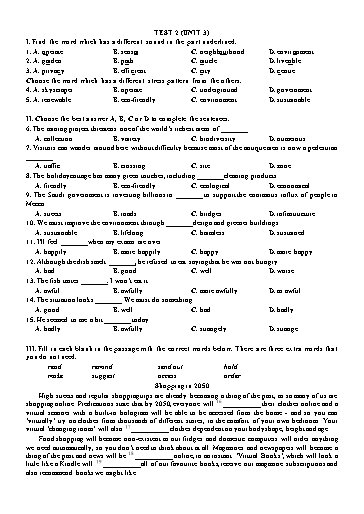
 Flagging down a taxi after shopping will also be a thing of the past - as smartphone apps will be able
to tap in to the nearest automatically controlled carpool and 20 __________ an electric car to wherever you
are, in an instant.
IV. Complete the sentences with the correct form of the verbs in brackets (present simple or present
continuous).
21. I __________ (think) you already __________ (know) my views on the matter.
22. He’s tired of working in an office. He __________ (think) of changing his job.
23. I __________ (just / smell) your roses. __________ they __________ (not smell) wonderful?
24. __________ you __________ (see) that house over there? No, not there! You __________ (not look)
where my finger __________ (point).
25. I __________ (not hear) anything. You __________ (just / imagine) things.
V. Choose the word or phrase among A, B, C or D that best fits the blank space in the following
passage.
 Silicon Valley is 26 __________ to hundreds of technology companies, so it comes as no surprise
that San Jose has partnered with technological giant Intel to transform itself 27 __________ a smart city.
San Jose and Intel will work 28 __________ to further the city's Green Vision initiative - a 15-year plan for
economic growth, and improve 29 __________ -which it launched in 2007.
 Intel expects to help San Jose create 25,000 clean-tech jobs, drive economic growth, and improve
the city's environmental 30 __________ . To achieve this 31 __________ , Intel will work with the city to
track real-time data on air quality, noise pollution, traffic flow, and other environmental and 32__________
concerns which it will then use to encourage 33 __________ to reduce emissions by using public
transportation or bicycles to get to work or school.
 Smart cities may sound like something of the distant future 34 __________ many people thought the
same thing about smartphones and smart homes. Up to now, over 70 percent of American adults have
owned a smartphone and 1.9 billion smart home devices have been installed. If smart cities are
35__________ like these other smart innovations, we will see them appear in our communities sooner rather
than later.
26. A. home B. house C. shelter D. housing
27. A. from B. to C. into D. towards
28. A. each other B. together C. one another D. themselves
29. A. love life B. a good life C. the life of quality D. quality of life
30. A. sustain B. sustainable C. sustainably D. sustainability
31. A. score B. goal C. point D. object
32. A. town B. rural C. urban D. countryside
33. A. inhabitants B. residence C. cavemen D. officials
34. A. because B. when C. so D. as
35. A. anything B. nothing C. one D. most
VI. Read the passage, and choose the correct answer A, B, C or D for each question.
 Today’s urban cities are practically bursting at the seams. According to research from the United
Nations, 54 percent of the world’s population lives in urban areas, a percentage that is expected to increase
to over 66 percent by 2050. In fact, India alone is projected to add 404 million urban dwellers to its
population by 2050.
 This rapid growth of the urban population has caused daunting problems for city planners, such as
overcrowded roads, excessive energy consumption and unemployment. Therefore, to build more
sustainable cities and accommodate the growing number of residents, many city leaders are turning to the
Internet of Things (IoT).
 The IoT has forever changed the way urban cities operate. Cities that were once detached and
inaccessible are now intelligent and highly connected. From Amsterdam to Seoul, cities are launching smart Daisy: What are you reading, Nick?
Nick: I ’m reading some predictions about New York in 2050.
Daisy: I think air pollution is a big problem because at present buildings account for three quarters of the
 city’s greenhouse gas emissions.
Nick: 41_________________________________________________________________________
 ________________________________. It’ll have enormous effect on New York’s future.
Daisy: I hope that there will be no more fossil fuels - all buildings in New York will run on renewable
 energy.
Nick: I think this will come true. 42 ___________________________________________________
 _________________________________________. Anyway, in a big city with heavy traffic like
 New York, it’s necessary to put in use an autonomous taxi fleet which carry people all the time.
Daisy: We’ll save time, energy and we’ll need fewer taxis, won’t we?
Nick: 43_________________________________________________________________________
 _______________________________________________. It could be replaced with planted
 areas that accept and filter sewage water running off from the street.
Daisy: I think during storms, the new sewage system can deal with polluted storm water better.
Nick: I think so. By 2050, we will have had time to follow the examples set by the Netherlands. 44 ______
Daisy: We could encourage cycling by building dedicated bicycle and pedestrian bridges over the city’s
 rivers.
Nick: I think New York will become a model city which focuses on making citizens smarter. 45
 ______________________________________________________. That enables every New
 Yorker to make better decisions about both their own lives and the larger community.
VIII. Write complete sentences about disadvantages of living in a smart city, using the words /
phrases given in their correct forms. You can add some more necessary words, but you have to use
all the words given.
Limited privacy
46. since / authorities / or / government / have access / security cameras / and / intelligent systems /
connected through many different spaces / citizens / have / difficulty / maintain / their anonymity.
__________________________________________________________________________________
__________________________________________________________________________________
__________________________________________________________________________________
__________________________________________________________________________________
47. facial recognition / change / concept / privacy / or / personal space
__________________________________________________________________________________
__________________________________________________________________________________
Pre-training is required
48. if / people / not know / technology / they / not be able / use it
__________________________________________________________________________________
__________________________________________________________________________________
49. without training / they / find it irrelevant / their daily lives / and / find it / difficult / use it
__________________________________________________________________________________
__________________________________________________________________________________
Excess network trust
50. Since / people / smart cities will / almost entirely / electronics and networks / they / lose / autonomy /
their decision making / and / become incompetent
__________________________________________________________________________________
__________________________________________________________________________________
File đính kèm:
- bai_tap_tieng_anh_lop_11_global_success_unit_3_test_2_co_dap.docx
- 9. UNIT 3 - TEST 2 - KEY.docx


