

Bài tập Tiếng Anh Lớp 11 Global Success - Unit 5: Global warming (Có đáp án)
 15 trang
08/11/2025
9940
15 trang
08/11/2025
9940
Bạn đang xem tài liệu "Bài tập Tiếng Anh Lớp 11 Global Success - Unit 5: Global warming (Có đáp án)", để tải tài liệu gốc về máy hãy click vào nút Download ở trên.
Tóm tắt nội dung tài liệu: Bài tập Tiếng Anh Lớp 11 Global Success - Unit 5: Global warming (Có đáp án)
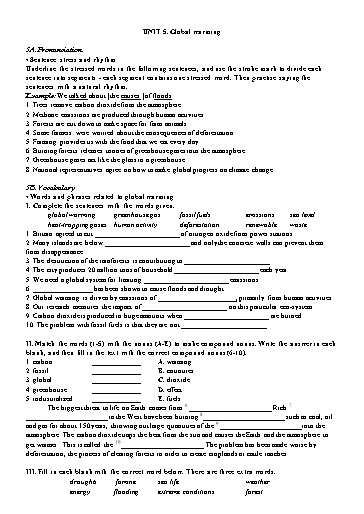
 The Expected Effects of Global Warming
- A rise in sea levels, causing 1 ______________________ in coastal areas.
- Higher sea surface temperatures, endangering 2 ______________________.
- The shrinking of glaciers, leading to a decrease in fresh water for rivers and less 3 __________________
production.
- A loss of tropical forests, an increase in arid lands, more 4 ______________________ fires, and a loss
of animal and plant species.
- A decrease in agricultural yields, leading to 5 ______________________.
IV. Fill in each blank in the passage with the correct word / phrase below.
 energy use endangered species carbon footprint climate change
 sea levels alternative sources greenhouse gases carbon emissions
 Why is global warming a problem? High levels of 1 ______________________ in the atmosphere
lead to 2 ______________________. The oceans and seas are getting warmer and the polar ice caps are
melting. This causes the rise in 3 __________________, which threatens low coastal regions and islands.
Furthermore, the weather is becoming more unpredictable, with severe storms and floods, or unexpected
droughts. Another effect of global warming is a rise in the number of 4 __________________. Many
animals and plants could become extinct if their natural habitats are changed.
 What can we do about it? Scientists now agree that there is an urgent need to cut down on 5
__________________ across the world. Moreover, we need to develop 6 __________________ of
energy, such as wind, wave or solar power.
 For individuals, being a vegetarian reduces your 7 __________________ (the amount of emissions
caused one person’s lifestyle) because it can reduce 8 __________________.
V. Match the words 1-5 with a-e. Write the answers in the blanks.
1. global __________________________ a. species
2. endangered __________________________ b. energy
3. solar __________________________ c. footprint
4. wind __________________________ d. warming
5. carbon __________________________ e. farm
VI. Complete the sentences with the words in Exercise V.
1. I don’t want to live near a __________________________. I think the turbines are ugly.
2. Our house gets electricity from __________________________. The special panels are on the roof.
3. The world’s climate is getting hotter because of __________________________.
4. Your __________________________ indicates how much CO2 your lifestyle creates.
5. The Bengal tiger is one of the animals on the list of __________________________.
VII. Complete the text with the words given below.
 freeze fuels gases greenhouse heat trap
 The Greenhouse Effect
 What is like when you’re in a 1 ___________________ on a sunny day? It’s boiling hot. That’s
because the sun’s rays 2 _________________ the air there and the glass windows 3 __________________
the heat inside. Outside, in the earth’s atmosphere, greenhouse 4 ___________________ such as carbon
dioxide do the same job as the glass in the greenhouse. They keep our planet warm. Without them, we’d 5
___________________. However, too much of them and the opposite happens. Burning fossil 6
___________________ such as oil and coal pollutes the earth’s atmosphere and makes the greenhouse
effect worse.
• Prepositions
VIII. Complete each sentence with the correct preposition. 8. Since it was first imported into Australia many years ago, the rabbit has become a serious pest because
it has no natural enemies there.
_____________________________________________________________________________________
_____________________________________________________________________________________
III. Reduce the adverb clause to a present participle clause if possible.
1. After the musician stopped playing, the audience stood up and clapped enthusiastically.
_____________________________________________________________________________________
2. Since David was driving to work in the rain, his car got a flat tyre.
_____________________________________________________________________________________
3. While David was driving to work, he had a flat tyre.
_____________________________________________________________________________________
4. Tom worked hard in the garden all afternoon, so he took a shower and then went to the cinema with his
friends.
_____________________________________________________________________________________
_____________________________________________________________________________________
5. Before a friend tries to do something hard, an American may say ‘Break a leg!’ to wish him or her
good luck.
_____________________________________________________________________________________
6. Lan always straightens her desk before she leaves the office at the end of the day.
_____________________________________________________________________________________
7. Before Bob left on his trip, his manager gave him a big raise.
_____________________________________________________________________________________
8. Mai got all the ingredients, so she made a delicious chicken curry for her friends.
_____________________________________________________________________________________
IV. Combine each pair of sentences using a present participle clause if possible.
1. Ann kept one hand on the steering wheel. She opened a can of soda with her free hand.
_____________________________________________________________________________________
2. He misunderstood the direction to the restaurant. He arrived one hour late for the dinner party.
_____________________________________________________________________________________
3. She lives a long distance from her office. She has to commute daily by train.
_____________________________________________________________________________________
4. David lives a long distance from his office. His car is essential.
_____________________________________________________________________________________
5. Ann remembered that she hadn’t turned off the oven. She went directly home.
_____________________________________________________________________________________
6. Phong tripped on the carpet. He spilt his coffee.
_____________________________________________________________________________________
7. She was lying by the swimming pool. She realised she was getting sunburnt.
_____________________________________________________________________________________
8. I met Mai after school. She suggested playing badminton.
_____________________________________________________________________________________
V. Match the present participle or past participle clauses to the suitable main clauses.
1. Trying to understand the physics problem, ___________________
2. Since injuring my arm, ___________________
3. Wanting to ask a question, ___________________
4. Exhausted after washing the windows, ___________________
5. Hearing the announcement that their plane was delayed, ___________________
6. Attempting to enter the highway, ___________________ 4. What are the two possible human causes of global warming?
_____________________________________________________________________________________
5. What are the two possible natural causes of global warming?
_____________________________________________________________________________________
Task 2. Read the comments. Would the bloggers agree or disagree with the statement. Circle the
correct answer.
6. Gloria would agree/ disagree with this statement: “Global warming is not a problem.”
7. Winston would agree/ disagree with this statement: “Global warming is a natural event.”
8. Sam would agree/ disagree with this statement: “Changes must be made to deal with global warming.”
9. Kris would agree/ disagree with this statement: “Global warming is caused by people.”
10. Linda would agree/ disagree with this statement: “IPCC is a reliable source for information about
global warming.”
II. Read the passage, and then decide whether the statements are true (T) or false (F).
 Consequences of Global Warming on Wildlife
 Increasing global temperatures are expected to harm ecosystems, pushing extinction to those
species that cannot adapt. The first comprehensive assessment of the extinction risk from global warming
found that more than 1 million species could be extinct by 2050 if the current rate continues.
 A recent study of nearly 2,000 species of plants and animals discovered movement toward the
poles at an average rate of 3.8 miles per decade.
 The latest climate change report found that approximately 20 to 30 percent of plant and animal
species assessed so far are likely to be at increased risk of extinction if global average temperature
increases by more than 2.7 to 4.5 degrees Fahrenheit.
 Some polar bears are drowning because they have to swim longer distances to reach ice floes. The
U.S. Geological Survey has predicted that two-thirds of the world’s polar bear populations will be extinct
by the mid-century due to melting of the Arctic ice cap.
 The ocean will continue to become more acidic due to carbon dioxide emissions. Because of this
acidification, species with hard calcium carbonate shells are vulnerable, as are coral reefs, which are vital
to ocean ecosystems. Scientists predict that a 3.6 degrees Fahrenheit increase in temperature would wipe
out 97 percent of the world’s coral reefs.
______ 1. A large number of species are at risk of extinction due to global warming.
______ 2. The latest climate change report found that 2,000 species of plants and animals are likely to be
at increased risk of extinction if global average temperature increases by more than 2.7 to 4.5 degrees
Fahrenheit.
______ 3. Some polar bears are drowning because they have to travel farther to come to their natural
habitat.
______ 4. The acidification of the oceans makes coral reefs vital to ocean ecosystems.
______ 5. A 3.6 degrees Fahrenheit increase in temperature is predicted to wipe out possibly 97 percent
of the world’s coral reefs.
III. Read the passage, and then decide whether the statements are true (T) or false (F).
 Global warming is primarily a problem of too much carbon dioxide in the atmosphere, which acts
as a blanket, trapping heat and warming the planet. Globally, the average surface temperature has
increased more than one degree Fahrenheit since the late 1800s. Most of that increase has occurred over
just the past three decades.
 We are overloading our atmosphere with carbon dioxide, which traps heat and steadily drives up
the planet’s temperature. Carbon dioxide comes from the fossil fuels we bum for energy, such as coal,
natural gas, and oil, and the loss of forests due to deforestation, especially in the tropics. 1. Oil, coal, and natural gas are examples of fossil fuels that increase global warming. ___________
2. Taking care of your car tires can help the environment and your budget. ___________
3. Incandescent light bulbs use less electricity than fluorescent bulbs. ___________
4. Foods with pesticides are bad for your health. ___________
5. Wind and solar power are renewable energy alternatives to fossil fuels. ___________
Task 2. According to the information in the text, match the beginning of each sentence on the left
with the best ending on the right, writing the answer in each blank.
1. An increase in carbon dioxide ... ___________ A. reduces pollution by 70% to 90%.
2. Energy-efficient appliances ... ___________ B. contributes to global warming.
3. Compact fluorescent bulbs ... ___________ C. take steps to curb global warming.
4. Recycling ... ___________D. save electricity.
5. People can ... ___________ E. cut down electricity use by 25%.
Task 3. Match the underlined words in the text with the definition.
1. curb (v) ___________ A. make something smaller
2. lessen (v) ___________ B. give your opinion about something in public
3. skip (v) ___________ C. throw something carelessly
4. toss (v) ___________ D. control or limit something
5. speak out (v) ___________ E. not to do something that you usually do
V. Read the text and do the tasks that follow.
 Six Surprising Results of Climate Change
 Most people have a general idea about what global warming involves. After all, the data that
shows rising temperatures and 1 _________ ice caps are there for all to see. Sea 2 _________ are rising at
a rate of about four milimetres per year. That may not sound like much, but the Earth’s changing climate
is already 3 _________ problem.
 Not 4 _________ is global warming shrinking glaciers and creating more powerful hurricanes, but
it also seems to be causing more forest fires than ever before. Recent wildfires in the western USA have
both covered more ground and 5 _________ for longer. Their increased size and frequency mean that
firefighters have a much harder time putting them 6 _________. What is more, there is a 7 _________
relationship between the warmer temperatures and the early arrival of spring. When the snow disappears,
forest 8 _________ become drier and stay dry for longer, which increases the chance that they might catch
fire.
 All over the world, temples, ancient monuments and other statues stand as reminders of past
civilisations, which until now have survived the tests of time. However, the immediate effects of global
warming may finally destroy them. Rising sea and extreme weather have the potential to damage these
unique sites. Floods caused by global warming have already damaged Sukhothai - the 600-year-old site
which was the ancient capital of a Thai kingdom.
 The average climber probably wouldn’t notice, but the Alps and other mountain ranges have
experienced gradual growth over the past century or so thanks to the melting of the glaciers on top of
them. For thousands of years, the weight of these glaciers has pushed the mountains down into the Earth,
squeezing them down like a cushion. As the glaciers melt, this weight is decreasing, and the surface is
slowly rising. Global warming speeds up the melting of these glaciers, so the mountains are growing
faster.
 One hundred and twenty-five lakes in the Arctic have disappeared in the past few decades, giving
support to the idea that global warming is working extremely fast nearest the Earth’s poles. Research into
the missing water points to the probability that frozen earth underneath lakes warmed up and became soft
- or thawed. As this normally-frozen ground thaws, the water in the lakes can escape through the soil,
draining the lakes. One researcher compared it to pulling the plug out of the bath.
File đính kèm:
- bai_tap_tieng_anh_lop_11_global_success_unit_5_global_warmin.doc
- 14. UNIT 5. Global warming - KEY.doc


