

Bài tập Tiếng Anh Lớp 11 Global Success - Unit 5: Global warming (Có file nghe và đáp án)
 17 trang
09/11/2025
5360
17 trang
09/11/2025
5360
Bạn đang xem tài liệu "Bài tập Tiếng Anh Lớp 11 Global Success - Unit 5: Global warming (Có file nghe và đáp án)", để tải tài liệu gốc về máy hãy click vào nút Download ở trên.
Tóm tắt nội dung tài liệu: Bài tập Tiếng Anh Lớp 11 Global Success - Unit 5: Global warming (Có file nghe và đáp án)
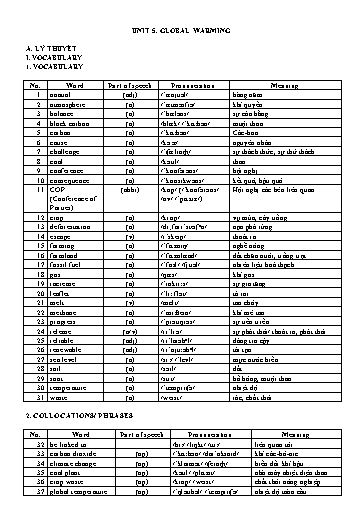
 38. global warming (np) /ˈɡləʊbəl/ /ˈwɔːmɪŋ/ sự nĩng lên tồn cầu
 39. greenhouse effect (np) /ˈɡriːnhaʊs/ /ɪˈfɛkt/ hiệu ứng nhà kính
 40. heat stress (np) /hiːt/ /strɛs/ ứng suất nhiệt
 41. heat-trapping (adj-n) /hiːt/-/ˈtrỉpɪŋ/ chất gây ơ nhiễm giữ nhiệt
 pollutant /pəˈluːtənt/
 42. human activity (np) /ˈhjuːmən/ /ỉkˈtɪvəti/ hoạt động của con người
 43. landfill waste (np) /ˈlỉndfɪl/ /weɪst/ chất thải ở bãi rác
 44. natural gas (np) /ˈnỉʧrəl/ /ɡỉs/ khí tự nhiên
 45. open fire (np) /ˈəʊpən/ /ˈfaɪə/ ngọn lửa trần
 46. polar ice cap (np) /ˈpəʊlər/ /aɪs/ /ˈkỉp/ chỏm băng vùng cực
 47. renewable energy (adj-n) /rɪˈnjuːəbᵊl/ /ˈɛnəʤi/ năng lượng tái tạo
 48. responsible for (adj-pre) /rɪsˈpɒnsəbᵊl/ /fɔː/ chịu trách nhiệm cho
 49. rising sea level (adj-n) /ˈraɪzɪŋ/ /siː/ /ˈlɛvl/ mực nước biển dâng cao
 50. run out (vp) /rʌn/ /aʊt/ hết, cạn kiệt
 51. suffer from (vp) /ˈsʌfə/ /frɒm/ chịu đựng
 52. United Nations (np) /jʊˈnaɪtɪd/ /ˈneɪʃᵊnz/ Liên Hợp Quốc
3. WORD FORMATION
 No. Word Part of speech Pronunciation Meaning
 53. emit (v) /iˈmɪt/ phát thải
 54. emission (n) /ɪˈmɪʃᵊn/ sự phát thải, khí thải
 55. environment (n) /ɪnˈvaɪərənmənt/ mơi trường
 56. environmental (adj) /ɪnˌvaɪ.rənˈmen.təl/ thuộc về mơi trường
 57. pollute (v) /pəˈluːt/ làm ơ nhiễm, gây ơ nhiễm
 58. pollutant (n) /pəˈluːtənt/ chất gây ơ nhiễm
 59. pollution (n) /pəˈluː.ʃən/ sự ơ nhiễm
II. PRONUNCIATION
Trọng âm câu và âm điệu
Trong một câu, trọng âm của câu thường rơi vào những từ chứa thơng tin quan trọng. Các từ được nhấn
mạnh bao gồm danh từ, động từ, tính từ và trạng từ. Cịn những từ chức năng như đại từ, giới từ, lượng từ,
mạo từ, liên từ thì sẽ khơng được nhấn mạnh. Sự phối hợp nhuần nhuyễn giữa các âm tiết được nhấn
mạnh và khơng được nhấn mạnh tạo thành âm điệu cho câu, giúp câu nĩi trở nên tự nhiên và trơi chảy
hơn.
Ví dụ: 1. She bought a new car.
 2. The kids are at the park.
 3. She is going to study tonight.
Trong các câu bên trên, những từ được gạch chân là những từ mang thơng tin nên thường được nhấn
mạnh.
III. GRAMMAR
Mệnh đề hiện tại phân từ/quá khứ phân từ
1. MỆNH ĐỀ HIỆN TẠI PHÂN TỪ
- Định nghĩa: Hiện tại phân từ là động từ cĩ đuơi -ing và được dùng với nghĩa chủ động. Hiện tại phân
từ được dùng để tạo mệnh đề hiện tại phân từ khi phân từ và động từ trong mệnh đề chính cĩ cùng chủ
ngữ và hành động được thực hiện bởi cùng một người hoặc vật.
- Cách dùng:
Mệnh đề hiện tại phân từ được dùng trong các trường hợp sau: coal plant open fire black carbon polar ice caps
 landfill waste methane deforestation fossil fuels
 1. ________________ 5. ________________
 2. ________________ 6. ________________
 3. ________________ 7. ________________
 4. ________________ 8. ________________
Task 2. Complete the following sentences with suitable words or phrases from Task 1. Make any
changes if necessary.
 1. The excess amount of waste in landfills can release ___________________, a greenhouse gas.
 2. Burning ___________________ like oil, coal, and natural gas releases carbon dioxide into the
 atmosphere, contributing to global warming.
 3. The emission of ___________________ from vehicles and industries has negative effects on air
 quality and our health.
 4. ________________ release smoke and harmful gases, so many countries are trying to replace
 them with cleaner energy sources.
 5. People in some parts of the world still cook their food over a (an) ___________________, which
 can produce smoke and pollution.
 6. The amount of ___________________ can be reduced by recycling, reusing, and composting our
 everyday items.
 7. The melting of the ___________________ is one of the causes of rising sea levels, which can be
 linked to global warming.
 8. The ___________________ of the Amazon rainforest contributes to the loss of animal homes and
 valuable farmland.
Task 3. Match the words or phrases on the left with their meanings on the right.
1. carbon dioxide a. refers to significant and long-term changes in the Earth’s weather
 patterns, including temperature, wind and so on. 1. The use of ____________________ sources, such as wind, solar and hydroelectric power is
 beneficial to tackle global warming.
 2. ____________________ like deforestation and burning fossil fuels raise global temperatures.
 3. The increasing amount of carbon dioxide in the ____________________ is a major contributor to
 global warming.
 4. Global warming is the long-term increase in the Earth’s average temperature due to human
 activities and the release of ____________________ pollutants.
 5. ____________________, resulting from higher temperatures, can negatively impact human
 health, agriculture, and wildlife.
Task 7. Choose the correct answers to complete the sentences.
 1. Burning fossil fuels like coal and natural gas can release / melt heat-trapping pollutants into the
 atmosphere.
 2. Using renewable energy sources, such as solar and wind power, can help escape / decrease
 greenhouse gas emissions.
 3. Healthy soot / soil is essential for promoting sustainable agriculture and maintaining a balanced
 ecosystem.
 4. Soil degradation and waste of farmland are some of the causes / consequences of unsustainable
 farming practices.
 5. Human activities, such as burning fossil fuel sand deforestation, are largely responsible / available
 for the greenhouse effect and climate change.
 6. Reducing carbon dioxide emissions is a challenge / waste in tackling global warming and
 preventing further environmental damage.
 7. Renewable energy is considered a reliable / negative and environmentally friendly alternative to
 fossil fuels.
 8. Many regions around the world run out / suffer from the consequences of global warming, such
 as rising temperatures and extreme weather events.
III. GRAMMAR
Task 1. Mark the letter A, B, C or D to indicate the correct answer to each of the following
questions.
1. _______ by human activities, global warming has become a major concern for scientists and
policymakers.
 A. Causing B. Caused C. Cause D. Causes
2. The melting ice caps, _______ to rising sea levels, present a threat to coastal communities.
 A. link B. linking C. links D. linked
3. _______ crops in the changing climate conditions, farmers are often faced with many challenges.
 A. Growing B. Growth C. Grown D. Grow
4. Landfill waste, _______ overtime, can have a negative impact on the environment.
 A. is gathered B. gathering C. gathered D. gather
5. The leaflets _______ by environmental organisations aim to raise awareness of the dangers of
deforestation.
 A. distribute B. distributed C. distributing D. are distributed
Task 2. Choose the correct answers to complete the sentences.
 1. Using / Used renewable energy sources, we can reduce our dependence on fossil fuels and
 decrease greenhouse gas emissions.
 2. Melted / Melting at an alarming rate due to an increase in temperatures, polar ice caps are causing
 sea levels to rise.
 3. Released / Releasing large amounts of carbon dioxide, coal plants contribute significantly to
 greenhouse gas emissions. 1. A. cause B. consequence C. contributor D. measure
2. A. to B. for C. with D. of
3. A. that B. then C. which D. where
4. A. therefore B. as C. but D. and
5. A. under B. for C. at D. in
6. A. favourable B. pleasant C. decent D. extreme
7. A. reduced B. reduction C. reducing D. reduce
8. A. less B. more C. much D. fewer
9. A. related B. compared C. connected D. regarded
10. A. restored B. restore C. restoration D. restoring
Task 2. Read the following passage and choose the correct answer to each of the following
questions.
 Global warming is the long-term warming of the planet’s overall temperature. Though this
warming trend has been going on for a long time, its pace has significantly increased in the last hundred
years due to the burning of fossil fuels. As the human population has increased, so has the volume of
fossil fuels burned. Fossil fuels include coal, oil, and natural gas, and burning them causes what is known
as the “greenhouse effect” in Earth’s atmosphere.
 The greenhouse effect is when the sun’s rays penetrate the atmosphere, but when that heat is
reflected off the surface cannot escape back into space. Gases produced by the burning of fossil fuels
prevent the heat from leaving the atmosphere. These greenhouse gases are carbon dioxide,
chlorofluorocarbons, water vapour, methane, and nitrous oxide. The excess heat in the atmosphere has
caused the average global temperature to rise overtime, otherwise known as global warming.
 Global warming has presented another issue called climate change. Sometimes these phrases are
used interchangeably, however, they are different. Climate change refers to changes in weather patterns
and growing seasons around the world. It also refers to sea level rise caused by the expansion of warmer
seas and melting ice sheets and glaciers. Global warming causes climate change, which poses a serious
threat to life on Earth in the forms of widespread flooding and extreme weather. Scientists continue to
study global warming and its impact on Earth.
 Source: https://education.nationalgeographic.org/resource/global-warming/
1. Which of the following can be the best title for the passage?
 A. A Brief Introduction to Global Warming
 B. The Effects of Global Warming on Earth’s Climate
 C. The Greenhouse Effect and Global Warming
 D. The Link between Fossil Fuels and Global Warming
2. According to paragraph 1, what has significantly led to the rising pace of global warming in the last
hundred years?
 A. Increased population B. Burning of fossil fuels
 C. Natural disasters D. Solar activity
3. The word “penetrate” in paragraph 2 is closest in meaning to _______.
 A. break in B. move through C. come across D. go into
4. According to paragraph 2, how does the greenhouse effect work?
 A. It reflects the sun’s rays off the Earth’s surface.
 B. It causes the burning of fossil fuels.
 C. It prevents the heat from escaping the atmosphere.
 D. It increases the average global temperature.
5. According to paragraph 2, which gases are contributors to the greenhouse effect?
 A. oxygen and nitrous oxide B. carbon dioxide and methane
 C. hydrogen and water vapour D. nitrogen and chlorofluorocarbons
6. The word “interchangeably” in paragraph 3 is closest in meaning to _______.
 A. exclusively B. collectively C. replaceably D. irreplaceably V. WRITING
Task 1. Reorder the given words and phrases to form meaningful sentences.
1. responsible / in / We / are / emissions. / greenhouse / for / the / increase / gas (10 words)
_____________________________________________________________________________________
2. Soot / affects / plants / is / pollutant / major / from / that / a / air / coal / quality. (12 words)
_____________________________________________________________________________________
3. rising / The / sea / linked / is / the / to / polar / melting / ice / level / of / caps. (13 words)
_____________________________________________________________________________________
4. a / balance / impact / Deforestation / the / significant / on / of / has / environment. / the (11 words)
_____________________________________________________________________________________
5. practices / impact / growth. / nutrients / the / Farming / of / can / soil / and / crop / balance (12 words)
_____________________________________________________________________________________
Task 2. Rewrite the following sentences using present or past participle clauses based on the given
words.
1. Many companies raise awareness of impacts of carbon emissions, so they promote the use of renewable
energy resources.
-> Raising ____________________________________________________________________________
2. Open fires and burning fossil fuels release soot and black carbon, which have negative effects on air
quality.
-> Released ___________________________________________________________________________
3. Deforestation reduces carbon absorption by trees so it affects the balance of the ecosystem badly.
-> Reducing __________________________________________________________________________
4. The destruction of coral reefs results from rising ocean temperatures, so it threatens ocean biodiversity.
-> Resulting __________________________________________________________________________
5. If the ozone layer is damaged badly, it will affect human health and ecosystems.
-> Damaged __________________________________________________________________________
Task 3. Write a paragraph (120-150 words) about solutions to climate change.
_____________________________________________________________________________________
_____________________________________________________________________________________
_____________________________________________________________________________________
_____________________________________________________________________________________
_____________________________________________________________________________________
_____________________________________________________________________________________
_____________________________________________________________________________________
_____________________________________________________________________________________
_____________________________________________________________________________________
_____________________________________________________________________________________
VI. SPEAKING
Task 1. Answer the following questions.
 1. Do you care about global warming?
_____________________________________________________________________________________
_____________________________________________________________________________________
_____________________________________________________________________________________
_____________________________________________________________________________________
_____________________________________________________________________________________
_____________________________________________________________________________________
 2. Is this phenomenon affecting your life?
_____________________________________________________________________________________
File đính kèm:
- bai_tap_tieng_anh_lop_11_global_success_unit_5_global_warmin.doc
 5. GS11_L_Unit5 Task1.mp3
- 5. GS11_L_Unit5 Task2.mp3
- 5. GS11_S_Unit5 Task1.mp3
- 5. GS11_S_Unit5 Task2.mp3
- UNIT 5. GLOBAL WARMING - KEY.doc


