

Bài tập Tiếng Anh Lớp 11 Global Success - Unit 5 - Phần: Listening (Có đáp án)
 4 trang
23/11/2025
2500
4 trang
23/11/2025
2500
Bạn đang xem tài liệu "Bài tập Tiếng Anh Lớp 11 Global Success - Unit 5 - Phần: Listening (Có đáp án)", để tải tài liệu gốc về máy hãy click vào nút Download ở trên.
Tóm tắt nội dung tài liệu: Bài tập Tiếng Anh Lớp 11 Global Success - Unit 5 - Phần: Listening (Có đáp án)
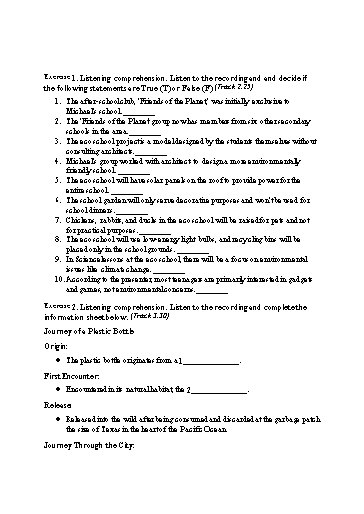
 ● Faces challenges from 3______________ who reject single-use plastics.
 ● Narrow escape in the 4______________ neighborhoods of the city.
Park Adventure:
 ● Not safe even in the local park due to threats from the 5______________ park
 warden and playful 6______________.
Countryside Expedition:
 ● Continues its migration through 7______________, city streets, orchards, and
 meadows.
 ● Faces threats from 8______________ who may attach it to a pole.
Stream Escape:
 ● Finds an escape in a stream, flowing towards the 9______________.
Ocean Voyage:
 ● Moves closer to the open sea and ultimately reunites with millions of its
 species in the 10______________ Garbage Patch.
 ● The final destination is the Great Pacific Garbage Patch, where it will live
 alongside other plastic waste.
Conclusion:
 ● The plastic bottle is non-biodegradable and will break into tiny pieces, entering
 the marine life’s 11______________. P: Very good. So what other plans do you have to make the school more environmentally
friendly?
M: We’ll use low-energy light bulbs in all the classrooms. We’ll also have recycling bins in
every classroom and in the school grounds.
P: And what about your lessons – will they be different from non-eco schools?
M: Most of our lessons will be similar to lessons in any secondary school. But in our Science
lessons we’ll focus more on environmental issues like climate change and global warming.
Then, in our Technology lessons we’ll learn about things like renewable energy and even
how to make solar panels.
P: I see. Well, we’ve almost run out of time. Thank you for talking to us about your project.
It’s very nice to meet a teenager who is so concerned about the environment. In my
experience, most seventeen- and eighteen-year-olds are only interested in gadgets and games.
M: Well, I like gadgets and games too, but I probably worry about the environment more
than my friends
Exercise 2.
 A plastics factory is the breeding ground for the familiar species, the plastic bottle. It
hatches here in safety before being filled with water and going out into the big wide world. We
first encounter our plastic bottle in its natural habitat, the supermarket.
 Once the water has been consumed, the bottle is discarded and released into the wild.
It encounters many predators on its journey to its final destination, a garbage patch the size of
Texas in the heart of the Pacific Ocean.
 As the bottle fights its way through the city, the ecowarrior is one of its most dangerous
enemies and may one day be responsible for its extinction. Ecowarriors reject single-use
plastics, claiming that plastic contamination is doing irreparable damage to the environment.
After a narrow escape our plastic bottle continues to make its way through the leafy
neighbourhoods of the city.
 You’d think our plastic bottle would be safe in the local park but no – the litter-
collecting park warden hunts the bottle and tries to catch it with his weapon. Our plastic bottle
knows that the park warden will not stop until it’s in captivity. Another dangerous enemy often
encountered in the park is the child. They love to play with their prey, kicking it around the
playground.
 But our brave bottle is still on the loose, continuing its miraculous migration through
built-up areas, down city streets and out into the orchards and meadows of the open
countryside. The farmer is the next threat to the survival of our plastic bottle. Many of the
species end up attached to a pole to scare off birds that come and eat the seeds on a freshly
ploughed field, or stuck forever in a ditch. But not our bottle – it continues its journey.
 In areas of natural beauty, the plastic bottle feels unwelcome. Fortunately, a gust of
wind picks it up and drops it in a stream where the bottle floats on the surface. The stream
flows out of the foothills and into the plain where it becomes a river. The river currents move
it ever closer to the open sea where it will be reunited with millions of its own species who
have, like our bottle, been set free to roam the Californian landscape. The sea is close now – it
can feel it.
 The bottle will now continue its journey across the ocean to the Great Pacific Garbage
Patch which has a thriving population of millions of tons of plastic waste. Our bottle will never
disappear completely because it isn’t biodegradable but will live alongside other plastic waste
before breaking into tiny pieces, entering marine life’s food chain and completing the cycle of
life.
File đính kèm:
- bai_tap_tieng_anh_lop_11_global_success_unit_5_phan_listenin.docx
 Track 2.25.mp3
- Track 3.30.mp3


