

Bài tập Tiếng Anh Lớp 11 Global Success - Unit 6: Global warming (Kèm đáp án)
 13 trang
09/11/2025
2640
13 trang
09/11/2025
2640
Bạn đang xem tài liệu "Bài tập Tiếng Anh Lớp 11 Global Success - Unit 6: Global warming (Kèm đáp án)", để tải tài liệu gốc về máy hãy click vào nút Download ở trên.
Tóm tắt nội dung tài liệu: Bài tập Tiếng Anh Lớp 11 Global Success - Unit 6: Global warming (Kèm đáp án)
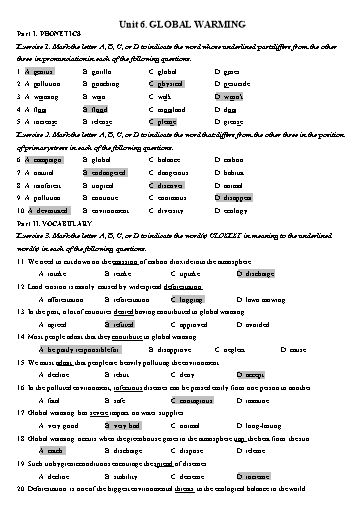
 A. sureties B. certainties C. dangers D. safety
21. As fossil fuel resources are running out, it is important for the government to find some types of alternative
energy.
 A. irreplaceable B. substitute C. impossible D. practical
22. Local people have cut down the forests to make way for farming.
 A. allow farming to take place B. lose way in farming
 C. have a way of farming D. give way to farming
23. Because farmers had been informed about the bad effects of chemical fertilisers, they started using them
sparingly on their farms.
 A. carelessly B. moderately C. recklessly D. irresponsibly
24. Global warming is one of the biggest issues facing humans nowadays.
 A. causes B. factors C. concerns D. agreements
25. The biggest cause of global warming is carbon dioxide emissions from coal burning power plants.
 A. fauna B. flora C. trees D. factories
26. Global warming effects on people and nature are catastrophic.
 A. destructive B. constructive C. evaluative D. creative
27. Coal burning releases a large amount of carbon dioxide into the atmosphere.
 A. discourages B. reduces C. relaxes D. discharges
28. The demand for cars is increasing rapidly in the modern world.
 A. need B. offer C . reply D. discovery
29. Forests absorb and capture carbon dioxide from the atmosphere.
 A. take up B. take in C. take over D. take to
30. The process of forests absorbing carbon dioxide from the atmosphere has been disrupted by the current
alarming rate of deforestation.
 A. discussed B. discovered C. disturbed D. distributed
31. Flood and drought are two major causes of famine.
 A. family B. obesity C. hygiene D. hunger
32. Water shortages are likely to delay economic growth and damage ecosystems.
 A. aid B. advance C. deter D. defer
33. It is important to maintain the biological diversity of the rainforests.
 A. similarity B. identity C. variety D. compatibility
34. We may help if we cut down on energy use by using LED lightbulbs and unplug unused electronic devices.
 A. reuse B. reduce C. recycle D. reproduce
35. Reusing and recycling glass, plastic, paper and other products help to reduce waste and pollution, and
conserve natural resources.
 A. preserve B. reserve C. converse D. reverse
36. The thick layer of global warming gases keeps more heat from the sun, which leads to the increase in the
earth temperature. 52. Humans now have to suffer the effects of global warming due to having treat the environment irresponsibly.
 A B C D
53. Having denied the responsibility for the environmental it caused, the factory was forced to close down.
 A B C D
54. Having been warn about the relationship between climate change and the spread of infectious diseases,
 A B C
everyone should get vaccinated.
 D
55. These companies were accused on having released a large amount of carbon dioxide into the atmosphere.
 A B C D
56. Having deciding on the topic of the presentation, he started finding relevant information for it.
 A B C D
57. Having known about the harmful affects the company had on our neighbourhood, we decided to boycott its
 A B C D
products.
58. Having signed an agreement to reduce carbon dioxide emissions, we were determined to help reduced
 A B C D
global warming.
59. Having identified the most urgent environmental problems, they start working out all possible solutions.
 A B C D
60. Having spent all their saving money, they started do some odd jobs to make ends meet.
 A B C D
61. Having cutting down many trees in the area, now the people here have to suffer really hot summers.
 A B C D
62. Having decided to use public transport instead private transport, we were determined to reduce carbon
 A B C D
footprints.
63. Having cycled to work every day, I become more responsibly for the environmental issues.
 A B C D
64. Having watched TV programmes about the farmers' careless use of chemical fertilisers on they crops, many
 A B C
citizen dwellers decided to grow their own vegetables.
 D
65. Having suffered water shortage in the past, we are all very economic on using water.
 A B C D
66. Having change our attitude to nature, we started changing our behaviours as well.
 A B C D
Exercise 6. Mark the letter A, B, C, or D to indicate the correct answer to each of the following questions. A. shared B. sharing C. share D. shares
85. He regretted ____ killed and eaten several rare species.
 A. to have B. having C. have D. has
86. His company was fined ____ dumped tons of toxic waste near the residential area.
 A. to have B. because of having C. for having D. of having
87. These students were rewarded ____ actively taken part in voluntary activities.
 A. with B. before C. on having D. for having
88. She was praised ____ donated a lot of money to the wildlife protection organisation.
 A. for having B. to have C. because of having D. due to having
89. I remember ____ advised you to stop hunting endangered animals.
 A. to have B. having C. have D. had
90. The local authorities were blamed ____ ignored the pollution issues in the area.
 A. about having B. on having C. for having D. before having
Part IV. SPEAKING
Exercise 7. Mark the letter A, B, C, or D to indicate the correct response to each of the following exchanges.
Two friends Nam and Lan are talking about the topic of global warming.
91. Nam: What are the main threats to the environment today?
 Lan: ____
 A. Threats are possible dangers to the environment.
 B. Probably deforestation and global warming.
 C. Environmental pollution is a big issue for our planet
 D. We need a clean environment to live in.
92. Lan: How can ordinary people help protect the environment?
 Nam: ____
 A. What can ordinary people do to help the environment?
 B. Environment really needs our help.
 C. We may use environmentally-friendly products.
 D. Both governments and individuals are to blame on.
93. Nam: Do you do anything to protect the environment?
 Lan: ____
 A. I refuse to use plastic bags and try to recycle as much as possible.
 B. I use a lot of plastic bags and containers to save the environment.
 C. I'm not interested in the subject of environment.
 D. I don't want to change my lifestyle.
94. Lan: What solution to air pollution can you suggest?
 Nam: ____
 A. Air pollution is really serious these days.
 B. Smoke from factory chimneys pollutes the air. 101.Lan: What can government do to punish factories that violate environmental law?
 Nam: ____
 A. So many of them are polluting the environment.
 B. Yes, I think a big fine would be relevant.
 C. They may force those factories to close down.
 D. There are no factories in this region.
102. Lan : Who has to suffer global warming effects the most?
 Nam: ____
 A. What are global warming effects?
 B. Maybe poor people in low-lying areas.
 C. All people suffer from global warming.
 D. Only few people benefit from global warming.
103. Lan: How can we help to fight deforestation?
 Nam: ____
 A. We may recycle paper and buy recycled paper products.
 B. We may cut down trees at an alarming rate.
 C. We should only cut branches of big trees.
 D. We should set up animal ranches near forests.
104. Nam: What will happen if the low-lying areas are flooded?
 Lan: ____
 A. Low-lying areas are often flooded.
 B. Flood happens when water level rises.
 C. Low-lying areas can never be flooded.
 D. People in these regions will have to face a lot of problems.
105. Lan: What do you do to help the environment?
 Nam: ____
 A. It is the responsibility of the government.
 B. I try to recycle more and reduce carbon footprint.
 C. Everyone can protect the environment.
 D. Environment helps people live comfortably.
Part V. READING
Exercise 8. Read the following passage and mark the letter A, B, C, or D to indicate the correct word or
phrase that best fits each of the numbered blanks.
 ENVIRONMENTAL CRIME
 We are probably all (106) ____ at some point in our lives of not caring for the environment as much as
 we should. Perhaps we drop litter without thinking, or cause (107) ____ by using our cars when it's not
 necessary. However, the real environmental (108) ____ are those big businesses which ignore the law.
 For many years now, (109) ____ have attempted to protect the environment by making businesses A. Environment pollution is real. B. Reasons why low-lying areas are flooded.
 C. Solutions to global warming. D. Reasons why global warming is a problem.
119. Which of the following is TRUE as the result of global warming?
 A. All people suffer from global warming. B. All people benefit from global warming.
 C. Life is more difficult for the majority of people. D. Life is easier for most people.
120. In paragraph 1, the word “this” refers to ____.
 A. harder life as a result of global warming B. easier life as a result of global warming
 C. climate change on global scale D. flood in low-lying areas
121. In paragraph 2, the word “erratic” is closest in meaning to ____.
 A. predictable B. unpredictable C. changeable D. unchangeable
122. According to the passage, all of the following are the results of global warming EXCEPT ____.
 A. higher temperature B. coastal erosion
 C. increasing sea level D. stable rainfall
123. What may happen to diseases and insect pests as a result of global warming?
 A. They will become extinct. B. They will increase in number.
 C. They will not harm our planet. D. They will be under good control.
Exercise 10. Read the following passage and mark the letter A, B, C, or D to indicate the correct answer to
each of the questions.
 The Amazon rainforest is home to more than a third of all the world's species of plants, birds and
 animals. Twenty per cent of all the birds in the world live in the rainforest. Scientists have discovered
 thousands of types of plants and animals that can only be found there. There are thousands - probably
 millions more that we haven't discovered yet. There are at least 2.5 million species of insects there.
 Imagine what would happen if they all lost their home? It couldn't happen, could it? Unfortunately, it's
 happening right now. Yet, the rainforest is big. But it's getting smaller. The problem is that people are
 cutting down the trees, mainly to make room for cows. These provide meat and make money for their
 owners. This process of cutting down trees is called ‘deforestation'.
 The good news is that it is slowing down. In 2004, for example, more than 27,000 square kilometres
 were cut down. That's an area bigger than Wales. In 2006, because of all the campaigns to save
 rainforest, it dropped to just over 13,000 square kilometres. The bad news is that it's not enough.
 Scientists predict that by 2030, the rainforest will have become smaller by 40%. It's possible that by the
 end of the 21st century, the rainforest will have completely disappeared. With deforestation, thousands
 of the animals, birds, fish and plants that live in the Amazon rainforest lose their home, their natural
 habitat. Some of them move to other areas, but most of them die. Many species have already become
 extinct, and many more will if deforestation continues. That will change the balance of life in the
 rainforest and could cause enormous problems to the region's ecosystem.
 There's another problem too. Trees and plants are a vital source of oxygen. If we cut them down, we
 lose that oxygen. But it's worse than just that. With deforestation, the trees and plants are burnt. This
 sends gases into the Earth's atmosphere, which stops some of the Earth's heat escaping. That then leads 133. The increase in earth's temperature can cause heat-related illnesses.
 A. Heat-related illnesses result from the increase in earth's temperature.
 B. Heat-related illnesses result in the increase in earth's temperature.
 C. Heat-related illnesses lead to the increase in earth's temperature.
 D. Heat-related illnesses trigger the increase in earth's temperature.
134. Carbon dioxide is one of the primary greenhouse gases that cause global warming.
 A. Carbon dioxide is the only greenhouse gas that causes global warming.
 B. Global warming results in greenhouse gases, including carbon dioxide.
 C. One of the main greenhouse gases that lead to global warming is carbon dioxide.
 D. Global warming causes greenhouse gases, including carbon dioxide.
135. Planting trees can contribute to reducing global warming.
 A. Global warming can't be controlled by planting trees.
 B. Planting trees is the only way to control global warming.
 C. Planting trees can accelerate global warming.
 D. Planting trees can help reduce global warming.
Exercise 12. Mark the letter A, B, C, or D to indicate the sentence that best combines each pair of sentences
in the following questions.
136. He said that he would take responsibility for his company's damage to the area. But then he denied that.
 A. Having denied his company's damage, he took responsibility for it.
 B. He denied having damaged to his company's area.
 C. He denied having taken responsibility for the damage to his company's area.
 D. He denied having said that he would take responsibility for his company's damage to the area.
137. He donated a lot of money to environmental protection campaigns. He was admired for that.
 A. Unless he donated a lot of money to environmental protection campaigns, he was admired.
 B. He was admired for having donated a lot of money to environmental protection campaigns.
 C. If he had donated a lot of money to environmental protection campaigns, he would have been
 admired.
 D. If he donates a lot of money to environmental protection campaigns, he will be admired.
138. They decided to cut down their carbon footprints. They were praised for that.
 A. They were praised for having decided to decrease their carbon footprints.
 B. They were not punished for having decided to decrease their carbon footprints.
 C. Unless they decided to cut down their carbon footprints, they were praised for that.
 D. If they decided to cut down their carbon footprints, they would be praised for that.
139. We have advised you on how to cut down your energy use. We remember that.
 A. We can no longer remember having advised you on how to decrease your energy use.
 B. We remember having advised you on how to maintain your energy use.
 C. We remember having advised you on how to decrease your energy use.
 D. We remember to have advised you on how to decrease your energy use.
File đính kèm:
- bai_tap_tieng_anh_lop_11_global_success_unit_6_global_warmin.doc


