

Bài tập Tiếng Anh Lớp 11 Global Success - Unit 6: Preserving our heritage (Có đáp án)
 14 trang
08/11/2025
8521
14 trang
08/11/2025
8521
Bạn đang xem tài liệu "Bài tập Tiếng Anh Lớp 11 Global Success - Unit 6: Preserving our heritage (Có đáp án)", để tải tài liệu gốc về máy hãy click vào nút Download ở trên.
Tóm tắt nội dung tài liệu: Bài tập Tiếng Anh Lớp 11 Global Success - Unit 6: Preserving our heritage (Có đáp án)
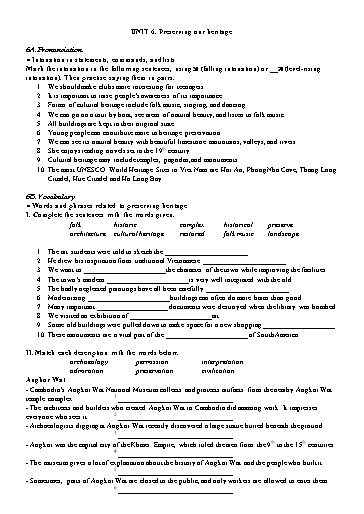
 III. Fill in each blank in the passage with the correct word / phrase below.
 temples community designs merchant pillars
 merchant ships attractions trading port destination objects
 The ancient town of Hoi An lies on the Thu Bon River, 30 km south of Da Nang. It was formerly
a major 1 _________________ in Southeast Asia between the 16th and the 17th centuries. Hoi An was also
an important centre for Dutch, Portuguese, Italian, Chinese, Japanese and other 2 _________________
from the Far East.
 Hoi An is famous for its old 3 _________________, pagodas, ancient homes and narrow streets.
All the houses were made of wood and their 4 _________________ were carved with ornamental 5
_________________.
 One of the main 6 _________________ of Hoi An is the Japanese Bridge, which was built in the
16th century and is still well-preserved. All visitors to Hoi An are recommended a visit to the Assembly
Hall of Cantonese Chinese Congregation. This house was built in 1855 and still keeps many precious 7
_________________ that belonged to the Chinese 8 _________________ of Hoi An. Another attractive
address to tourists is Tan Ky House, which was constructed nearly two centuries ago as a house for a
Vietnamese 9 _________________. The house now looks almost exactly as it did in the early 19th century.
 In recent years, Hoi An has become a popular tourist 10 _________________ in Viet Nam. In
1999, it was certified by UNESCO as a World Cultural Heritage Site.
IV. Complete the following sentences with the correct form of the words in brackets.
 1. In 1805, King Gia Long requested the building of a new, smaller citadel called Ha Noi Citadel
 with a new _________________ style. (architecture)
 2. The Complex of Hue Monuments is a _________________ of many royal monuments from the
 Nguyen Dynasty. (combine)
 3. As for me, the Citadel of the Ho Dynasty is one of the most _________________ destinations in
 Viet Nam because of its value. (attract)
 4. Homestay has become _________________ when historic travel is on the rise. (trend)
 5. _________________ of Cultural Heritage is an international degree programme at University of
 Bologna in Italy. (restore)
 6. Cat Ba Archipelago bears the exceptionally natural values with its _________________ forests
 which cover the limestone system and the mangrove wetlands. (tropic)
 7. Besides the _________________ value of geology, Phong Nha - Ke Bang is also favoured with
 the mysterious and majestic landscapes by nature. (history)
 8. Management and _________________ in Hoi An are further strengthened through master
 planning and action plans. (preserve)
● Prepositions
Complete each sentence with the correct preposition.
 1. The report offers suggestions ____________ improvement ____________ policy.
 2. The building is ____________ a bad state of repair.
 3. Businessmen can get opportunities to reach the public ____________ social media such as blogs,
 podcasts and other forms.
 4. Participants are encouraged to give voice ____________ their personal hopes, fears and dreams.
 5. It was a real team effort - everyone contributed something _________ the success of the project.
 6. Children can have fun and learn ____________ music at the same time.
 7. He already had an idea ____________ his next novel.
 8. She trained ____________ the race, sometimes running as much as 60 miles a week.
 9. We need to explain why these issues are important and relate them ____________ everyday life.
 10. The meeting was a social event ____________ retired people in the neighbourhood. IV. Rewrite the answers in the short exchanges using to-infinitive phrases.
Example: Why did you come here?
 - Because I wanted to see my friends.
 → I came here to see my friends.
 1. Q: Why do you go to the beach every weekend?
 A: Because I like swimming.
 → She _________________________________________________________________________
 2. Q: Why did you move to Ha Noi?
 A: I wanted to find work.
 → He _________________________________________________________________________
 3. Q: Why are you leaving home?
 A: I’m going to university in Tokyo.
 → She _________________________________________________________________________
 4. Q: Why are you having a party?
 A: It’s my seventeenth birthday, and I want to celebrate it.
 → He _________________________________________________________________________
 5. Q: Why do you get up at five every morning?
 A: I do my training then.
 → He _________________________________________________________________________
 6. Q: Why are you saving money?
 A: I want to buy a new smartphone.
 → She _________________________________________________________________________
 7. Q: Why did you buy a new suit?
 A: I want to wear it at the office party.
 → He _________________________________________________________________________
 8. Q: Why did you turn on TV very late last night?
 A: We wanted to watch the World Cup final match.
 → They _______________________________________________________________________
6D. Reading
I. Match each of eight world heritage sites in Viet Nam with its description, writing the answer in
each blank.
 1. Complex of Hue A. The commercial activity of the port made it an
 Monuments important trade center from the 15th to the 19th century.
 Local and foreign traders have left their marks with
 numerous buildings that make up an exceptionally well-
 preserved ancient town.
 2. Ha Long Bay B. It remained its political center for 13 centuries. The
 central sector of the Citadel embodies a unique culture
 from the Red River area.
 3. Hoi An Ancient Town C. Developed from the 4th to 13th century, it consists of
 the remains of several temples. This site used to be the
 political and religious capital of the Champa Kingdom.
 4. Phong Nha-Ke Bang D. With several buildings remaining along the Huong
 National Park River of the Royal Citadel, the Imperial Enclosure, and
 the Forbidden City, it is the landmark of the imperial
 Vietnamese history, arts and architecture.
 5. My Son Sanctuary E. Situated in the south of the Red River Delta, it is a
 breathtaking area of limestone mountain surrounding low
 cultivated valleys. It is also the site of Hoa Lu, the ancient
 capital of Viet Nam from the 10th and 11th centuries. III. Read the passage about the Complex of Yen Tu Monuments and Landscape, and then answer
the questions.
 The Complex of Yen Tu Monuments and Landscape
 The Complex of Yen Tu Monuments and Landscape is located on the Dong Trieu Range, at the
intersection of two provinces: Quang Ninh and Bac Giang. Relics on and excavated under the ground in
the Complex of Yen Tu Monuments and Landscape have proved a long history of cultural exchanges in
the country. The heritage site, with dozens of pagodas, towers and small temples, and thousands of
antiquities - especially old books, preserves spiritual values of Truc Lam Zen Buddhism and the cultural
traces of the Dai Viet civilization. The values of Truc Lam Zen Buddhism and Dai Viet culture have been
kept throughout the history of Viet Nam, promoted to other countries in the world by generations of Zen
masters and will be retained in the future.
 Truc Lam is a pure Vietnamese Zen Buddhism which focuses on inner feelings but at the same
time enters into life with a forgiveness approach. Truc Lam aims to connect religion to life in a positive
way and builds a close link to true patriotism. King Tran Nhan Tong, the founder of Truc Lam, was the
one who collected a lot of older books to guide Buddhists and followers of Truc Lam Zen Buddhism on
how to practise their religion and become good people.
 Yen Tu is thought of as a natural ecological museum due to its rich bio-diversity. The natural
landscape of this place met the requirements of a Buddhism center, which was why it was chosen by
Vietnamese Buddhism followers as a place to come and build small temples covered with grass, to
practice their religion.
 1. What has proved that Yen Tu has a long history of cultural exchanges in the country?
_____________________________________________________________________________________
_____________________________________________________________________________________
 2. What attractions can visitors see at Yen Tu?
_____________________________________________________________________________________
_____________________________________________________________________________________
 3. What does the heritage site preserve?
_____________________________________________________________________________________
_____________________________________________________________________________________
 4. What does Truc Lam Zen Buddhism aim to do?
_____________________________________________________________________________________
_____________________________________________________________________________________
 5. What did King Tran Nhan Tong do for followers of Truc Lam Zen Buddhism?
_____________________________________________________________________________________
_____________________________________________________________________________________
 6. Why was Yen Tu chosen a Buddhism center?
_____________________________________________________________________________________
_____________________________________________________________________________________
IV. Read the text, and then do the tasks that follow.
 My Son Sanctuary
 Hidden away in the tropical forest near the port city of Da Nang and the very popular World
Heritage town of Hoi An is the Champa civilization’s sacred valley of My Son, or “Beautiful Mountain”.
I joined the full day package tour from Hoi An, which was quite very convenient as it included all
transportation, ticket fee, lunch and guide. I arrived in My Son around 10 o’clock. After walking for a
while, 1 found the complex of tourist facilities, and one of them is the performance hall. Our guide
insisted us keeping going into the forest. Within few minutes, I started to see the complex of ancient
Hindu temples made from brick.
 At first, the dilapidated state of the complex was quite shocking, and almost nothing was left to
see. I decided to discover the site by myself, and I started to be impressed by the amazing quality of brick ‘Our guide told us that the stones around the edge of Stonehenge are called sarsens and the largest
ones weighs more than 40 tons and is 3 ________________ feet high. They think the sarsens came from
quarries 25 miles away. However, the smaller ones, which are called bluestones and are In the middle of
the circle, were from the Presell Hills in Wales. I asked the guide If that was far away and he said it was
about 4 ________________ miles away! I can’t imagine how the stones were transported to Stonehenge
because they didn’t have any vehicles or machinery.’ Nick 14
 ‘The guide told us about the remains of a large prehistoric village that was discovered by
archeologists last year. It’s less than 5 ________________ miles from Stonehenge and they think it’s
where the builders lived when they were constructing the stone circle. He said that they’d found lots of
animal bones and pieces of broken pottery. I asked her if they’d had parties there and she thought that was
exactly what had happened.’ Cara, 14
 ‘Stonehenge was a place where the summer solstice, which is the longest day of the year in the
Northern Hemisphere, was celebrated. The guide told us that people still come today to celebrate it. They
meet very early in the morning and watch the sun rise over the stones. He said it was the most beautiful
thing in the world. He asked me if I’d ever seen it. I haven’t, but I’d really like to see it next June 6
___________________.’ Jane, 15
Task 1. Complete the text with the numbers below.
 24 200 1986 20th a million two
Task 2. Read the text, and mark the sentences true (T) or false (F).
 1. The pyramids in Egypt are older than Stonehenge. __________
 2. Stonehenge was built by UNESCO. __________
 3. Different types of stones were used by the builders. __________
 4. Some of the stones were carried a great distance. __________
 5. Experts have known about the village near Stonehenge for years. __________
 6. They believe that the builders who lived there used to have parties. __________
 7. Celebrating the summer solstice at Stonehenge is an old tradition. __________
 8. Jane went to Stonehenge last June. __________
VI. Read the article about the Moai, and do the tasks that follow.
 THE MYSTERIOUS MOAI
1. ______________________________
The Moai are beautiful stone statues that you can see on the Chilean island of Rapa Nui (Easter Island), in
the Pacific Ocean. There are 887 statues, and we know that the first ones were made about 1,00 years ago.
However, we don’t know very much about the people who made them, or the reasons why they made
them. The stones are a beautiful mystery.
2. ______________________________
The Moai are statues of men with very large heads, and smaller bodies and arms. Only one has legs and
feet.
3. ______________________________
We know that people used hand tools to make the stones because archeologists have found examples of
many old tools all over the island. They believed it must have taken about a year to make each statue,
with five or six people working on each one.
4. ______________________________
This is a more difficult question! Some of the statues are huge, and people can’t have carried them using
just their hands. The largest stones are nearly ten metres long, and weigh about 18,000 kilograms.
Professor Carla Lopez says, ‘The people must have had some way of moving these stones. Some
archeologists think they might have pulled the stones across the island using ropes. But the stones were so
heavy, it must have taken between 180 and 250 men to pull each one.’
5. ______________________________
File đính kèm:
- bai_tap_tieng_anh_lop_11_global_success_unit_6_preserving_ou.doc
- 18. UNIT 6. Preserving our heritage - KEY.doc


