

Bài tập Tiếng Anh Lớp 11 Global Success - Unit 7: Education options for school leavers (Có đáp án)
 10 trang
08/11/2025
9040
10 trang
08/11/2025
9040
Bạn đang xem tài liệu "Bài tập Tiếng Anh Lớp 11 Global Success - Unit 7: Education options for school leavers (Có đáp án)", để tải tài liệu gốc về máy hãy click vào nút Download ở trên.
Tóm tắt nội dung tài liệu: Bài tập Tiếng Anh Lớp 11 Global Success - Unit 7: Education options for school leavers (Có đáp án)
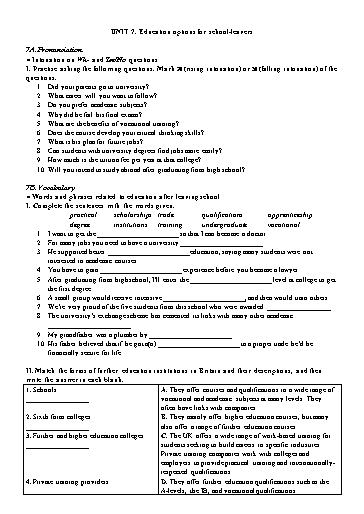
 5. Universities E. These colleges mainly cater for students aged 16-18 and
_________________ specialise in academic courses to prepare students for
 higher education.
III. Fill in each blank in the following sentences with the correct word below.
 experience degree institutions scholarship compulsory
 qualifications reports campus academic counsellor
 1. She wasn’t ________________ and hated school.
 2. In the USA, private colleges and universities are usually smaller than public ________________.
 3. A Bachelor’s degree is usually ________________ for higher-level positions.
 4. Just like American students, you will have to submit your academic ________________ as part of
 your application for admission to any American university or college.
 5. A ________________ provides you with information, advice and support with your application.
 6. They will participate in workshops and get hands-on ________________ leading classes.
 7. A foreign student can apply directly to an American university for aid, a ________________ or
 work-study option.
 8. International Baccalaureate (IB) and other international ________________ taught at International
 Schools in Viet Nam are equivalent to A-levels.
 9. On ________________ , students usually live in residence halls or dormitories that are often
 called “dorms”.
 10. A major at university is the specific field of study in which your ________________ is focused.
IV. Fill in each blank in the passage with the correct words below.
 requirement prepare academic year pursue proceed
 lasts undertake pre-university compulsory degrees
 School System of Singapore
 Education in Singapore is 1 ________________ for ten years, although university bound students
study for thirteen. Classes are taught in English and the 2________________ runs from July to April.
 Primary and secondary education 3 ________________ for ten years and is compulsory. At the
end of Grade 10, students sit the GCE O-level examinations. Students who complete secondary education
may 4 ________________ to pre-university education at the Junior Colleges, 5 ________________
certificate or diploma studies at one of the Polytechnics, or leave school and enter the workforce. In the
Singaporean education system, 6 ________________ education lasts for three years. These three years
will 7 ________________ students for the GCE A-level examinations.
 Upon completion of GCE A-levels, students may 8 ________________ a bachelor’s degree at one
of Singapore’s public or private universities, which is obtained after three to five years of study.
Bachelor’s 9 ________________ in Engineering, Dentistry, Law, Building, Real Estate, Music and
Architecture require four years, while Medicine requires five. The minimum English 10
________________ for entry to a bachelor’s degree is IELTS 6.0 or equivalent.
● Prepositions
V. Complete each sentence with the correct preposition.
 1. She applied ________________ a job with the local newspaper.
 2. His height and reach give him a big advantage ________________ other boxers.
 3. Farming is not an attractive career option ________________ many young people.
 4. It is hard for low-skilled workers to earn their way out of poverty ________________ a tough job
 market that favours skilled and educated workers.
 5. She would be their first choice ________________ the job.
 6. She received an honourary degree ________________ Harvard.
 7. It may be necessary ________________ him to have a training course for the job.
 8. She related rising unemployment rates directly ________________ government policies. 3. She had looked through the fashion magazines. She didn’t find the style that she liked.
_____________________________________________________________________________________
 4. I sat in the front row in the theatre. I saw everything beautifully.
_____________________________________________________________________________________
 5. The lion found his cage door open. He left the cage and walked slowly towards the zoo entrance.
_____________________________________________________________________________________
 6. I had heard that the caves were dangerous. I didn’t want to go any further without a torch.
_____________________________________________________________________________________
 7. The film star wore extremely fashionable clothes. She was surrounded by photographers and
 reporters.
_____________________________________________________________________________________
 8. He passed under a ladder. He got a pot of paint fallen on his head.
_____________________________________________________________________________________
 9. I had misunderstood the questions. I gave wrong answers to them.
_____________________________________________________________________________________
 10. We thought he would never survive. He had fallen from such a height.
_____________________________________________________________________________________
7D. Reading
I. Read the passage about further and higher education, and then answer the questions.
 The difference between higher and further education can be a common cause of confusion. Further
education is used to describe the education that occurs following compulsory post-16 secondary
education, which is usually distinct from that offered in universities (higher education). It includes a few
different levels such as A-Levels and Higher National Diplomas. Foundation Degrees are also a type of
further education and take 2 years to complete compared with the 3-4 years of most bachelor’s degrees
which are offered by both universities and colleges. Sometimes it is possible to extend a Foundation
Degree to a bachelor’s degree, with one year or more of extra study.
 Further education is usually taught in the sixth-form college part of a school or in independent
further education colleges, as well as in other work-based, adult and community learning institutions. In
the United States, further education is sometimes referred to as continuing education.
 Higher education primarily describes post-18 learning that takes place at universities, as well as
other colleges and institutions that award academic degrees, and professional qualifications. While higher
education is the common name in the UK and Ireland, it is also known as post-secondary, tertiary and
third level education.
 1. What can further and higher education be used to describe?
_____________________________________________________________________________________
 2. What levels does further education include?
_____________________________________________________________________________________
 3. How can students with a Foundation Degree get a bachelor’s degree?
_____________________________________________________________________________________
 4. Where can students attend further education?
_____________________________________________________________________________________
 5. What does higher education award students?
_____________________________________________________________________________________
II. Read the passage about studying abroad for Vietnamese students, and then answer the
questions.
 Viet Nam has a growing youth population, and this together with an increasing prosperous middle
class means that demand for university education is greater than ever before. A decade ago, fewer than
10,000 Vietnamese families could afford to send their child abroad to study. Today there are more than
100,000 Vietnamese international students around the world, most of whom are funded by their parents. 3. Where do most international students in Viet Nam come from?
_____________________________________________________________________________________
 4. What majors do they study?
_____________________________________________________________________________________
 5. What should the leading Vietnamese universities do to attract more international students?
_____________________________________________________________________________________
IV. Read the text about the IB and A-level programmes, and then decide whether the statements
are true (T), false (F) or not given (NG).
 Students in Singapore have the option of sitting for the Singapore-Cambridge A-level exam,
which is a different version of the international A-level examination. Has the International Baccalaureate
(IB) better than the A-levels in terms of preparing a student to enter a recognized and prestigious
university?
 It really depends on the student’s academic strengths. The IB is more about a comprehensive
educational style, while the A-levels puts more emphasis on individual subject knowledge. An IB student
must take six subjects, three at higher level and three at standard, which must include maths, a science,
English, and at least one foreign language, while A-levels with three subjects studied in depth. So, if
words aren’t the student’s strength, then the language component of the IB (including the compulsory
4000-word essay) may pull the student’s overall IB score down.
 On the other hand, if the student is well-rounded and copes confidently with Arts subjects as well
as Maths and Science, then the IB programme may be ideal for the learner. Experts believe the A-levels
give a student depth of knowledge, while the IB gives a broad education. They also believe that the IB
may prepare a child better for facing the challenges of a university education.
 If parents wonder if the IB would suit their child, they should talk to the teachers and their child
before coming to an educated and well-informed decision.
1. ___________ The Singapore-Cambridge A-level exam is conducted based on the international A-level
examination.
2. ___________ The IB is more suitable for all-around students, while the A-levels focus more on a
particular field.
3. ___________ The IB programme includes six subjects at international levels.
4. ___________ A student who is not very good at language write another document instead of the 4000-
word essay.
5. ___________ A-levels help students study three science subjects in depth.
6. ___________ The IB programme may be ideal for the learner who is good at both Arts subjects and
Science subjects.
7. ___________ The IB is not suitable for students who may meet some challenges at the university
environment.
8. ___________ Parents and teachers can decide whether the student should follow the IB or not.
V. Choose the word or phrase among A, B, C or D that best fits the blank space in the following
passage.
 Like any other universities, the Open University can give you a degree. However, you don’t have
to 1 _______ working to study. It can also open up a whole variety 2 _______ interest. If you have 3
_______ studied before, you will enjoy the special, new pleasure of 4 _______ your knowledge. You will
make friends of 5 _______ kinds. You may also 6 _______ that your qualification provides new career
opportunities.
 You don’t actually 7 _______ to the Open University for lectures, but study at home, using
television, radio and computer software. You can 8 _______ one class a month if you wish at an Open
University centre. Of course, there are exams to take, as in 9 _______ university. If you 10 _______ like to
know more, all you have to do is complete the form below. It could be the start of a wonderful new period
in your life. 5. As a foreign student, you can get involved in social activities quickly because _________.
 A. you can get support about British further education
 B. Britain is a multicultural society with much support from colleges
 C. the UK has a wonderful mix of different peoples from all over the world
 D. you can enjoy your time in British further education
7E. Speaking
● Everyday English
I. Choose the correct response. Then practise the short exchanges in pairs.
 1. A: Why do students take a gap year? B: a/ They want to gain experience.
 b/ They want to continue their education.
 2. A: Studying abroad costs a lot of money. B: a/ You should surf for more information.
 b/ You should apply for scholarships.
 3. A: I’ll go to college after high school. B: a/ Good for you. I go to a technical college.
 b/ Do you want to get a job soon?
 4. A: How about a credit-based course? B: a/ It takes more time to complete the course.
 b/ It’s the best choice for us now.
 5. A: I’d like to join in the student exchange B: a/ Wow. You can travel to several countries.
 programme. b/ Does your school have such a programme?
 6. A: Have you ever used the cloud? B: a/ Yes, I used it when I forgot my USB.
 b/ Yes, it was a day of nice weather.
 7. A: My uncle is a worker, but he wants to B: a/ He can work on his own at home.
 follow higher education. b/ I think he can take distance education.
 8. A: Do you like cloud learning? B: a/ I prefer campus life with social activities.
 b/ Yes, face-to-face teaching and learning is the
 best choice.
 9. A: My brother follows postgraduate B: a/ He should study them at the same time.
 education when he gets a BA degree. b/ He should gain some experience first.
 10. A: Nam tries to get seven credits this year. B: a/ I think he shouldn’t push himself hard.
 b/ I think he tries to pass the entrance exam.
● Vocational training vs. academic study
II. Complete the dialogue with the phrases below. There is one extra that you do not need.
 A. What do you think is the second benefit?
 B. Vocational schools attract students from many regions and countries.
 C. There are several benefits for those who want to become qualified manual labourers in the
 future.
 D. Why do workers with vocational training get a job easily?
 E. Why do you think so?
 F. Some of the young people cannot afford to pursue their university.
Phong: Nowadays many people go to university for academic study.
Nick: But in fact more people should be encouraged to do vocational training because there is a lack of
qualified workers such as electricians or plumbers.
Phong: 1 __________?
Nick: First, nowadays employers place more emphasis on experience than knowledge at university. In
order to get well-paid jobs, students should study practical courses and work as part-time workers besides
studying subjects at school.
Phong: 2 __________?
Nick: Second, many people after graduating from college cannot make a living, or even do not have a
job. By encouraging people to take vocational courses, there would be less unemployed workers, and
fewer crime cases.
File đính kèm:
- bai_tap_tieng_anh_lop_11_global_success_unit_7_education_opt.doc
- 21. UNIT 7. Education options for school-leavers - KEY.doc


