

Bài tập Tiếng Anh Lớp 11 Global Success - Unit 7: Education options for school leavers (Có file nghe và đáp án)
 16 trang
09/11/2025
2356
16 trang
09/11/2025
2356
Bạn đang xem tài liệu "Bài tập Tiếng Anh Lớp 11 Global Success - Unit 7: Education options for school leavers (Có file nghe và đáp án)", để tải tài liệu gốc về máy hãy click vào nút Download ở trên.
Tóm tắt nội dung tài liệu: Bài tập Tiếng Anh Lớp 11 Global Success - Unit 7: Education options for school leavers (Có file nghe và đáp án)
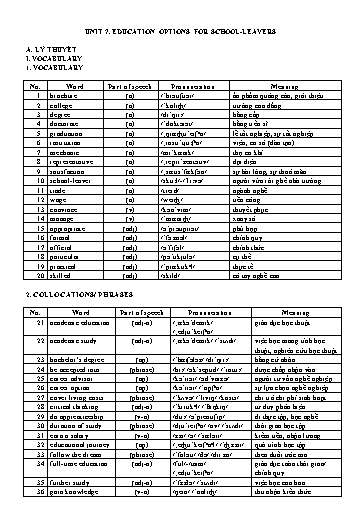
 37. give opinion (v-n) /ɡɪv/ /əˈpɪnjən/ đưa ra ý kiến
 38. grow sb’s business (v-n) /ɡrəʊ/ /ˈbɪznɪs/ phỏt triển việc kinh doanh
 của ai
 39. hands-on (adj-n) /hổndz/-/ɒn/ kinh nghiệm thực hành
 experience /ɪksˈpɪərɪəns/
 40. higher education (adj-n) /ˈhaɪər/ /ˌedjʊˈkeɪʃᵊn/ giỏo dục đại học
 41. job market (np) /ʤɒb/ /ˈmɑːkɪt/ thị trường việc làm
 42. job-specific skill (adj-n) /ʤɒb/-/spɪˈsɪfɪk/ /skɪl/ kĩ năng cho một ngành
 nghề cụ thể
 43. master’s degree (phrase) /ˈmɑːstəz/ /dɪˈɡriː/ bằng thạc sĩ
 44. on the job (phrase) /ɒn/ /ðə/ /ʤɒb/ khi làm việc
 45. research skill (np) /rɪˈsɜːʧ/ /skɪl/ kĩ năng nghiờn cứu
 46. sixth-form college (adj-n) /sɪksθ/-/fɔːm/ /ˈkɒlɪʤ/ trường cao đẳng hỡnh thức
 thứ sỏu (16-19 tuổi) chuẩn
 bị cho học sinh vào cỏc
 trường đại học
 47. take a year off (phrase) /teɪk/ /ə/ /jɪər/ /ɒf/ nghỉ một năm
 48. university entrance (np) /ˌjuːnɪˈvɜːsəti/ /ˈentrəns/ kỳ thi tuyển sinh đại học
 exam /ɪɡˈzổm/
 49. vocational (adj-n) /vəʊˈkeɪʃənl/ giỏo dục nghề nghiệp
 education /ˌedjʊˈkeɪʃᵊn/
 50. career education (np) /kəˈrɪər/ /ˌedjʊˈkeɪʃᵊn/ giỏo dục nghề nghiệp
 51. technical education (adj-n) /ˈteknɪkəl/ /ˌedjʊˈkeɪʃᵊn/ giỏo dục kỹ thuật
 52. vocational school (adj-n) /vəʊˈkeɪʃənl/ /skuːl/ trường dạy nghề
 53. vocational training (adj-n) /vəʊˈkeɪʃənl/ /ˈtreɪ.nɪŋ/ đào tạo nghề
 54. get into (vp) /ɡet/ /ˈɪntuː/ được nhận vào (trường)
 55. focus on (vp) /ˈfəʊkəs/ /ɒn/ tập trung
 56. apply for (vp) /əˈplaɪ/ /fɔː/ ứng tuyển
 57. succeed in (vp) /səkˈsiːd/ /ɪn/ thành cụng
 58. related to (vp) /rɪˈleɪtid/ /tuː/ liờn quan đến
 59. education fair (np) /ˌeʤʊˈkeɪʃᵊn/ /feə/ hội chợ giỏo dục
 60. earn high grades (phrase) /ɜːn/ /haɪ/ /ɡreɪdz/ đạt điểm cao
3. WORD FORMATION
 No. Word Part of speech Pronunciation Meaning
 61. academic (adj) /ˌổkəˈdemɪk/ cú tớnh chất học thuật
 62. academy (n) /əˈkổdəmi/ học viện
 63. advice (n) /ədˈvaɪs/ lời khuyờn
 64. advisor (n) /ədˈvaɪzə/ cố vấn
 65. apprentice (n) /əˈprentɪs/ người học việc
 66. apprenticeship (n) /əˈprentɪʃɪp/ sự học việc/ học nghề, thời gian
 học nghề
 67. critic (n) /ˈkrɪtɪk/ nhà phờ bỡnh
 68. critical (adj) /ˈkrɪtɪkᵊl/ cú tư duy phản biện
 69. doctor (n) /ˈdɒktə/ tiến sĩ
 70. doctorate (n) /ˈdɒktərət/ bằng tiến sĩ
 71. profession (n) /prəˈfeʃᵊn/ nghề nghiệp
 72. professional (adj) /prəˈfeʃᵊnᵊl/ chuyờn nghiệp
 73. qualification (n) /ˌkwɒlɪfɪˈkeɪʃᵊn/ trỡnh độ chuyờn mụn 2. MỆNH ĐỀ PHÂN TỪ HOÀN THÀNH
a. Định nghĩa:
 Phõn từ hoàn thành cú dạng giống với danh động từ hoàn thành (Having + quỏ khứ phõn từ)
b. Cỏch dựng:
 STT Cỏch dựng Vớ dụ
 1 Diễn tả hành động đó xảy - Having finished homework, he watched TV.
 ra trước hành động ở Làm xong bài tập về nhà, anh ấy xem tivi.
 mệnh đề chớnh - Having completed his bachelor’s degree, he was ready to get
 further education options.
 Sau khi hoàn thành bằng cử nhõn, anh ấy sẵn sàng để cú được cỏc
 lựa chọn học tập cao hơn.
 - Having explored various education options, she decided to enroll
 in a local community college.
 - Sau khi khỏm phỏ nhiều lựa chọn giỏo dục khỏc nhau, cụ quyết
 định đăng ký vào một trường cao đẳng cộng đồng ở địa phương.
 2 Nờu lý do cho hành động - Having not noticed the message, he did not come to meet us.
 ở mệnh đề chớnh Vỡ khụng để ý đến tin nhắn nờn anh ấy khụng đến gặp chỳng tụi.
 - Having experienced challenges in traditional classes, they opted
 for online education.
 Vỡ đó trải qua những thỏch thức trong cỏc lớp học truyền thống
 nờn họ đó chọn giỏo dục trực tuyến.
B. THỰC HÀNH
I. PRONUNCIATION
Task 1. Find the word whose underlined part differs from the other three in pronunciation in each
of the following questions.
1. A. college B. wage C. graduation D. manage
2. A. trade B. accepted C. salary D. career
3. A. sensible B. degree C. apprentice D. professional
4. A. advice B. qualify C. living D. opinion
5. A. business B. advisor C. sense D. hands-on
6. A. cost B. doctorate C. job D. convince
7. A. academic B. dream C. study D. educational
8. A. bachelor B. technical C. school D. mechanic
9. A. cover B. specific C. critical D. particular
10. A. master B. market C. apprentice D. option
Task 2. Find the word that differs from the other three in the position of stress in each of the
following questions.
1. A. vocation B. sensible C. salary D. qualify
2. A. critical B. doctorate C. business D. apprentice
3. A. leaver B. college C. degree D. brochure
4. A. manage B. formal C. exam D. entrance
5. A. bachelor B. mechanic C. critic D. technical
6. A. knowledge B. master C. option D. convince
7. A. academic B. professional C. appropriate D. particular
8. A. experience B. institution C. apprenticeship D. vocational
9. A. specific B. practical C. duration D. advisor
10. A. follow B. further C. advice D. doctor
II. VOCABULARY gain knowledge grow business cover living cost(s)
 earn a salary give opinion(s)
1. Having completed his study, he started to _____________________ as an engineer. He can get 6
million dong each week.
2. Part-time jobs can help students _____________________ while attending college.
3. Higher education provides an opportunity for students to ___________________ in their chosen field.
4. With a master’s degree in business administration, she wanted to _____________________ her own
_____________________.
5. When pursuing higher education, students are encouraged to _____________________ their
_____________________ and participate in meaningful discussions.
Task 5. Complete each sentence with one suitable phrase from the box.
 get into succeed in related to focus on apply for
1. School-leavers should _____________________ their interests and strengths when choosing their
educational path.
2. It’s challenging to _____________________ a good university, but with hard work, it’s possible.
3. With great effort, students can _________________ their chosen field of study and achieve their goals.
4. Choosing a career _____________________ your passions can make the learning experience more
enjoyable.
5. After leaving high school, he plans to _____________________ vocational training to become a
skilled mechanic.
Task 6. Choose the correct word to complete each sentence.
1. It’s sensible / particular to manage your money carefully before starting your journey to higher
education.
2. She is excellent in her professional / academic studies, earning top grades in all her classes.
3. It is skilled / appropriate to wear formal clothes when people attend interviews.
4. The formal / practical skills learned in engineering courses are essential for solving real-life problems.
5. She gained valuable experience on / in the job while working part-time as a waitress.
6. Students can manage / convince to work 2 part-time jobs to pay for their living costs.
Task 7. Complete each sentence using the correct form of the word in brackets.
1. Her _____________________ achievements in high school helped her get into a famous university.
(ACADEMY)
2. _____________________ schools provide hands-on training for specific careers. (VOCATION)
3. Having a degree is a common _____________________ for many jobs. (QUALIFY)
4. She received her _____________________ in chemistry after conducting a great research. (DOCTOR)
5. Developing _____________________ skills during college can help you succeed in your career.
(PROFESSION)
6. Developing _____________________ thinking skills is essential for higher education to deal with
complex problems. (CRITIC)
7. The career _____________________ helped students with their plans after high school graduation.
(ADVICE)
8. Completing an _____________________ is a great way to gain practical experience in your field.
(APPRENTICE)
III. GRAMMAR
Task 1. Complete the sentences with the correct form of perfect gerund of the verbs in brackets.
1. He denied _____________________ in the university entrance exam. (CHEAT)
2. _____________________ the first place at the computer science competition made him proud. (WIN) 1. A. accept B. accepted C. accepting D. to accept
2. A. do B. play C. make D. take
3. A. group B. groups C. is grouped D. are grouped
4. A. on B. in C. for D. of
5. A. to buy B. to prefer C. to offer D. to refer
6. A. with B. on C. in D. through
7. A. use B. using C. used D. to use
8. A. nevertheless B. so that C. but D. otherwise
9. A. for B. into C. at D. out of
10. A. which B. that C. who D. when
Task 2. Read the following passage and choose the correct answer to each of the following
questions.
 Vocational learning opportunities play a critical role in skill development. In non- vocational
studies, students often spend hours of their time exploring a variety of different subjects. Their class time
tends to be only a few hours per week, as they will spend many hours in the library and on computers
conducting research and writing papers that help them continue to build their theoretical knowledge in a
variety of fields.
 Even within their chosen discipline, they often spend a significant amount of time exploring
theory and ideas used by other professionals in the industry. They have significantly fewer opportunities
to actually put these ideas to work compared to students going through a vocational education situation.
The skills for work and vocation are significantly limited for these students, as their theoretical
knowledge does not have the work experience that helps them transition from a classroom study topic
into their actual profession. This can sometimes cause challenges when the students graduate and
transition into the working world.
 However, for students in vocational education and training, this situation gets corrected. Students
spend hours in the practical workshops each week learning hands-on practical skills related to their
chosen field. Class time tends to increase in these schools, compared to their outside research time,
because students spend more time exploring actual work opportunities that prepare them for their future
jobs. They do not focus as much time on researching the theoretical as learning the practical.
 Students also have courses that will help them use the highly specialised equipment that they need
to do their jobs well. Rather than simply learning about this type of equipment or how it might be useful
in the job, they actually have the chance to try out their own skills while still in school. When the time
comes for them to transition to an actual job, they have the experience they need to begin the job right
away. They will not have to spend time learning how to physically operate the equipment on the job,
allowing them to become a valuable employee and build a career faster.
 Source: https://hospitalityinsights.ehl.edu/vocational-training-career-development
1. Which of the following can be the best title for the passage?
 A. Challenges in Moving from Theory to a Profession
 B. Benefits of Vocational Education
 C. Importance of Specialised Equipment in Vocational Learning
 D. Drawbacks of Non-vocational Studies
2. What do non-vocational students mainly explore within their discipline?
 A. practical skills B. research opportunities
 C. theories and ideas D. specialised equipment
3. How does vocational education help with the transition to work?
 A. by providing lots of theoretical knowledge
 B. by reducing class time
 C. by offering more research opportunities
 D. by providing practical work experience ___________ 5. People with a master’s degree have a higher unemployment rate than those with a
bachelor’s degree.
___________ 6. Healthcare is the main factor in career satisfaction for individuals with graduate degrees.
___________ 7. People with master’s degrees earn over $250 less per week than those with bachelor’s
degrees.
___________ 8. Master’s-level jobs generally offer more benefits.
V. WRITING
Task 1. Complete the following sentences using the given words. Change the form of the verb if
necessary.
1. His / father / regretted / not / gone / university.
_____________________________________________________________________________________
2. Many / school-leavers / choose / go / university / study / academic / subjects.
_____________________________________________________________________________________
3. There / many / educational / opportunities / school-leavers / today.
_____________________________________________________________________________________
4. It I usually / take / at least / three years / complete / degree programmes / university.
_____________________________________________________________________________________
5. Not / having / ask / anyone / advice, / she / make / wrong / decision / education.
_____________________________________________________________________________________
Task 2. Finish the second sentence so that it has a similar meaning to the first one, beginning with
the given word(s).
1. She did not apply for universities. She chose a vocational school.
-> Not _______________________________________________________________________ school.
2. My friend took a boring course at university. He regretted it.
-> My friend ________________________________________________________________ university.
3. After he finished his master’s degree, he became a biologist.
-> Having __________________________________________________________________ biologist.
4. Nam borrowed my notebooks. He did not remember it.
-> Nam _____________________________________________________________________ notebooks.
5. He failed the university entrance exam, then he became a carpenter.
-> Having __________________________________________________________________ carpenter.
Task 3. Write a letter (150-170 words) to ask for information about a university course. You should
ask for qualifications, subjects and topics, optional courses, tuition fees, scholarships.
_____________________________________________________________________________________
_____________________________________________________________________________________
_____________________________________________________________________________________
_____________________________________________________________________________________
_____________________________________________________________________________________
_____________________________________________________________________________________
_____________________________________________________________________________________
_____________________________________________________________________________________
_____________________________________________________________________________________
_____________________________________________________________________________________
_____________________________________________________________________________________
_____________________________________________________________________________________
_____________________________________________________________________________________
_____________________________________________________________________________________
File đính kèm:
- bai_tap_tieng_anh_lop_11_global_success_unit_7_education_opt.doc
 5. GS11_L_Unit 7 Task 1.mp3
- 6. GS11_L_Unit 7 Task 2.mp3
- 7. GS11_S_Unit 7 Task 1.mp3
- 8. GS11_S_Unit 7 Task 2.mp3
- UNIT 7. EDUCATION OPTIONS FOR SCHOOL-LEAVERS - KEY.doc


