

Bài tập Tiếng Anh Lớp 11 Global Success - Unit 7: Further education (Kèm đáp án)
 12 trang
09/11/2025
2270
12 trang
09/11/2025
2270
Bạn đang xem tài liệu "Bài tập Tiếng Anh Lớp 11 Global Success - Unit 7: Further education (Kèm đáp án)", để tải tài liệu gốc về máy hãy click vào nút Download ở trên.
Tóm tắt nội dung tài liệu: Bài tập Tiếng Anh Lớp 11 Global Success - Unit 7: Further education (Kèm đáp án)
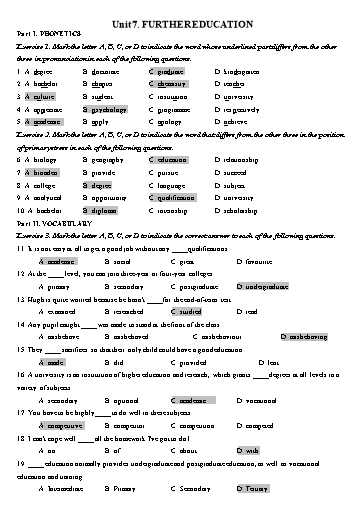
 20. You'll find plenty of books on the ____ of business studies in the library.
 A. lesson B. subject C. curriculum D. schedule
21. I wonder if you could tell me who was awarded the ____.
 A. scholar B. scholastic C. scholarship D. scholarly
22. My dad said that I'd better spend more time on my ____.
 A. student B. studied C. studious D. studies
23. He has got a degree ____ Information Technology from Oxford University.
 A. in B. for C. on D. of
24. I don't really ____ the point of taking the exam when you are not ready for it.
 A. annoy B. have C. see D. take
25. If you're not sure what “something” means, look it ____ in the dictionary.
 A. for B. out C. at D. up
26. Mrs Dawson said that we are ____ our lesson in the library next Monday.
 A. going B. having C. making D. reading
27. My dad wants me to go to university, but I'm in ____ minds about it.
 A. different B. my C. some D. two
28. Yesterday, we had a discussion ____ different cultures.
 A. about B. around C. for D. from
29. I still have a lot ____ about the English language.
 A. for learning B. of learning C. learning D. to learn
30. Belinda missed a few months of school because of illness and found it difficult to keep ____ with her
classmates.
 A. on B. off C. down D. up
31. If you need to ____ the teacher's attention, just put up your hand.
 A. attract B. pay C. take D. pull
32. I did six hours of ____ for the test, but I still failed.
 A. education B. survey C. revision D. training
33. Please, don't forget ____ your essays during Friday's lesson.
 A. hand in B. handing in C. to hand in D. to handing in
34. Australians and New Zealanders often have a/an ____ year before going to college or after finishing high
school to travel overseas independently.
 A. gap B. new C. busy D. graduation
35. It's my ____ ceremony next week; I think my parents are looking forward to it more than I am.
 A. graduation B. graduate C. graduating D. graduates
36. Going to university is expensive because in addition to the tuition ____, there are expenses for
accommodation, books, living costs, etc.
 A. grants B. fees C. fares D. scholarships
37. When I got to 16, some of my friends left school to get a job, but most ____. 52. You can have your book back now. I ____ it.
 A. have been reading B. have read C. had read D. read
53. You look upset. ____ you ____?
 A. Are – crying B. Do - cry C. Have - been crying D. Have - cried
54. How many times ____ you ____ that international conference?
 A. did – attend B. do - attend C. have - been attending D. have - attended
55. I ____ for my math textbook all day, but I ____ it yet.
 A. have been looking/haven't found B. have looked/haven't found
 C. have been looking/haven't been finding D. have looked/haven't been finding
56. Mum ____ all morning. She ____ lots of Christmas presents.
 A. has shopped/has bought B. has been shopping/has bought
 C. has been shopping/has been buying D. has shopped/has been buying
57. Kevin ____ his homework, but he ____ it yet.
 A. has been doing/hasn't been finishing B. has done/hasn't finished
 C. has been doing/hasn't finished D. has done/hasn't been finishing
58. Pete ____ at Midfield Secondary School since 2006, but he ____ music in his lessons twice.
 A. has been teaching/has only played B. has been teaching/has only been playing
 C. has taught/has only been playing D. has taught/has only played
59. I ____ the biography of Robbie Williams, but I'm on page 50.
 A. have read B. have been reading C. had read D. was reading
60. Jimmy can go out when he ____ for the exam.
 A. has been studying B. has been studied C. has studied D. studied
61.I ____ the latest Harry Potter book all day. I'm dying to know what happens in the end!
 A. am reading B. have been reading C. have read D. had read
62. So far I ____ any of the exams at school.
 A. haven't been failing B. hadn't failed C. didn't fail D. haven't failed
63. We ____ our classroom for the upcoming Teachers' Day, but there's still a lot to do.
 A. are decorating B. decorated C. have been decorating D. have decorated
64. Margaret ____ in the school marathon for charity before.
 A. has never run B. never runs C. never ran D. has never been running
65. My brother graduated from Hong Kong University of Science and Technology last month and ____ for a
job since then.
 A. has been looking B. has looked C. was looking D. had looked
66. Tim ____ for the scholarship to study abroad in the USA at least twice.
 A. applied B. is applying C. has been applying D. has applied
67. All the students ____ for their academic transcripts all this week, but they ____ them yet.
 A. have waited/haven't received B. have been waiting/haven't received
 C. have waited/haven't been receiving D. have been waiting/haven't been receiving 82. I have been unable to make out what the lecturer was saying because we were right at the back of the hall.
 A B C D
83. I have found a lot of informations about the history of English language teaching recently.
 A B C D
84. Although there were a number of significant differences between the two systems, both countries share a
 A B C
commitment to high quality education.
 D
85. I have never been understanding why such a lot of people want to study abroad.
 A B C D
86. It is the first time the Internet has ever applied in English teaching and learning in this remote district.
 A B C D
87. Due to the geographical barrier, he has been deciding to choose distance education in order to get his
 A B C D
university degree.
88. Lily couldn't answer any questions in the end-of-term examination this morning, but she thinks she
 A B C
has failed.
 D
89. I have started doing my homework when I got home from school, but I stopped to watch my favourite
 A B C
music show.
 D
90. Prof. Daniel, who has been working in our faculty for almost 15 years, is giving a seminar on further
 ABC
education to students on next Friday.
 D
Part IV. SPEAKING
Exercise 8. Mark the letter A, B, C, or D to indicate the correct response to each of the following exchanges.
91. “Could you pass that book over to me, please?” – “____”
 A. Yes, of course. B. No, why not? C. Actually, I'm busy. D. Yes, go ahead.
92. “If I were you, I would apply for the scholarship to the University of Melbourne.” – “____”
 A. I'm not afraid so. B. No way! C. I guess I should. D. I hope so.
93. “I hear you've passed your exam. Congratulations!” – “____”
 A. What a pity! B. You're welcome. C. I'm alright. D. Thank you.
94. “Why do you choose French as your second major?” – “____”
 A. Because it's quite like English. B. Because they are friendly.
 C. I don't really care. D. It's nice to say so. practical elements. You will spend one or two days a week, or several weeks at once, at a vocational
 school where you will acquire the theoretical knowledge that you will need in your future occupation.
 The rest of the time will be spent at a company. There you get to apply your newly acquired knowledge
 in practice, for example by learning to operate machinery. You will get to know what your company
 does, learn how it operates and find out if you can see yourself working there after completing your
 training.
 This combination of theory and practice gives you a real head start into your job: by the time you have
 completed your training, you will not only have the required technical knowledge, but you will also
 have hands-on experience in your job. There are around 350 officially recognised training programmes
 in Germany, so chances are good that one of them will suit your interests and talents. You can find out
 which one that might be by visiting one of the jobs and vocational training fairs which are organised in
 many German cities at different times in the year.
 Employment prospects for students who have completed a dual vocational training programme are very
 good. This is one of the reasons why this kind of training is very popular with young Germans: around
 two thirds of all students leaving school go on to start a vocational training programme.
106. Which of the following is probably the best title of the passage?
 A. Employment Opportunities and Prospects in Germany
 B. Higher Education System in Germany
 C. Dual Vocational Training System in Germany
 D. Combination of Theory and Practice in Studying in Germany
107. The word "it" in the first paragraph refers to ____.
 A. company B. machinery C. knowledge D. organisation
108. Which of the following statements best describes the dual vocational training programmes?
 A. These programmes consist of an intensive theoretical course of two and a half years at a vocational
 school.
 B. These programmes require you to have only practical working time at a certain company.
 C. These programmes offer you some necessary technical skills to do your future job.
 D. These programmes provide you with both theoretical knowledge and practical working experience.
109. The word "hands-on” in the second paragraph is closest in meaning to ____.
 A. theoretical B. practical C. technical D. integral
110. How many German school leavers choose this vocational training programme?
 A. well over 75% B. around one out of five
 C. less than a third D. about 70%
Exercise 10. Read the following passage and mark the letter A, B, C, or D to indicate the correct answer to
each of the questions.
 Do you think education is better now than it was in your grandparents' time? Many older people in the
 UK believe the opposite. “Schools were better in our day,” they complain. “There isn't enough
 discipline these days. Kids don't work as hard as we did, either. The syllabus isn't as challenging, so C. There was more to remember. D. They were less difficult.
116. What was surprising about the students' results after taking the 1950s-style exams?
 A. All the students found the exams difficult.
 B. Students didn't do as well as expected.
 C. Students who were predicted to fail did rather well.
 D. Students did better than twenty-first century exams.
117. The word “these” in the last paragraph refers to ____.
 A. school-kids B. subjects C. series D. vocational schools
118. Which of the following statements is TRUE according to the passage?
 A. Vocational schools provided poorer children with equipment.
 B. Vocational schools took children who were good at studying.
 C. Vocational schools prepared students for employment.
 D. Vocational schools were a complete waste of time.
Exercise 11. Read the following passage and mark the letter A, B, C, or D to indicate the correct word or
phrase that best fits each of the numbered blanks.
 GAP YEAR
 In the professional or career world, a gap year is a year before going to college or university and after
 finishing high school or (119) ____ a year off before going into graduate school after completing a
 bachelor as an undergraduate. (120) ____ this time, students may engage in advanced academic courses,
 extra-academic courses and non-academic courses, such as yearlong pre-college math courses, language
 studies, learning a trade, art studies, volunteer work, travel, internships, sports and more. Gap years are
 sometimes considered a way for students to become independent and learn a great deal of (121) ____
 prior to engaging in university life.
 Australians and New Zealanders have a tradition of travelling overseas independently (122) ____ a
 young age. In New Zealand, this is known as “doing an OE” (Overseas Experience). Sometimes, an OE
 is (123) ____ to one year, but often Australians and New Zealanders will remain overseas for three to
 five years, with many working short-term in service industry jobs to fund their continuing travels.
 Europe and Asia are popular destinations for doing an OE. In Australia, through exchange programmes
 and benefits for youth, there are so many opportunities for a young person to broaden their (124) ____
 through travel in a gap year.
119. A. calling B. going C. taking D. turning
120. A. During B. When C. While D. By
121. A. responsible B. responsibility C. irresponsible D. irresponsibility
122. A. at B. on C. in D. for
123. A. distributed B. used C. spent D. limited
124. A. head B. mind C. brain D. memory
Exercise 12. Read the following passage and mark the letter A, B, C, or D to indicate the correct word or
phrase that best fits each of the numbered blanks. 135. The last time my friend wrote a letter to me was in February.
 A. I haven't never received a letter from my friend since February.
 B. I last received a letter from my friend in February.
 C. It was in February since I first received a letter from my friend.
 D. My friend last wrote a letter to me when in February.
Exercise 14. Mark the letter A, B, C, or D to indicate the sentence that best combines each pair of sentences
in the following questions.
136. Marie prepared her homework carefully. She could answer all the questions and got good marks.
 A. Although she prepared her homework carefully, Marie could not answer all the questions and got
 good marks.
 B. Having prepared her homework carefully, Marie could answer all the questions and got good marks.
 C. If she had prepared her homework carefully, Marie could have answered all the questions and got
 good marks.
 D. It was because of her careful preparation for the homework, Marie couldn't answer all the questions
 and got good marks.
137. We have been trying to learn English for years. We haven't succeeded yet.
 A. Although we have been trying to learn English for years, we haven't succeeded yet.
 B. After we've been trying to learn English for years, we have succeeded.
 C. We haven't succeeded yet since we have been trying to learn English for years.
 D. We have been trying to learn English for years, so we haven't succeeded yet.
138. The teacher was giving the lesson. The lights went out.
 A. The lights went out as soon as the teacher started giving the lesson.
 B. If the teacher had been giving the lesson, the lights wouldn't have gone out.
 C. The teacher was giving the lesson, so the lights went out.
 D. While the teacher was giving the lesson, the lights went out.
139. Our school started building a new canteen in June. They are still building it now.
 A. Our school have started building a new canteen from June till now.
 B. Our school have been building a new canteen since June.
 C. Our school have built a new canteen now since starting in June.
 D. Our school are building the new canteen which started in June.
140. Henry only started learning English last year. However, he can now speak it like a native.
 A. If he had started learning English last year, Henry could now speak it like a native.
 B. After starting learning English last year, Henry can now speak it like a native.
 C. Although he only started learning English last year, Henry can now speak it like a native.
 D. Henry, who has only started learning English since last year, can now speak it like a native.
File đính kèm:
- bai_tap_tieng_anh_lop_11_global_success_unit_7_further_educa.doc


