

Bài tập Tiếng Anh Lớp 11 Global Success - Unit 8: Becoming independent (Có đáp án)
 15 trang
08/11/2025
1730
15 trang
08/11/2025
1730
Bạn đang xem tài liệu "Bài tập Tiếng Anh Lớp 11 Global Success - Unit 8: Becoming independent (Có đáp án)", để tải tài liệu gốc về máy hãy click vào nút Download ở trên.
Tóm tắt nội dung tài liệu: Bài tập Tiếng Anh Lớp 11 Global Success - Unit 8: Becoming independent (Có đáp án)
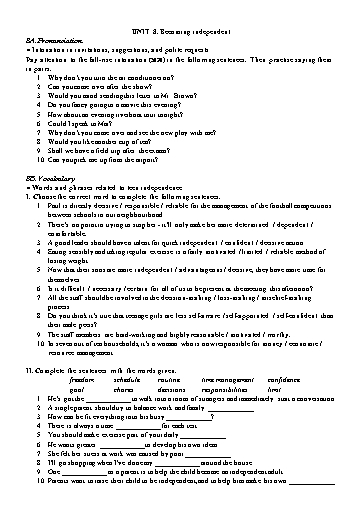
 III. Complete the sentences with the correct form of the verbs or verbal phrases given.
 get around develop base on make use make sure
 get into relax carry out achieve come up with
 1. Try to ______________________ of your time well.
 2. I’m not trying to _____________________ the habit of always having biscuits with my coffee.
 3. My close friend, Phong, _____________________ a fantastic idea for the school trip.
 4. We had to use public transport to _____________________.
 5. The police will _____________________ an investigation into what actually happened.
 6. I’m looking for a job which will enable me to _____________________ my talents.
 7. After work, she _____________________ with a cup of coffee and the newspaper.
 8. I’ve been working all day, but I feel as if I’ve _____________________ nothing.
 9. _____________________ he is honest before you lend him any money.
 10. Their relationship was _____________________ mutual respect.
IV. Fill in each blank with the correct word given below.
 plan system team issue information
 focus effort work flow techniques
 1. I actively look for ways to improve the _________________ of my work, and the way that I
 approach tasks.
 2. I can maintain _________________ on one task for a significant period of time.
 3. I spend lots of time looking for _________________ or documents, or locating missing items.
 4. I use the talents, time, and expertise of other people in my _________________ to help get the
 work done.
 5. I actively look for ways to avoid wasting time and _________________ - both for myself and for
 my team.
 6. I use _________________ like skimming and note taking to identify the key points from the
 documents that I receive.
 7. I have a clear _________________ for dealing with disruptions and interruptions.
 8. I delay difficult or unpleasant tasks until the last minute - or until the ______________ disappears
 on its own.
 9. I use a formal tracking _________________ to understand how I spend my time.
 10. I do all of the tasks that are assigned to me, and hope that I can keep up with the volume of
 _________________.
● Prepositions
V. Complete each sentence with the correct preposition.
 1. He has a very good relationship ____________________ his uncle.
 2. The authorities are discussing a plan _______________ action to deal with the crisis.
 3. The two partners still talk on the phone _______________ time to time.
 4. The doctor says she’s making a good recovery, and she should be _______________ and about in
 a few days’ time.
 5. Did she pay you _______________ looking after her dogs while she was away?
 6. That man has taken over responsibility _______________ this project.
 7. Do you think I’ll be able to achieve my goal ___________ losing five kilos before the summer?
 8. It is important _______________ him to attend lectures every day.
 9. We based our decision _______________ the facts in the report.
 10. The work that the students do during the year will count _______________ their final grade.
8C. Grammar
● Cleft sentences with It is / was ... that / who ...
I. Rewrite the following sentences after the example, paying attention to the subject of the sentence. 3. I took these photographs in the countryside.
_____________________________________________________________________________________
 4. Linda is going to spend her summer vacation in Viet Nam.
_____________________________________________________________________________________
 5. Many children like to play in the schoolyard.
_____________________________________________________________________________________
 6. Scientists found some strange paintings on the walls of the cave.
_____________________________________________________________________________________
 7. John will finish his study in July.
_____________________________________________________________________________________
 8. Jane took a university badge out of her pocket.
_____________________________________________________________________________________
IV. Rewrite the sentences using cleft sentences focusing on the underlined parts.
 1. Peter lent us the money, but Paul did not.
_____________________________________________________________________________________
 2. I have lost my English book.
_____________________________________________________________________________________
 3. I saw him in the street only last week.
_____________________________________________________________________________________
 4. Argentina won the World Cup in 2022.
_____________________________________________________________________________________
 5. The smoke from the factory chimneys pollutes the air.
_____________________________________________________________________________________
 6. Mastering a second language takes a lot of time and practice.
_____________________________________________________________________________________
 7. You will succeed only by hard work.
_____________________________________________________________________________________
 8. The countryside is most beautiful in autumn.
_____________________________________________________________________________________
 9. What I saw at the dance party surprised me.
_____________________________________________________________________________________
 10. Did you start the fight, or was it someone else?
_____________________________________________________________________________________
V. Rewrite the following sentences, beginning as shown.
 1. Singapore became a nation in 1965.
It was in _____________________________________________________________________________.
 2. Princess Dianna was usually referred as The Rose of England.
It was The Rose _______________________________________________________________________.
 3. Mary didn’t begin to read until she was eight.
It was not ____________________________________________________________________________.
 4. I didn’t realise he was your brother until I saw the photograph.
It was only when ______________________________________________________________________.
 5. The noise next door did not stop until after midnight.
It was not ____________________________________________________________________________.
 6. I only heard her husband’s side of the story when I met him at the party.
It was only ___________________________________________________________________________.
 7. The reporters only heard about the changes of the wedding plans when they arrived at the venue.
It was only ___________________________________________________________________________.
 8. Bill Gates has donated a big sum of money to several charities. 5. For whom can they arrange an expert’s visit?
_____________________________________________________________________________________
_____________________________________________________________________________________
II. Read the text, and then do the tasks that follow.
 The Ability to Get from One Place to Another
 One important life skill that teenagers need to learn in order to become independent, and to
generally be able to operate without their parents is transportation, or “getting from Point A to Point B”.
While it sounds simple, many teens do not have a good grasp of this simple skill. There is a bus to get to
school and often, the family rely upon for transportation to go anywhere else.
 Always leaving this important life skill to parents can lead a child to develop the bad habit of
never taking the responsibility of being where they need to be and blaming others for being late or not
showing up. That will hinder your teen’s daily living and success.
 Young adults have goals, dreams and responsibilities that will require them to know all they can
about different modes of transportation.
 Teens need to know “how to get there from here”. Therefore, parents need to give the
responsibility of transporting themselves from one place to another to their teens as often as possible.
When parents do this, teens learn valuable transportation lessons.
 Transportation lessons and experiences are taught in high school and some can be taught by
getting your teens involved with travel clubs or various youth events.
 These life skills are learned best when taught by experience, but you can also use the Internet to
help when the concept of using experience as a teacher is not readily applicable. Give these lessons your
best efforts as teaching your teens how to go where they need to on their own will boost their confidence
and add to their overall sense of independence.
Task 1. Decide whether the statements are true (T) or false (F).
________ 1. The fact that children depend on their parents for transportation to go anywhere may have a
negative impact on them.
________ 2. Parents should take the responsibility of transporting their teens as often as possible.
________ 3. Transportation lessons can be taught at school or in community.
________ 4. Experiences and the Internet play an important role in learning this life skill.
________ 5. Adults need to give all the responsibility of learning how to go where teens need to the teens
to boost their confidence and their sense of independence.
Task 2. Match the underlined words in the text with the definition.
1. operate (v) ________ A. arrive
2. grasp (n) ________ B. make something become better
3. show up (phr. v) ________ C. ability to get something
4. hinder (v) ________ D. work in a particular way
5. boost (v) ________ E. make it difficult for someone to do something
III. Read the text, and then do the tasks that follow.
 Why Do We Use Time-management Skills?
 It is important that you develop effective strategies for managing your time to balance the
conflicting demands of time for study, leisure, and work. Time-management skills are valuable not only
in job-hunting, but also in many other aspects of life: from revising for examinations to working in a
vacation job.
 Sometimes it may seem that there isn’t enough time to do everything that you need to. This can
lead to a build-up of stress. When revising for examinations, or during your final year when you have to
combine the pressures of intensive study with finding time to apply for jobs, good management of your
time can be particularly important. Once we have identified ways in which we can improve the
management of our time, we can begin to adjust our routines and patterns of behaviour to reduce any
time-related stress in our lives. 3. What will happen if parents don’t push their child at all?
_____________________________________________________________________________________
 4. What is the best way to help children more independent?
_____________________________________________________________________________________
 5. Why could the boy in the last paragraph feel comfortable?
_____________________________________________________________________________________
Task 2. Match the underlined words in the text with the definition.
1. perspective (n) _______ A. full of something
2. counterproductive (adj) _______ B. existing only in a particular area
3. flooded (adj) _______ C. having the opposite effect to the one which was intended
4. confined (adj) _______ D. little by little
5. incrementally (adv) _______ E. a particular thought
V. Read the passage, and choose the correct answer A, B, C or D for each question.
 An important part of being an adult in the USA is becoming more independent from your parents.
First, make sure you are living somewhere rather than your parents’ house. If your parents own the
property in which you live, they will have a say in how you maintain that property. If you want to be
independent and make your own decisions about how you live, you will need to obtain your own housing
that is completely separate from your parents both physically and financially.
 Second, generate your own income and be as financially self-sufficient as possible. One of the
main challenges in becoming independent as an adult is acquiring a sufficient income to allow you to live
without the financial assistance of your parents. This can be particularly difficult if you are still a
university student, but it is not impossible. Seek scholarships and part- time jobs. If you are no longer a
student, find employment that offers a salary that can cover your expenses. It may be necessary to obtain
multiple sources of income in order to become financially self-sufficient and independent from your
parents.
 Next, budget your expenses carefully. When first becoming financially independent, it may be
necessary to cut back on some of your expenses and strictly stick to a budget. Determine exactly what you
can afford in terms of rent, food, clothing, transportation and entertainment based on your own income,
create a budget. While you may experience a dip in your standard of living at first, learning how to follow
a budget and be self-sufficient will help you stay independent.
 Finally, avoid relying on your parents as a first resort option for help of any kind. This, in no way,
means that you may never ask your parents for help again, it just means that as an independent adult,
there should be other sources of support within your life that you can turn to when necessary.
1. You need to have your own accommodation so that _______.
 A. your parents can’t change your lifestyles and decisions
 B. you have no relationship with your parents
 C. your parents will have a say in how you maintain that property
 D. you will be as financially self-sufficient as possible
2. All of the following statements are true about acquiring your own income EXCEPT that _______.
 A. it allows you to become financially independent from your parents
 B. you can’t earn a living when you are still a university student
 C. you have to look for scholarships and part-time jobs as being a student
 D. sometimes you have to do several jobs in order to earn enough money
3. An important task of becoming financially independent of your parents is that _______.
 A. you learn how to set a budget that increases your standard of living
 B. you have to cut back on your expenses sharply all the time
 C. your salary can cover your medical and legal expenses
 D. you have to plan a reasonable budget and obey it strictly 8. Multitasking is for intelligent people. _________
 9. China has one of the longest school days in the world. _________
 10. Students in different countries have the different number of school days a year. _________
VII. Read the text, and do the tasks that follow.
 Every year 30,000 young people in the UK can learn what it is like to run their own business
before leaving school. These 15-19 years olds take part in a scheme called Young Enterprise. It is
organized by the UK’s largest business education charity, which was founded in 1962.
 Young Enterprise’s objective is ‘to inspire and equip young people to learn and succeed through
enterprise.’ Under the guidance of business mentors, who are volunteers from some of the country’s most
well-known companies, each Young Enterprise group runs its own real company for a year.
 It is up to the group to name the company, assign roles like managing director, marketing manager
and accountant, decide on a product or service, work out how to finance and market it, and finally sell it.
A year later, the business is closed, hopefully with a profit.
 Young Enterprise gives its participants the opportunity to develop valuable skills such as
communication, teamwork and decision-making. It also gives them an understanding of how a real
business works. They will be able to use this knowledge and experience in the future.
 Young Enterprise sounds like a good thing, doesn’t it? But does it really work? According to
research in 2012, if you take part in Young Enterprise at school, you’ll be:
● almost twice as likely to have your own business and employ people
● more likely to have higher earnings
● more likely to be successful in your career
● more likely to be innovative and high-tech
 So, if you could join a Young Enterprise group in your school, would you?
Task 1. Choose the best title for the text.
 A. Learning by watching B. Learning by talking C. Learning by doing
Task 2. Choose the correct answers.
1. Who is Young Enterprise for?
 A. Students at university
 B. Teenagers who don’t want to go to school
 C. Teenagers in the last few years of school
2. What is the aim of the Young Enterprise charity?
 A. To make money
 B. To set up big companies
 C. To educate young people about business
3. Who are the mentors?
 A. Teachers B. Business people C. Students
4. Who makes the decisions in each group?
 A. The mentor B. The managing director C. All the members
5. What skill does Young Enterprise teach you?
 A. How to work with other people
 B. How to work on your own
 C. How to write a curriculum vitae for a future job
6. What effect can participating in Young Enterprise NOT have on your future job?
 A. You’ll probably be a better employee.
 B. You’ll probably earn more money.
 C. You’ll probably be able to continue the business you started with the scheme.
VIII. Read the text and do the tasks that follow.
File đính kèm:
- bai_tap_tieng_anh_lop_11_global_success_unit_8_becoming_inde.doc
- 24. UNIT 8. Becoming independent - KEY.doc


