

Bài tập Tiếng Anh Lớp 11 Global Success - Unit 8: Becoming independent (Kèm đáp án)
 15 trang
23/11/2025
2691
15 trang
23/11/2025
2691
Bạn đang xem tài liệu "Bài tập Tiếng Anh Lớp 11 Global Success - Unit 8: Becoming independent (Kèm đáp án)", để tải tài liệu gốc về máy hãy click vào nút Download ở trên.
Tóm tắt nội dung tài liệu: Bài tập Tiếng Anh Lớp 11 Global Success - Unit 8: Becoming independent (Kèm đáp án)
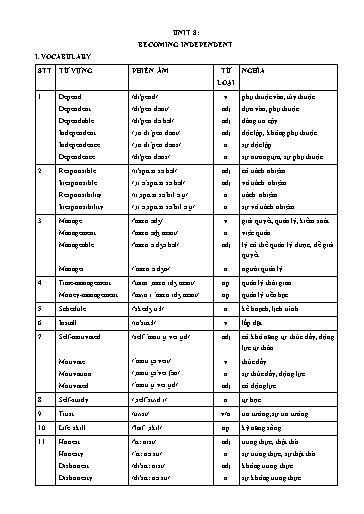
 12 Reliable /rɪˈlaɪ.ə.bəl/ adj cĩ thể tin tưởng
 Rely /rɪ'laɪ/ v phụ thuộc
 Reliant /rɪ'laɪ.ənt/ adj dựa dẫm, phụ thuộc
 Reliability /rɪˌlaɪ.əˈbɪl.ə.t̬i/ n sự tin cậy
13 Harm /ha:rm/ n/v sự tổn hại/gây hại
 Harmful /'hɑ:rm.fəl/ adj cĩ hại
 Harmless /'hɑ:rm.ləs/ adj vơ hại
14 Pressure /ˈpreʃ.ɚ/ n áp lực, áp suất, sức ép
15 Decision-making skill /dɪ'sɪʒ.ən 'meɪ.kɪŋ skɪl/ np kỹ năng ra quyết định
16 Teenager /'ti:nˌeɪ.dʒɚ/ n người ờ độ tuổi thanh thiếu niên
 Teenage /'ti:n.eɪdʒ/ adj thanh thiếu niên
17 Public transport /ˌpʌb.hk 'trỉn.spɔ:rt/ np phương tiện giao thơng cơng
 cộng
18 Identify /aɪˈden.t̬ə.faɪ/ v nhận ra, nhận dạng
19 Solve /sa:lv/ v giải quyết, tìm ra lời giải
 Solution /sə'lu:.ʃən/ n giải pháp, cách giải quyết
20 Option /'ɑ:p.ʃən/ n sự lựa chọn, tùy chọn
 Optional /'ɑ:p.ʃən.əl/ adj khơng bắt buộc, tùy chọn
21 Review /rɪ'vju:/ v xem xét
22 Specific /spə'sɪf.ɪk/ adj rõ ràng, cụ thể, đặc trưng, riêng
 biệt
23 Extracurricular /ˌek.strə.kəˈrɪk.jə.lɚ np hoạt động ngoại khĩa
 activity ỉkˈtɪv.ə.t̬i/
24 Separately /ˈsep.ɚ.ət.li/ adv tách biệt, riêng biệt
25 Washing powder /ˈwɑː.ʃɪŋ ˌpaʊ.dɚ/ np bột giặt
 Washing liquid /ˈwɑː.ʃɪŋ ˌlɪk.wɪd/ np nước giặt
26 Instruction /ɪn'strʌk.ʃən/ n chỉ dẫn, hướng dẫn
27 Item /'aɪ.t̬əm/ n khoản; mĩn; đồ
28 Rinse /rɪns/ v giặt, súc; rửa
29 Measure /'meʒ.ɚ/ v đo lường
30 Sense of responsibility /sens əv np tinh thần trách nhiệm
 rɪˌspɑːn.səˈbɪl.ə.t̬i/
31 Organized /'ɔ:r.gən.aɪzd/ adj được tổ chức tốt, cĩ tổ chức
32 Curious /ˈkjʊr.i.əs/ adj tị mị, ham hiểu biết
33 Characteristic /ˌker.ək.təˈrɪs.tɪk/ n/adj đặc trưng 28 Make decisions đưa ra quyết định
 29 Remove sth from sth loại bỏ cái gì khỏi cái gì
 30 Add sth to sth thêm cái gì vào cái gì
 31 Set goals to do sth đặt mục tiêu để làm gì
 32 Make plans to do sth lập kế hoạch để làm gì
 33 On one’s own tự thân, tự mình
 34 Try to do sth cố gắng làm điều gì
 Try doing sth thử làm điều gì
 35 Move on to sth chuyển sang cái gì
 36 Make an effort to do sth nỗ lực làm điều gì
 37 Be afraid of doing sth sợ làm điều gì
 38 Motivate sb to do sth thúc đẩy ai làm gì
 39 Do babysitting trơng trẻ
 40 Count towards sth được bao gồm để tính vào cái gì
 41 The pros and cons ưu nhược điểm
III. GRAMMAR (Cleft sentences with It is/was.... that/who....)
- Câu chẻ được dùng để tập trung vào một phân cụ thể của câu và để nhấn mạnh điều chúng ta muốn
nĩi.
- Cấu trúc của câu chẻ cĩ dạng:
 IT IS/WAS + THÀNH PHẦN NHẤN MẠNH + THAT/WHO + ...
 (Thành phẫn nhấn mạnh gồm: chủ ngữ/tân ngữ/trạng ngữ)
Ví dụ:
+ The teacher's guidance helped him excel in the subject.
→ It was the teacher's guidance that helped him excel in the subject. (Nhân mạnh chủ ngữ)
+ I met my wife for the first time in London.
→ It was in London that I met my wife for the first time. (Nhấn mạnh trạng ngữ)
+ I often ask my brother to help me with my homework.
→ It is my brother who/that I often ask to help me with my homework. {Nhấn mạnh tân ngữ)
IV. PRACTICE EXERCISES
A. PHONETICS
Mark the letter A, B, C, or D to indicate the word whose underlined part differs from the other three
in pronunciation in each of the following questions.
1. A. normal B. forty C. world D. chores
2. A. great B. dream C. heat D. treat 1. Becoming (DEPEND) ________ is important for teenagers because that is helpful for them in the
 future.
2. Not many people have the (CONFIDENT) ________ to deal with difficult situations.
3. His (RESPONSIBLE) ________ causes a lot of trouble and financial damages to the company.
4. Before we make a (DECIDE) ________ , we must think carefully.
5. Students’ (MOTIVATE) ________ makes them study hard.
Mark the letter A, B, C, or D to indicate the correct answer to each of the following sentences.
1. Whenever I have a difficult situation, I ask him because he often ________ the solutions easily.
 A. carries out B. comes up with C. gets around D. gets into
2. Her mother wants her to contact her ________ while she’s out.
 A. from day to day B. from time to time
 C. from hour to hour D. from minute to minute
3. We should make ________ of time-management tools to know what we need to do every day or week.
 A. benefit B. help C. use D. sure
4. It was ________ their parents' trust that took a long time.
 A. achieving B. bringing C. checking D. earning
5. The most important thing to be independent is getting into the ________ of planning what you do in
a day, a month or a year.
 A. habit B. time C. schedule D. challenge
6. Their son is ________ at home. He can cook, clean the house and do the laundry!
 A. dependent B. independent C. dependence D. independence
7. When teenagers do some part-time jobs, they get to know how to ________ their money.
 A. manage B. management C. manager D. manageable
8. I want to ________ the time-management app to plan my weekly schedule.
 A. installment B. installing C. installed D. install
9. If you have any problems, write down the options, so that you can review the advantages and
________ of each one.
 A. disadvantageous B. advantageous C. disadvantageously D. disadvantages
10. Once you have made your choice, you must create a plan of ________ steps to move forward.
 A. separate B. specific C. common D. detailed
11. It's my father who taught me how to be responsible ________ money.
 A. with B. for C. about D. in
12. All teenagers need to study basic ________ that are necessary or extremely useful to manage well
in daily life.
 A. cooking skills B. communication skills C. life skills D. teamwork skills
13. He always ________ his parents, especially his father.
 A. follows B. trusts C thinks D. hopes
14. They never have to ask their children to study hard because they are highly ________.
 A. self-motivated B. self-confident C. self-studying D. self-teaching 7. I met my old friend at the mall yesterday.
→ It _____________________________________________________________________________.
8. He always dreamed of owning the expensive and luxurious sports car.
→ It _____________________________________________________________________________.
9. She called her mother to share the good news.
→ It _____________________________________________________________________________.
10. We could go outside only after the rain had stopped.
→ It _____________________________________________________________________________.
Find and correct the mistake in the following sentences.
11. It was with much difficulty who she solved the challenging math problem.
 A B C D
12. It is the fascinating and insightful documentary about the wildlife that kept us glued to
 A B C D
the television.
13. It was the top of the Eiffel Tower that they shared a romantic kiss.
 A B C D
14. There was the gold necklace that she wore to the elegant dinner.
 A B C D
15. It is the delicious aroma of the food that draw us into the restaurant.
 A B C D
D. SPEAKING
Mark the letter A, B, C, or D to indicate the sentence that best completes each of the following
exchanges.
1. Jane is talking to Sue.
 Sue: Have a nice holiday!
 Jane: ________
 A. Same to you. B. Thanks for your compliment.
 C. You’re welcome. D. Thank you for what you’ve done.
2. Sue is asking Jane.
 Sue: I wish you best luck in your new position.
 Jane: ________
 A. You too. B. You are the best.
 C. Thank you for your wish. D. Thanks. I will not forget you.
3. Jane and Sue are talking to each other.
 Jane: Hope you feel better soon.
 Sue: ________
 A. I see. I'll do my best. B. Never mind. 6. A. more B. few C. much D. less
7. A. get B. taken C. made D. done
8. A. turn to B. result from C. lead to D. make up
9. A. enlarge B. promote C. push D. limit
10. A. fostering B. fostered C. to foster D. foster
Read the following passage and mark the letter A, B, C, or D to indicate the correct answer to each
of the questions from 11 to 17.
 The age at which teenagers should become independent is a topic of debate and can vary depending
on cultural norms and individual circumstances. While there is no set age that universally marks the
transition to independence, it is generally recognized that the teenage years are a crucial period for
developing autonomy and taking on increasing responsibility.
 During adolescence, teenagers undergo significant physical, emotional, and cognitive changes.
They begin to form their own identities, explore their interests, and develop a sense of self. This period
provides an opportunity for teenagers to gradually take on more independence and learn essential life
skills that will prepare them for adulthood. However, it is important to note that independence should be
a gradual process and not something expected to happen overnight. Teenagers still require guidance,
support, and supervision from parents, caregivers, and trusted adults. The transition to independence
should be based on individual maturity, readiness, and the ability to handle increasing responsibilities.
Factors such as cultural expectations, family dynamics, and the level of trust and communication within
the family also play a role in determining when teenagers should become more independent. Open and
honest communication between parents and teenagers is crucial in navigating this transition, as it allows
for discussions about expectations, boundaries, and the gradual relinquishing of parental control.
 It is important to recognize that the journey towards independence is not solely determined by age,
but also by the readiness and capabilities of the teenager. Some teenagers may display greater maturity
and responsibility at an earlier age, while others may require more time and support to develop these
skills. Parental guidance and assessment of the teenager’s readiness are vital in determining when they
should gradually assume more independence. It is essential to strike a balance between fostering
independence and ensuring the teenager’s well-being and safety. By providing opportunities for growth,
encouraging responsible decision-making, and maintaining a supportive environment, parents can help
teenagers navigate the path to independence at a pace that suits their individual development.
 (Adapted from The Forbes)
11. Which of the following can be the best title for the passage?
 A. The Importance of Independence in Teenagers
 B. Determining the Age of Independence for Teenagers
 C. The Transition to Independence in Adolescence
 D. Cultivating Autonomy and Responsibility in Teenagers
12. According to the passage, the following factors should be considered when determining the transition
to independence for teenagers EXCEPT ________ .
 A. Their physical and emotional changes during adolescence.
 B. Cultural norms and individual circumstances.
 C. The level of trust and communication within the family.
 D. Financial ability to pay for life on their own. 10. The child is able to communicate ________ her foreign teacher fluently.
 UNIT 8: 45-MINUTE TEST
Mark the letter A, B, C, or D to indicate the word whose underlined part differs from the other three
in pronunciation in each of the following questions.
1. A. honest B. house C. help D. hard
2. A. trust B. stuck C. focus D. study
Mark the letter A, B, C, or D to indicate the word that differs from the other three in the position of
primary stress in each of the following questions.
3. A. parent B. money C. schedule D. belief
4. A. extremely B. important C. computer D. motivate
5. A. independent B. activity C. responsible D. reliable
Mark the letter A, B, C, or D to indicate the word(s) CLOSEST in meaning to the underlined word(s)
in each of the following sentences.
6. He is a dependable worker. He works hard and never says anything wrong.
 A. responsible B. manageable C. reliable D. separate
7. Parents never trust in their children completely. They often check and follow them when they go out.
 A. hope B. believe C. expect D. hold
Mark the letter A, B, C, or D to indicate the word(s) OPPOSITE in meaning to the underlined word(s)
in each of the following sentences.
8. Some parents think playing with bad friends is harmful for their children. They may be influenced
by their friends’ behaviours.
 A. toxic B. destructive C. painful D. innocuous
9. Music and art are optional subjects in some programmes at my school.
 A. compulsory B. controllable C. manageable D. necessary
Mark the letter A, B, C, or D to indicate the correct answer to each of the following sentences.
10. My parents thought I didn't have the confidence to ________ difficult situations.
 A. carry out B. deal with C. get around D. write down
11. He's managed to convince them that he’s responsible when he’s ________.
 A. out and about B. out and away C. out and out D. out of work
12. Jack is good ________ managing his time and money.
 A. on B. in C. at D. about
13. They showed me a time-managing app to plan my weekly schedule including all my activities and
________.
 A. responsible B. irresponsible C. responsibilities D. irresponsibilities
14. Some parents encourage their children ________ part-time jobs and pay me for doing certain chores
around the house.
 A. take B. to take C. taking D. taken
15. My sister is ________ because she’s able to do or achieve something without pressure from others.
File đính kèm:
- bai_tap_tieng_anh_lop_11_global_success_unit_8_becoming_inde.docx
- ANSWER KEYS.docx


