

Bài tập Tiếng Anh Lớp 11 Global Success - Unit 9: Cities of the future (Kèm đáp án)
 13 trang
09/11/2025
1570
13 trang
09/11/2025
1570
Bạn đang xem tài liệu "Bài tập Tiếng Anh Lớp 11 Global Success - Unit 9: Cities of the future (Kèm đáp án)", để tải tài liệu gốc về máy hãy click vào nút Download ở trên.
Tóm tắt nội dung tài liệu: Bài tập Tiếng Anh Lớp 11 Global Success - Unit 9: Cities of the future (Kèm đáp án)
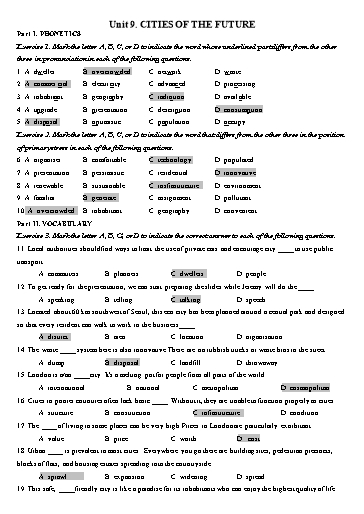
 A. environment B. environmental C. environmentally D. environmentalist
20. ____ waste is putting city dweller's health at a real risk.
 A. Treatment B. Untreated C. Non-treatment D. Non-treated
21. Every month, scientists invent new gadgets and ____ to help us with our daily lives, and discover ways to
make existing technology faster and better.
 A. experiments B. effects C. laboratories D. equipment
22. Unlike the country where the day often ends quite early in the evening, the city offers its people exciting
____.
 A. activities B. performances C. nightlife D. night clubs
23. The roads are terrible. I'm always getting ____ in traffic.
 A. stuck B. lost C. exhausted D. late
24. A pedestrian ____ is a specified place on the road where people can cross.
 A. crossroads B. crossing C. junction D. T-junction
25. Everything's a bit more expensive here and property prices are extremely high. A lot of people have no
choice but to live in the ____ and commute in to work.
 A. outskirt B. suburbs C. city D. urban
26. It's much safer for cyclists to get around these days with cycle ____ everywhere.
 A. lanes B. streets C. roads D. paths
27. The ____ is where you'll find all the large department stores and banks.
 A. city heart B. town hall C . city centre D. business district
28. Exhaust ____ from cars are responsible for much of the air pollution in cities.
 A. fumes B. smokes C. gases D . smog
29. Many factories still allow ____, such as toxic waste, to flow into our rivers
 A. pollution B. litters C. garbage D. pollutants
30. Many commuters struggling to work through the rush-hour ____ ask 'Is it worth it?'
 A. congestion B. vehicles C. roads D. accidents
31. It is perhaps, the daily stresses and ____ of the city which make life there a matter of survival rather than of
enjoyment.
 A depresses B. strains C. demands D. challenges
32. Most cars nowadays are fitted with a security ____ of some kind.
 A. motor B. gadget C. tool D. device
33. The greenhouse ____ takes place when certain gases in the atmosphere trap sun's heat.
 A emission B. gas C. effect D. affect
34. Pollution and heavy traffic are common problems in ____ cities.
 A cosmopolitan B. modern C. metropolitan D. overcrowded
35. Millions of people around the world still live in poverty. They are struggling every day simply to ____.
 A. get up B. get by C. get on D. get round A. social B. mental C. moral D. manual
50. Governments have to join hands to solve the environmental problems on a global scale.
 A. worldwide B. nationwide C. local D. international
Part III. GRAMMAR
Exercise 6. Mark the letter A, B, C, or D to indicate the correct answer to each of the following questions.
51. This is the right DVD, ____?
 A. isn't this B. is this C. isn't it D. is it
52. I'm not the only one, ____?
 A. aren't I B. am I C. am not I D. are not I
53. Let's go out tonight, ____?
 A. shall we B. will we C. could we D. would we
54. Don't forget to write to me soon, ____?
 A. would you B. could you C. can you D. will you
55. Nothing frightens you, ____?
 A. does it B. doesn't it C. do they D. don't they
56. Somebody's just called my name, ____?
 A. hasn't he B. didn't he С . haven't they D. have they
57. I suppose you don't like the course, ____?
 A. don't I B. do I C. don't you D. do you
58. Everyone's going to be there, ____?
 A. isn't he B. is he C. aren't they D. are they
59. We never enjoy our city break, ____?
 A. do we B. don't we C. have we D. haven't we
60. There will be more and more megacities in the world,
 A. will it B. won't it C. will there D. won't there
61. No one wants to live in a polluted city, ____?
 A. do they B. don't they C. does he D. doesn't he
62. I think city dwellers can enjoy an exciting nightlife, ____?
 A. don't you think B. don't I C. can't they D. can they
63. There's hardly anything that can be done to reduce pollution, ____?
 A. isn't there B. is there C. can it D. can't it
64. You have to wear uniform when going to work, ____?
 A. haven't you B. have you C. do you D. don't you
65. We are supposed to submit the assignment by Friday, ____?
 A. don't we B. are we C. aren't we D. do we
66. Put these flowers near the window, ____?
 A. will you B. would you C. could you D. all are correct
67. None of the old people likes living in urban areas, ____? 85. If you meet John, will tell him I want to see him.
 A B C D
 86. None of your friends really enjoyed themselves at the party, didn't they?
 A B C D
87. If you borrow my coat, don't get it dirty, can you?
 A B C D
88. You never work more than you have to, do you?
 A B C D
89. You made no effort to make friends with Darren, didn't you?
 A B C D
90. You sent that letter I gave you, haven't you?
 A B C D
Part IV. SPEAKING
Exercise 9. Mark the letter A, B, C, or D to indicate the correct response to each of the following exchanges.
91. “____?" – "It's ten minutes' walk from here.”
 A. How long does it take to get to the town centre?
 B. Can you show me the way to the town centre?
 C. How far is it from here to the town centre?
 D. How can we get to the town centre?
92. “What a boring lecture!" - “____”
 A. Yes, it was dull, wasn't it? B. I don't agree. It's dull.
 C. It's interesting, wasn't it? D. I'm sorry not.
93. “I believe people will have a better life in the future.” - “____ Life will be more enjoyable than it is today,
won't it?”
 A. No, I don't think so. B. Not exactly. C. Yes, I agree. D. You can't be right.
94. ” ____” – “That's right. London will be cleaner and more sustainable.”
 A. This means there'll be no pollution, will there?
 B. This means there'll be no pollution, won't there?
 C. This means there won't be no pollution, will there?
 D. This means there'll be no pollution, doesn't it?
95. "What's the weather forecast?” – “____”
 A. Don't forget your raincoat, will you?
 B. Don't forget your raincoat, do you?
 C. It's going to rain. Don't forget your raincoat, will you?
 D. It's going to rain. Don't forget your raincoat, do you?
96. “Global warming will continue to be a big threat to life on earth.” – “____”
 A. We can't afford to ignore its effects any longer.
 B. Then we can't afford to ignore its effects any longer, can we? MARRAKECH
 Where can you go in January for almost guaranteed sunshine – without travelling for most of the day to
 get there? The answer is Marrakech in Morocco, a four-hour (106) ____ from Britain, where the average
 temperature is a pleasant 66°F.
 Marrakech is a city of (107) ____ beauty, with its pink buildings and green palm trees contrasting with
 the snow-covered (108) ____ of the Atlas Mountains in the distance. For tourists, there's the added
 attraction of excellent food at reasonable prices, and high quality accommodation, such as Hotel La
 Momounia, (109) ____ as one of the top hotels in the world.
 (110) ____ Marrakech is one of Morocco's busiest and most modern cities, the influence of the Middle
 Ages is still very evident. (111) ____ can admire the battlements, towers, and mosques, which were
 built (112) ____ centuries ago. And forget about shopping malls – for perfumes, fabrics, antiques, spices
 and crafts, (113) ____ the ‘souks’, open-air market places where you'll almost (114) ____ find
 something to take back home.
 For those who want to (115) ____ sport Marrakech has plenty to offer. (116) ____ to golf and tennis,
 there is also skiing on the slopes of the high Atlas Mountains, where the (117) ____ of the surrounding
 area are quite spectacular. Alternatively, you could just relax by a heated swimming pool and dream of
 your next visit.
106. A. travel B. trip C. flight D. voyage
107. A. big B. great C. large D. high
108. A. peaks B. hills C. heads D. surfaces
109. A. thought B. regarded C. believed D. guessed
110. A. Because B. However C. Despite D. Although
111. A. Spectators B. Viewers C. Sightseers D. Onlookers
112. A. several B. plenty C. other D. all
113. A. work out B. put up with C. head for D. make up for
114. A. likely B. certainly C. probably D. possibly
115. A. do B. exercise C. take off D. go in
116. A. As well B. Apart C. In addition D. Moreover
117. A. visions B. views C. aspects D. appearances
Exercise 11. Read the following passage and mark the letter A, B, C, or D to indicate the correct answer to
each of the questions.
 A NEW CAPITAL
 When the new state of Pakistan was founded in 1947, Karachi acted as the capital city. However, it was
 difficult for Karachi to remain in this role due to a number of drawbacks such as the climate and the
 state of the existing buildings. Rather than try to overcome these drawbacks, the government decided to
 create a new capital city. In 1959, a commission was established to investigate the possible locations of
 this new city. The advisor appointed to the commission was Dr Doxiadis, a famous architect and city
 planner. Exercise 12. Read the following passage and mark the letter A, B, C, or D to indicate the correct answer to
each of the questions.
 LESSONS FROM CURITIBA
 Urban planning deals with the physical, economic, and social development of cities. Today urban
 populations are increasing rapidly, and growing cities are putting enormous pressure on the
 environment. For this reason, the type of urban planning found in Curitiba, in southern Brazil, is more
 important than ever.
 Curitiba is a fine example of how urban planning can work. This has not always been the case, however.
 At one time, Curitiba faced the same problems as many other cities all over the world, namely
 overcrowding, pollution, and an increased demand for services, transport, and housing. How, then, did
 Curitiba address these problems?
 By the 1940s the population of Curitiba had grown to about 150,000 as immigrants from countries such
 as Japan, Syria, and Lebanon came to work in agriculture and industry. These people needed both
 housing and transportation. Curitiba's leaders realised that it was not sensible to deal with these
 problems separately. Consequently, they employed a French planner and architect, Alfred Agache, to
 find an overall solution.
 Agache studied all aspects of the problem. He designed a scheme which gave priority to public services
 such as sanitation and public transport. At the same time, the scheme included centres which helped
 both community life and commerce to develop, and reduced traffic congestion. This was the first
 scheme to address several problems of growing cities at the same time. Unfortunately, some parts of his
 plan were not completed. The result, as described below, was that his scheme only served Curitiba for
 another 20 years.
 By the 1960s, the population of Curitiba had grown to about 430,000 inhabitants, so the city had to
 rethink its needs. In order to do this, the mayor put together a team of architects and town planners led
 by Jaime Lerner. This team produced the Curitiba Master Plan. This consisted of taking Agache's
 original plan and adding wide, high-speed roads which crossed the smaller streets. Their proposals also
 included plans to minimise urban growth, reduce city centre traffic, and preserve the city's historic
 district. It is clear that the Curitiba Master Plan was one of the first attempts to integrate all aspects of
 city planning.
 This integrated approach to urban design was maintained throughout the 1980s as Curitiba's population
 grew to almost one million inhabitants. Environmental facilities were added, such as a recycling
 programme for household waste, and parks and 'green' spaces were protected from development.
 However, good transportation remained central to the planning.
 Good transportation still remains a priority, together with the needs for jobs. A growing population
 needs employment, so business parks and centres have been added to encourage new small businesses.
 All these changes will continue be the population of Curitiba increases, but its city planners are
 continually searching for solutions to the problems.
123. What aspect of development does urban planning NOT deal with? B. If I am you, I will tell your parents the truth.
 C. If I were you, I would tell your parents the truth.
 D. If I were you, I will tell your parents the truth.
133. My computer always crashes when a CD is inserted.
 A. If I insert a CD, my computer will crash.
 B. If I insert a CD, my computer crashes.
 C. If you want my computer to crash, insert a CD.
 D. Unless you want my computer to crash, insert a CD.
134. Water always boils when you heat it long enough.
 A. If heated long enough, water boils. B. If water is heated long enough, it boils.
 C. If you heat water long enough, it boils. D. All are correct.
135. Plants and flowers can't live without water.
 A. If you water plants and flowers, they can't live.
 B. If you water plants and flowers, they will live.
 C. If you don't water plants and flowers, they can't live.
 D. Unless you water plants and flowers, they live.
Exercise 14. Mark the letter A, B, C, or D to indicate the sentence that best combines each pair of sentences
in the following questions.
136. Researchers are developing low-cost devices. These devices can detect water pollutants in rivers and lakes.
 A. Researchers are developing low-cost devices that can detect water pollutants in rivers and lakes.
 B. Researchers are developing low-cost devices to detect water pollutants in rivers and lakes.
 C. Researchers are developing low-cost devices so that they can detect water pollutants in rivers and
 lakes.
 D. Researchers are developing low-cost devices who can detect water pollutants in rivers and lakes.
137. Urban planners carry out projects to develop a city. They look at the needs of local people and the
environment when they do this.
 A. While carrying out projects to develop a city, urban planners look at the needs of local people and the
 environment when they do this.
 B. While carrying out projects to develop a city, urban planners look at the needs of local people and the
 environment.
 C. If they carry out projects to develop a city, urban planners look at the needs of local people and the
 environment when they do this.
 D. As carrying out projects to develop a city, urban planners look at the needs of local people and the
 environment.
138. Most Superstar City Dwellers are quite happy with their life and work. Barbara and Mark are quite happy,
too.
 A. Not only most Superstar City Dwellers are quite happy with their life and work but also Barbara and
 Mark are quite happy, too.
File đính kèm:
- bai_tap_tieng_anh_lop_11_global_success_unit_9_cities_of_the.doc


