

Bài tập Tiếng Anh Lớp 11 Global Success - Unit 9: Social issues (Kèm đáp án)
 14 trang
23/11/2025
1051
14 trang
23/11/2025
1051
Bạn đang xem tài liệu "Bài tập Tiếng Anh Lớp 11 Global Success - Unit 9: Social issues (Kèm đáp án)", để tải tài liệu gốc về máy hãy click vào nút Download ở trên.
Tóm tắt nội dung tài liệu: Bài tập Tiếng Anh Lớp 11 Global Success - Unit 9: Social issues (Kèm đáp án)
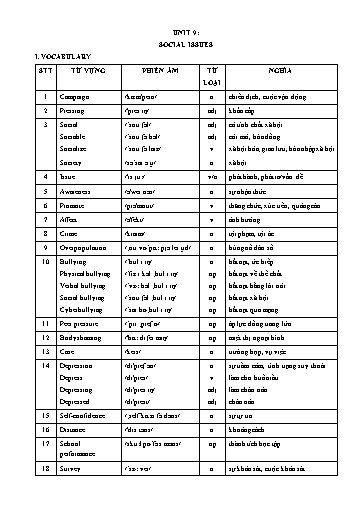
 19 The odd one out /ðiː ɑːdz wʌn aʊt/ np người lập dị, lạc lừng
 20 Appearance /ə'pɪr.əns/ n sự xuất hiện, diện mạo, vẻ bề ngoài
 21 Fashionable /'fổʃ.ən.ə.bəl/ adj hợp thời trang
 22 Permission /pɚˈmɪʃ.ən/ n sự cho phộp
 23 Consequence /'kɒnsɪkwəns/ n hậu quả
 24 Offensive /ə'fensɪv/ adj làm khú chịu, kinh tởm; xỳc phạm,
 làm mất lũng; làm nhục, sỉ nhục
 25 Embarrassed /ɪm'ber.əst/ adj lỳng tỳng, ngại ngựng, xấu hổ
 26 Painful /'peɪn.fəl/ adj đau đớn
 27 Sympathy /'sɪm.pə.θi/ n sự đồng cảm, sự thương cảm
 28 Anxious /'ổŋk.ʃəs/ adj lo lắng
 Anxiety /ổŋˈzaɪ.ə.t̬i/ n nỗi lo
 29 Victim /'vɪk.təm/ n nạn nhõn
 30 Poverty /ˈpɑː.vɚ.t̬i/ n sự nghốo đúi
II. STRUCTURES
 STT CẤU TRÚC NGHĨA
 1 Draw attention to sth thu hỳt sự chỳ ý về cỏi gỡ
 2 Focus on sth tập trung vào cỏi gỡ
 3 For instance = for example vớ dụ
 4 Agree with sb đồng ý, đồng tỡnh với ai
 5 Struggle with sth đấu tranh/chật vật với cỏi gỡ
 6 Decide on sth quyết định điều gỡ
 7 Complain about sth phàn nàn về điều gỡ
 8 Be similar to sth tương tự như cỏi gỡ
 9 Hang out with sb đi chơi/la cà với ai
 10 Have a good/bad influence on sb cú ảnh hưởng tốt/xấu đến ai
 11 Instead of sth/doing sth thay vỡ cỏi gỡ/làm cỏi gỡ
 12 Get/be angry with sb tức giận với ai
 13 Fail to do sth thất bại khi làm gỡ
 14 Lead to sth dẫn đến điều gỡ
 15 Stand up to sb/sth chống lại; khỏng cự; đối đầu với ai/cỏi gỡ
 16 Sooner or later sớm hay muộn Để thể hiện kết quả As a result,...: Kết quả là
 As a consequence,...: Hậu quả là
 Therefore, ...: Vỡ vậy
IV. PRACTICE EXERCISES
A. PHONETICS
Mark the letter A, B, C, or D to indicate the word whose underlined part differs from the other three
in pronunciation in each of the following questions.
1. A. effect B. mention C. pressure D. member
2. A. smoke B. go C. close D. odd
3. A. bully B. funny C. deny D. happy
4. A. danger B. game C. generous D. manage
5. A. lead B. deal C. health D. beat
Mark the letter A, B, C, or D to indicate the word that differs from the other three in the position of
primary stress in each of the following questions.
1. A. approve B. permit C. study D. promote
2. A. idea B. resource C. issue D. campaign
3. A. positive B. consequence C. permission D. teenager
4. A. relationship B. information C. participate D. activity
5. A. interest B. seventy C. alcohol D. appearance
B. VOCABULARY
Mark the letter A, B, C, or D to indicate the word(s) CLOSEST in meaning to the underlined word(s)
in each of the following sentences.
1. I felt embarrassed when my friends made fun of my hair.
 A. confident B. tired C. ashamed D. miserable
2. She became deeply depressed when her exam results were not as good as she expected.
 A. upset B. cheerful C. happy D. disappointing
3. She’s always the odd one out at school. She doesn’t have many friends.
 A. a warm-hearted person B. a good person
 C. an excellent person D. a distinct person
4. The party was a huge success, thanks to Jane's sociable nature and ability to engage with guests.
 A. unfriendly B. outgoing C. common D. kind
5. What a disappointing result! My friends will laugh at me.
 A. encouraging B. pleasing C. unsatisfying D. strong
Mark the letter A, B, C, or D to indicate the word(s) OPPOSITE in meaning to the underlined word(s)
in each of the following sentences.
1. Two million people are living in abject poverty.
 A. wealth B. misery C. difficulty D. hardship 10. The boy does not want to go to school because he is afraid of being ________.
 A. bully B. bullied C. bullying D. to bully
11. Many children live in ________. They often stop going to school and work.
 A. poverty B. wealth C. tiredness D. happiness
12. There are more and more _______ TV programmes for children. Parents are complaining about that.
 A. suitable B. anxious C. violent D. depressed
13. We are going to start a campaign to raise ________ of animal rights.
 A. aware B. unaware C. unawareness D. awareness
14. The campaign helps to ________ people’s attention to social issues.
 A. pay B. draw C. start D. play
15. One of the most common forms of ________ bullying is body shaming.
 A. physical B. cyber- C. verbal D. social
Fill in the blanks with suitable prepositions.
1. The emails we have received from teenagers this week point ________ the effects of peer pressure.
2. It's not always easy to stand ________ to peer pressure but sooner or later you need to decide what is
best for you.
3. He thinks they should focus on a problem teens struggle ________ every day.
4. About 20% of the teens in the survey struggled to live ________ the poverty line every day.
5. My brother is suffering ________ bullying at school and needs help.
Mark the letter A, B, C, or D to indicate the underlined part that needs correction in each of the
following questions.
1. Should we report bully to teachers or speak to our parents first?
 A B C D
2. Despite his success, he seems to lack self-confident socially.
 A B C D
3. Jack has a bad effect on his brother, which makes him disobey anyone besides Jack.
 A B C D
4. There is tremendous peer press to wear fashionable clothes.
 A B C D
5. The children are the helpless patients of the family violence.
 A B C D
C. GRAMMAR
Mark the letter A, B, C, or D to indicate the correct answer to each of the following questions.
1. The restaurant not only serves delicious food but has excellent customer service; ________, it offers
a cozy ambiance.
 A. moreover B. in addition to C. however D. because
2. She missed her flight ________ a traffic jam on the way to the airport.
 A. because B. because of C. although D. in spite of Jane: ________
 A. How interesting! B. How can it happen?
 C. Thanks for your information. D. I’m sorry to hear that.
3. Jane and Sue are talking to each other.
 Jane: My son is being bullied at school. - Sue: ________
 A. That’s too bad. B. Is that important?
 C. Poor you. D. Don't hesitate to talk to me.
4. Jane is talking to Jack.
 Jack: I can’t go shopping with you tonight. I have to finish my project.
 Jane: ________
 A. What a good project! B. I’m fine, thanks.
 C. What a shame. D. You're doing well.
5. Rose is talking to Jane.
 Rose: I’m going to see the doctor tomorrow. I have a bad cold.
 Jane: ________
 A. I know it. B. Hope you get better soon.
 C. I can sympathize with you. D. Don't worry.
E. READING
Read the following passage and mark the letter A, B, C, or D to indicate the correct word or phrase
that best fits each of the numbered blanks from 1 to 10.
Crime is a prevalent issue (1) ________ affects societies worldwide, and it encompasses a wide range
of (2) ________ activities. From theft and vandalism to more serious offenses like robbery and assault,
crime can have significant consequences for individuals and communities. One of the main causes of
crime is socioeconomic factors. Poverty, unemployment, and (3) ________ access to basic resources
can push individuals towards criminal behavior as a means of survival or (4) ________ of desperation.
(5) ________ , societal factors such as inequality, discrimination, and social exclusion can contribute to
feelings of frustration and resentment, leading to an increased likelihood of criminal activity.
 Efforts to combat crime involve various strategies, (6) ________ law enforcement, prevention
programs, and community engagement. Law enforcement agencies work to uphold the law, investigate
crimes, and apprehend offenders. Prevention programs aim to address the root causes of crime (7)
________ providing support and resources to at-risk individuals and communities. These programs
focus on education, job training, and mentorship to empower individuals and steer them (8) ________
from criminal behavior. Community engagement plays a crucial role in reducing crime by fostering
strong social connections, promoting (9) ________ watch programs, and encouraging citizens to report
(10) ________ activities.
 (Adapted from BBC News)
1. A. that B. where C. when D. who
2. A. illiterate B. implicit C. illegible D. illegal
3. A. absence B. lack C. lack of D. short
4. A. as a matter B. as a result C. in spite D. in conclusion C. healthcare systems D. public resources
15. The word "alleviate” in paragraph 2 is closest in meaning to ________ .
 A. ease B. aggravate C. execute D. control
16. Which of the following is not true according to the passage?
 A. Homelessness can arise from factors such as poverty, lack of affordable housing, mental health
 issues, substance abuse, and systemic inequality.
 B. Homeless individuals often face challenges in accessing basic necessities, healthcare, employment
 opportunities, and social support networks.
 C. Homelessness only affects individuals and does not have any impact on society.
 D. Homelessness places a burden on public resources, such as emergency shelters, healthcare
 systems, and law enforcement.
17. Which of the following can be inferred from the passage?
 A. Collaboration and coordination among governments, nonprofit organizations, and communities
 are essential to addressing homelessness effectively.
 B. Homelessness is a problem that only affects a few isolated individuals and does not have broader
 societal implications.
 C. Providing immediate interventions, such as emergency shelters and transitional housing, is the
 most effective long-term solution to homelessness.
 D. The root causes of homelessness are solely related to mental health issues and substance abuse.
 UNIT 9:15-MINUTE TEST
I. Choose the best answer.
1. Some people cannot control their anger when drinking alcohol. ________, they become violent.
 A. Besides B. As a result C. By contrast D. Moreover
2. ________ it was raining, we still went to the park.
 A. Although B. In spite of C. As D. Besides
3. We can’t go to his party ________ we’re going away that weekend.
 A. because B. because of C. although D. despite
4. ________ his illness, he looked cheerful.
 A. In addition B. However C. Despite D. Furthermore
5. They tried hard. ________ they lost the game.
 A. Although B. However C. By contrast D. Therefore
6. ________ the party was fun, I went home early.
 A. However B. As a result C. Despite D. Though
7. She’s friendly. ________ her sister is a bit strict and unfriendly.
 A. Besides B. As a result C. By contrast D. Moreover
8. ________ the law, people continue to use mobile phones while driving.
 A. In spite of B. However C. In addition D. Therefore 25. The main source of teenagers' anxious and depression was social pressure, such as the pressure
 A B C
to look good or to fit in social groups.
 D
READING
Read the following passage and mark the letter A, B, C, or D to indicate the correct word or phrase
that best fits each of the numbered blanks from 26 to 30.
 Overpopulation refers to a situation (26) ________ the number of people in a particular area exceeds
the available resources and infrastructure to support them adequately. It is a (27) ________ issue that
can have significant social, economic, and environmental consequences. Overpopulated areas often face
challenges (28) ________ strained healthcare systems, inadequate housing, increased competition for
resources, and environmental degradation. These issues can lead to poverty, unemployment,
overcrowding, and a decline in (29) ________ of life. Addressing overpopulation requires a
comprehensive approach that includes family planning, sustainable development, and (30) ________
distribution of resources to ensure a balanced and sustainable future for all.
 (Adapted from The English Patient)
26. A. where B. which C. who D. when
27. A. in-house B. local C. global D. glocal
28. A. for example B. such as C. consisting D. comprising
29. A. standard B. cost C. quantity D. quality
30. A. equality B. equitably C. equitable D. equity
Read the following passage and mark the letter A, B, C, or D to indicate the correct answer to each
of the questions from 31 to 35.
 Living in a big city can offer many advantages, such as access to diverse cultures, job opportunities,
and vibrant social scenes. However, it also comes with its fair share of social problems. One prevalent
issue is homelessness. In big cities, the high cost of housing and limited affordable options make it
challenging for some individuals and families to secure a stable place to live. This leads to a significant
homeless population, often struggling to meet their basic needs and facing difficulties in finding
employment or accessing social services. Another social problem in big cities is the increased crime
rates. The density of population and anonymity can contribute to higher levels of criminal activity. Theft,
vandalism, and assaults are more common in urban areas, causing concerns for residents’ safety and
well-being. Additionally, social inequality and poverty are prevalent in big cities. While these areas offer
many opportunities, they also widen the gap between the rich and the poor. The stark contrast in living
conditions and access to resources can create social divisions and lead to feelings of marginalization
among certain communities.
 Addressing these social problems requires a collective effort from both the government and the
community. Implementing affordable housing initiatives, providing support services for the homeless,
and promoting inclusive policies can help alleviate the issue of homelessness. Similarly, investing in
community policing, enhancing public safety measures, and implementing programs aimed at reducing
poverty and inequality can contribute to a safer and more equitable city. It is essential for residents to
come together, support local organizations, and actively participate in initiatives that tackle these social
File đính kèm:
- bai_tap_tieng_anh_lop_11_global_success_unit_9_social_issues.docx
- ANSWER KEYS.docx


