

Bài tập trắc nghiệm Tiếng Anh Lớp 10 Global Success (Kèm đáp án)
 253 trang
30/10/2025
2552
253 trang
30/10/2025
2552
Bạn đang xem 30 trang mẫu của tài liệu "Bài tập trắc nghiệm Tiếng Anh Lớp 10 Global Success (Kèm đáp án)", để tải tài liệu gốc về máy hãy click vào nút Download ở trên.
Tóm tắt nội dung tài liệu: Bài tập trắc nghiệm Tiếng Anh Lớp 10 Global Success (Kèm đáp án)
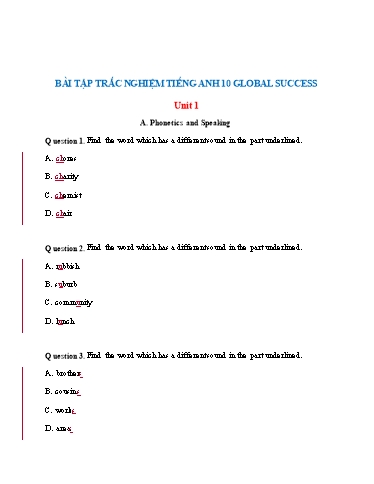
 Question 4. Find the word which has a different sound in the part underlined.
A. skill
B. split
C. children
D. finance
Question 5. Find the word which has a different sound in the part underlined.
A. breadwinner
B. clean
C. each
D. lead
Question 6. Find the word which has a different sound in the part underlined.
A. chore
B. work
C. more
D. divorce
Question 7. Find the word which has a different sound in the part underlined. Question 11. Find the word which has a different sound in the part underlined.
A. share
B. alike
C. tradition
D. equal
Question 12. Find the word which has a different sound in the part underlined.
A. generation
B. grateful
C. educate
D. grandparents
Question 13. Find the word which has a different sound in the part underlined.
A. cleaned
B. shared
C. called
D. visited
Question 14. Find the word which has a different sound in the part underlined.
A. trashed
B. talked Question 18. Mark the letter A, B, C, or D to indicate the word that differs from the
other three in the position of primary stress
A. contribute
B. generous
C. homemaker
D. meaningful
Question 19. Mark the letter A, B, C, or D to indicate the word that differs from the
other three in the position of primary stress
A. grocery
B. enormous
C. consumption
D. financial
Question 20. Mark the letter A, B, C, or D to indicate the word that differs from the
other three in the position of primary stress
A. relationship
B. collaborate
C. responsible
D. generation
 B. Vocabulary and Grammar
Question 1. Choose the best answer In ____ to your regular duties, you can do many other things around the home that
would benefit your family.
A. reply
B. response
C. addition
D. return
Question 5. Choose the best answer
Scheduling a family meeting ____ a regular basis is a good way to make sure this
activity happens.
A. on
B. in
C. with
D. by
Question 6. Choose the best answer
A family is made up ____ people who care about one another.
A. by
B. from
C. of
D. with
Question 7. Choose the best answer Strong families are the foundation of strong communities, ____ a strong foundation
needed to construct a sturdy building.
A. as
B. like
C. for
D. since
Question 11. Mark the letter A, B, C, or D to indicate the word(s) CLOSEST in
meaning to the underlined word(s)
All families have ups and downs, but strong families know the importance of sticking
together - especially during the tough times.
A. fun and sorrows
B. bread and butter
C. risks and benefits
D. rises and falls
Question 12. Mark the letter A, B, C, or D to indicate the word(s) CLOSEST in
meaning to the underlined word(s)
Examples of crisis in the family can include a death, a damaging storm, or a burglary
and many other stressful events that can affect the entire family.
A. time of hardship
B. time of fun
C. time of gathering
D. time of reunion B. being polite and showing respect
C. being uneducated and causing offence
D. being polite and offering assistance
Question 16. Mark the letter A, B, C, or D to indicate the underlined part that needs
correction
Everyone can play an important role by always doing their best to help their
families flourishes.
A. play
B. role
C. their
D. fourishes
Question 17. Mark the letter A, B, C, or D to indicate the underlined part that needs
correction
Each family member need to develop certain traits and skills and then practice being
a strong and supportive member of the family.
A. need to develop
B. traits and skills
C. strong and supportive
D. the family
Question 18. Mark the letter A, B, C, or D to indicate the underlined part that needs
correction C. Reading
Questions 1-5. Read the following passage and mark the letter A, B, C, or D to
indicate the correct answer to each of the questions.
The family in Britain is changing. The once typical British family headed by two
parents has undergone substantial changes during the twentieth century. In particular
there has been a rise in the number of single-person households, which increased
from 18 to 29 per cent of all households between 1971 and 2002. By the year 2020, it
is estimated that there will be more single people than married people. Fifty years
ago, this would have been socially unacceptable in Britain.
In the past, people got married and stayed married. Divorce was very difficult,
expensive and took a long time. Today, people's views on marriage are changing.
Many couples, mostly in their twenties or thirties, live together (cohabit) without
getting married. Only about 60% of these couples will eventually get married.
In the past, people married before they had children, but now about 40% of children
in Britain are born to unmarried cohabiting) parents. In 2000, around a quarter of
unmarried people between the ages of 16 and 59 were cohabiting in Great Britain.
Cohabiting couples are also starting families without first being married. Before 1960
this was very unusual, but in 2001 around 23 per cent of births in the UK were to
cohabiting couples.
People are generally getting married at a later age now and many women do not want
to have children immediately. They prefer to concentrate on their jobs and put
off having a baby until late thirties.
The number of single-parent families is increasing. This is mainly due to more
marriages ending in divorce, but some women are also choosing to have children as
lone parents without being married.
Question 1. Which of the following could be the best title for the passage?
A. Changing Values and Norms of the British Family
B. Changes in Marriage among British Young Generations
C. Changing Insights into and Ideas of the British Family B. positive
C. negative
D. predictive
Question 6. According to the passage, which of the following is NOT true?
A. Family is a vital part of your life.
B. Not everyone has a family.
C. We will effortlessly be damaged without our family.
D. Some laws in the world may oppose the functions of family.
Question 7. In the writer's opinion, ____.
A. it is not the function of the family to make sure we are happy
B. your family will be with you regardless of difficulties
C. family creates some easily-spoilt creatures
D. people can be easily forgiven by people around
Question 8. To children, family plays a role in ____.
A. teaching them academic subjects
B. developing their personal traits
C. helping them to find a good job
D. encouraging them to study a lot at school C. during
D. for
Question 13.
A. made
B. taken
C. done
D. decided
Question 14.
A. which
B. that
C. when
D. where
Question 15.
A. develop
B. develops
C. developing
D. developed
Question 16. Question 20.
A. best
B. hard
C. heart
D. full
 D. Writing
Question 1. Rearrange the sentences to make meaningful sentences
What/ can/ to/ you/ parents/ do/ a/ hand/ give/ with/ your/ the housework?
A. What you can do to give your parents a hand with the housework?
B. What do you can to give your parents a hand with the housework?
C. What do you can give to your parents a hand with the housework?
D. What can you do to give your parents a hand with the housework?
Question 2. Rearrange the sentences to make meaningful sentences
I/ when/ mother/ usually/ in/ having/ my/ confide/ problems.
A. I usually confide my mother in when having problems.
B. I usually confide when having problems in my mother.
C. I usually confide in when my mother having problems.
D. I usually confide in my mother when having problems. Question 6. Mark the letter A, B, C, or D to indicate the sentence that is closest in
meaning to the first one
Effectively managing a family requires balancing time and money.
A. To effectively manage a family requires balancing time against money.
B. Time and money in balance is a requirement for an effective family manager.
C. Balancing time and money is required to effectively manage a family.
D. An effective family manager must be able to balance time and money.
Question 7. Mark the letter A, B, C, or D to indicate the sentence that is closest in
meaning to the first one
It is important that family members talk and listen to one another.
A. Family members should always talk and listen to one another.
B. Talking and listening to family members is important to everyone.
C. Family members always find it important to talk and listen to one another.
D. Talking and listening to one another must be done among family members.
Question 8. Mark the letter A, B, C, or D to indicate the sentence that is closest in
meaning to the first one
You can show your love for your family through special words and actions.
A. Through special words and actions can you show your love for your family.
B. Your love for your family through special words and actions can be shown.
C. Special words and actions can be shown through your love for your family.
D. It can be shown through special words and actions that your family is loved. A. Your family would not be the same if there were no one like you.
B. If there were someone like you, your family would be the same.
C. There is no one like you, without whom, your family would not be the same.
D. Because there is no one like you, then your family would never be the same.
Question 12. Mark the letter A, B, C, or D to indicate the sentence that best
combines each pair of sentences given
I am the youngest son in the family. I didn’t have to do much housework.
A. Being the youngest son in the family, I didn’t have to do much housework.
B. If I was the youngest son in the family, I wouldn t have done much housework.
C. Although I am the youngest son in the family, I wouldn’t have done much
housework.
D. Despite the fact that I am the youngest son in the family, I did not have to do
much housework.
Question 13. Mark the letter A, B, C, or D to indicate the sentence that best
combines each pair of sentences given
We need to share the tasks. The burden on each member will be more tolerable.
A. Although the burden on each member will be more tolerable, we still need to
share the tasks.
B. We need to share the tasks so the burden on each member will be more tolerable.
C. Unless we share the tasks, the burden on each member will be more tolerable.
D. It is essential to share the tasks, otherwise, the burden on each member will be
more tolerable. A. Your family would not be the same if there were no one like you.
B. If there were someone like you, your family would be the same.
C. There is no one like you, without whom, your family would not be the same.
D. Because there is no one like you, then your family would never be the same.
Question 17. Mark the letter A, B, C, or D to indicate the sentence that best
combines each pair of sentences given
The nuclear household is an ideal many strive for. A nuclear household consists of
one or two parents and some kids under one roof.
A. The nuclear household, which consists of one or two parents and some kids under
one roof, is an ideal many strive for.
B. Even though a nuclear household consists of one or two parents and some kids
under one roof, it is an ideal many strive for.
C. The nuclear household is an ideal many strive for, but a nuclear household
consists of one or two parents and some kids under one roof.
D. The nuclear household is an ideal many strive for because a nuclear household
consists of one or two parents and some kids under one roof.
Question 18. Mark the letter A, B, C, or D to indicate the sentence that best
combines each pair of sentences given
He tried his best. He won the biggest prize.
A. If he had tried his best, he could have won the biggest prize.
B. Unless he tried his best, he couldn’t win the biggest prize.
C. Although he tried his best, he still won the biggest prize.
D. If he hadn’t tried his best, he couldn’t have won the biggest prize. B. calorie
C. donate
D. allergy
Question 2. Find the word which has a different sound in the part underlined
A. help
B. benefit
C. elderly
D. garden
Question 3. Find the word which has a different sound in the part underlined
A. volunteer
B. collage
C. commUnity
D. doctor
Question 4. Find the word which has a different sound in the part underlined
A. provide
B. individual
C. situation B. cultural
C. drum
D. sculpture
Question 9. Find the word which has a different sound in the part underlined
A. tablecloth
B. authenticity
C. through
D. although
Question 10. Find the word which has a different sound in the part underlined
A. attraction
B. surface
C. lacquerware
D. artisan
Question 11. Find the word which has a different sound in the part underlined
A. weave
B. treat
C. deal
D. drumhead D. machine
Question 16. Choose the word which has a different stress pattern from the others.
A. artefact
B. embroider
C. carpentry
D. conical
Question 17. Choose the word which has a different stress pattern from the others.
A. complicated
B. experience
C. prosperity
D. traditional
Question 18. Choose the word which has a different stress pattern from the others.
A. historical
B. embroidery
C. authority
D. architecture
Question 19. Choose the word which has a different stress pattern from the others.
A. effective B. never
C. late
D. recent
Question 3. Choose the word or the phrase or sentence that best completes each
unfinished sentence below
The boy likes ________ games but hates ___________ his lessons.
A. play / study
B. playing / study
C. play / studying
D. playing / studying
Question 4. Mark the letter A, B, C, or D to indicate the word(s) CLOSEST in
meaning to the underlined word(s) in each question
We must admit that people are heavily polluting the environment.
A. decline
B. rebut
C. deny
D. accept
Question 5. Mark the letter A, B, C, or D to indicate the word(s) CLOSEST in
meaning to the underlined word(s) in each question
Most people admit that they contribute to global warming.
File đính kèm:
- bai_tap_trac_nghiem_tieng_anh_lop_10_global_success_kem_dap.docx


