

Bài tập từ vựng và ngữ pháp Tiếng Anh Lớp 11 Global Success - Unit 7: Education options for school leavers (Có đáp án)
 15 trang
12/11/2025
6543
15 trang
12/11/2025
6543
Bạn đang xem tài liệu "Bài tập từ vựng và ngữ pháp Tiếng Anh Lớp 11 Global Success - Unit 7: Education options for school leavers (Có đáp án)", để tải tài liệu gốc về máy hãy click vào nút Download ở trên.
Tóm tắt nội dung tài liệu: Bài tập từ vựng và ngữ pháp Tiếng Anh Lớp 11 Global Success - Unit 7: Education options for school leavers (Có đáp án)
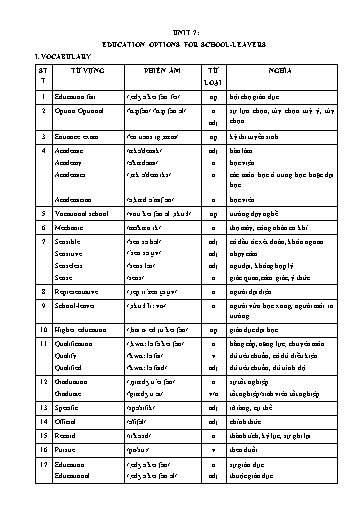
 Educated /ˈedʒ.ə.keɪ.t̬ɪd/ adj được đào tạo, cú học thức
 Educative /ˈedʒ.ə.keɪ.t̬ɪv/ adj mang tớnh giỏo dục
 Educator /ˈedʒ.ə.keɪ.t̬ɚ/ n giỏo viờn, giảng viờn
 Educate /ˈedʒ.ə.keɪt/ v giỏo dục, dạy học
 18 Expert /ˈek.spɝːt/ n/adj chuyờn gia/về mặt chuyờn mụn
 19 Formal /'fɔ:r.məl/ adj chớnh thức; chớnh thống, trang trọng
 Informal /ɪn'fɔ:r.məl/ adj khụng chớnh thống
 20 Degree /dɪ'gri:/ n bằng cấp
 21 Independently /ˌɪn.dɪˈpen.dənt.li/ adv một cỏch độc lập
 22 Job market /dʒɑ:b 'ma:r.kɪt/ np thị trường việc làm
 23 Apprenticeship /əˈpren.t̬ɪs.ʃɪp/ n quỏ trỡnh/thời gian học việc
 Apprentice /əˈpren.t̬ɪs/ n người học việc
 24 Hands-on /ˌhổnd'za:n/ adj thực tế, thực tiễn
 25 Experience /ɪk'spɪr.i.əns/ n kinh nghiệm, sự từng trải
 26 Wage /weɪdʒ/ n tiền cụng
 Salary /ˈsổl.ɚ.i/ n tiền lương
 27 Cover /'kʌv.ɚ/ v trang trải; bao phủ, bao trựm
 28 Living cost /'lɪvɪŋ ˌkɑ:st/ np sinh hoạt phớ
 29 Institution /ˌɪn.stə'tu:.ʃən/ n cơ quan; trụ sở cơ quan, tổ chức, thể
 chế
 30 Educational journey /ˌedʒ.əˈkeɪ.ʃən.əl np hành trỡnh giỏo dục
 ˈdʒɝː.ni/
 31 Critical thinking skill /ˌkrɪt̬.ɪ.kəl ˈθɪŋ.kɪŋ skɪl/ np kỹ năng tư duy phản biện
 32 Professional /prə'feʃ.ən.əl/ adj chuyờn nghiệp
 33 Brochure /broʊˈʃʊr/ n tờ rơi quảng cỏo
 34 Formal education /'fɔ:r.məl ˌedʒ.əˈkeɪ.ʃən/ np giỏo dục chớnh quy
 35 Alternatively /ɑːlˈtɝː.nə.t̬ɪv.li/ adv ngoài ra
 36 Bachelor's degree /ˌbổtʃ.əl.ɚz dɪˈɡriː/ np bằng cử nhõn
 37 Master's degree /ˌmổs.tɚz dɪˈɡriː/ np bằng thạc sĩ
 38 Doctorate /ˈdɑːk.tɚ.ət/ n bằng tiến sĩ
II. STRUCTURES
 STT CẤU TRÚC NGHĨA
 1 Make a decision đưa ra quyết định + Tõn ngữ sau một số động từ (admit, deny, forget, remember, mention, regret, etc.) hoặc sau
 giới từ
 Vớ dụ: He admitted having skipped the important meeting to attend a personal event.
 (Anh ta thừa nhận đó bỏ qua cuộc họp quan trọng đú để tham gia một sự kiện cỏ nhõn.)
 The team is proud of having won the championship for the third consecutive year.
 (Đội tự hào vỡ đó giành chức vụ địch năm thứ ba liờn tiếp.)
2. Perfect participle clause (Mệnh đề phõn từ hoàn thành)
- Phõn từ hoàn thành cú dạng giống như danh động từ hoàn thành: HAVING + VP2
- Chỳng ta cú thể sử dụng mệnh đề phõn từ hoàn thành để:
 + Miờu tả một hành động xảy ra trước hành động trong mệnh đề chớnh
 Vớ dụ: Having completed my assignments, I rewarded myself with a movie night.
 (Sau khi hoàn thành nhiệm vụ, tụi tự thưởng cho mỡnh một đờm xem phim.)
 + Núi về lớ do cho hành động trong mệnh đề chớnh
 Vớ dụ: Having traveled to many countries, they became seasoned adventurers.
 (Đó đi đến nhiều quốc gia, họ trở thành những nhà thỏm hiểm dày dạn kinh nghiệm.)
IV. PRACTICE EXERCISES
A. PHONETICS
Mark the letter A, B, C, or D to indicate the word whose underlined part differs from the other three
in pronunciation in each of the following questions.
1. A. event B. exam C. edit D. enhance
2. A. sensible B. business C. person D. institute
3. A. trade B. date C. place D. map
4. A. check B. chef C. brochure D. schedule
5. A. real B. ready C. threat D. head
Mark the letter A, B, C, or D to indicate the word that differs from the other three in the position of
primary stress in each of the following questions.
1. A. subject B. degree C. market D. expert
2. A. vocation B. addition C. graduate D. advantage
3. A. different B. specific C. dependent D. convenient
4. A. discussion B. appointment C. duration D. bachelor
5. A. qualification B. university C. educational D. representative
B. VOCABULARY
Mark the letter A, B, C, or D to indicate the word(s) CLOSEST in meaning to the underlined word(s)
in each of the following sentences.
1. I want to become a restaurant cook, so I'm looking for a professional cooking course.
 A. checked B. trained C. accepted D. connected
2. We can learn a lot about a particular school from its school’s brochure which has a lot of information. A. for B. about C. to D. from
6. ________ is really for people who want formal learning to get an academic degree.
 A. Distance education B. Continuing education
 C. Service education D. Higher education
7. Vocational education will help you ________ the practical skills and knowledge necessary for a
specific job.
 A. take B. catch C. gain D. keep
8. After getting their vocational qualifications, ________ can immediately start work and earn a salary.
 A. graduates B. school-leavers C. teachers D. professors
9. Apprenticeship provides students with ________ experience and gives them wages to cover their
living costs.
 A. hands-off B. hands-free C. hands-on D. hands-down
10. He ________ getting one of the most prestigious companies’ scholarships.
 A. focused on B. succeeded in C. asked about D. asked for
11. Students can get a ________ related to an academic subject at college or university.
 A. certificate B. credit C. degree D. qualification
12. ________ is a period of time working for and learning from a skilled person.
 A. Apprenticeship B. Probation C. Undergraduate D. Postgraduate
13. He has worked as a visiting lecturer for various educational ________.
 A. institutions B. secondary schools C universities D. primary schools
14. In England students must stay in ________ education or do a training course until the age of 18.
 A. sixth-form B. apprentice C. full-time D. part-time
15. Exams are taken at the end of the two-year course and the grades are used to ________ university
courses.
 A. apply for B. get into C. refer to D. go on
Fill in the blanks with suitable prepositions.
1. In the UK students usually focus ________ three or four subjects they are interested in or related to
 the degree they want to study at university.
2. Nowadays there are educational opportunities available ________ all school-leavers.
3. At vocational schools, the students can do apprenticeship and get experience ________ the job.
4. Students with IELTS certificates have an advantage ________ students having no English certificates.
5. He was proud ________ having won first place in the competition.
Mark the letter A, B, C, or D to indicate the underlined part that needs correction in each of the
following questions.
1. Some students prefer getting into vocational courses or find a job after leaving school.
 A B C D
2. Having qualifications from good educator institutions helps young people find jobs
 A B C A. All right. I'll see you then. B. Sorry. I forgot to make an appointment.
 C. That suits you. D. Is it convenient for you?
2. Sue is asking Jane.
 Sue: Could I meet you on Thursday morning? I would like your advice on how to prepare for
 apprenticeship next month.
 Jane: ________
 A. It’s OK for me to do some training.
 B. Apprenticeship is good for your future job.
 C. I'm fine if you want to go around.
 D. Sorry. I have another appointment at that time. I'm free in the afternoon.
3. Jane and Sue are talking to each other.
 Jane: What time can I come to see you tomorrow?
 Sue: ________
 A. Would you mind if I leave now? B. Would 9 o’clock suit you?
 C. I think it will be fine. D. Do you get there by car?
4. Jane is talking to Jack.
 Jack: I want to go shopping with you. When’s convenient for you?
 Jane: ________
 A. OK. I'll go and see you. B. You’ve got an appointment with me.
 C. I'm free tomorrow morning. D. I couldn’t make it at that time.
5. Rose is talking to Jane.
 Rose: I’d like to arrange an appointment with you tonight.
 Jane: ________
 A. That sounds great. B. I want some more time.
 C. That doesn’t mean to me. D. Are you free then?
E. READING
Read the following passage and mark the letter A, B, C, or D to indicate the correct word or phrase
that best fits each of the numbered blanks from Ito 10.
 A school-leaver (1) ________ to an individual who has recently completed their secondary education
and is transitioning (2) ________ the next phase of their academic or professional journey. It is a
significant milestone in their lives, as they (3) ________ farewell to their school years and embark on a
new chapter. School-leavers face a myriad of options and decisions, (4) ________ from pursuing higher
education to vocational training or entering the workforce directly. This period marks a crucial time for
self-reflection and exploration, [5] ________ they discover their passions, interests, and strengths while
considering the future pathways available to them.
 For many school-leavers, the decision to continue their education at a college or university is a (6)
________ choice. Higher education provides an opportunity to specialize in a specific field of study and
gain in-depth knowledge and skills. It opens (7) ________ to a wide range of career opportunities and
equips individuals with critical thinking, problem-solving, and communication skills essential for C. Making Informed Decisions: How to Choose the Right Education Path for School-Leavers
 D. Mapping Future Careers: Exploring Opportunities for School-Leavers
12. According to the passage, the common path after leaving school for students is ________ .
 A. tertiary education B. VET programs C. apprenticeship D. internship
13. The word "align with” in paragraph 1 is closest in meaning to ________ .
 A. come up with B. deal with C. go with D. match with
14. The word "emphasize" in paragraph 2 is closest in meaning to ________ .
 A. understate B. highlight C. strengthen D. italicize
15. The word "them" in the last paragraph refers to ________ .
 A. aspirations B. options C. school-leavers D. decisions
16. Which of the following is NOT true according to the passage?
 A. Pursuing higher education at a university or college typically involves obtaining a bachelor’s
 degree.
 B. Vocational education and training (VET) programs focus on providing practical skills and
 knowledge for specific industries or trades.
 C. Apprenticeships do not offer any classroom instruction and are solely based on on-the-job training.
 D. School-leavers have the opportunity to specialize in areas aligned with their career aspirations
 through university or college education.
17. It can be inferred from the passage that ________.
 A. Apprenticeships provide a more practical learning experience compared to higher education.
 B. Vocational education and training (VET) programs are more beneficial for school-leavers than
 pursuing a university degree.
 C. School-leavers should prioritize earning potential when choosing an education option.
 D. Considering individual interests and career aspirations when choosing an education option for
 school-leavers is important.
 UNIT 7:15-MINUTE TEST
I. Rewrite the sentences using Perfect Participle Clauses or Perfect Gerunds.
1. She didn’t get up early and then she got to school late.
→ _______________________________________________________________________________.
2. After Jack had sent the CV online, he realized that he had forgotten to fill in his phone number.
→ _______________________________________________________________________________.
3. I had not prepared well for the presentation, so I didn’t get a good mark on it.
→ _______________________________________________________________________________.
4. After he bought a new book, he read it anywhere and anytime.
→ _______________________________________________________________________________.
5. He didn’t remember that he had met her at his teacher’s house.
→ _______________________________________________________________________________. A. Finish B. To finish C. Having finished D. Finished
12. To be considered for this position, applicants must possess the necessary ________ and experience.
 A. qualifications B. degrees C. certificates D. credits
13. Many young people find it hard to get a good job after ________.
 A. graduate B. graduated C. to graduate D. graduation
14. ________ about the job advertisement earlier, I missed the deadline for applying for it.
 A. Having known B. Not having known C. Known D. Know
15. Higher education is really for people who want formal learning in order to get an ________ degree.
 A. academic B. academy C. academician D. academia
16. If you are good at certain subjects and need a degree ________ those subjects, the university is the
right choice for you.
 A. focused on B. relied on C. related to D. based on
17. I would like to thank my teacher for ________ me to pursue my passion for writing.
 A. being inspired B. inspire C. to inspire D. having inspired
18. Besides studying, university students have a chance to live ________.
 A. dependent B. independently C. independent D. dependence
19. University students have broader career ________ and an advantage in the job market.
 A. options B. experiences C. decisions D. application
20. ________ answering questions a lot made me feel confident in the interview.
 A. To practise B. To have practise C. Having practised D. Practised
21. Vocational schools may offer students an ________ in which they may have hands-on experience.
 A. probation B. apprenticeship C. training D. challenge
22. There are a lot of ________ opportunities for school-leavers today.
 A. education B. educate C. educator D. educational
Mark the letter A, B, C, or D to indicate the underlined part that needs correction in each of the
following questions.
23. He was proud of had won the first place in the English Speaking Contest.
 A B C D
24. Vocation training is usually much shorter than a college or university course.
 A B C D
25. Failed the university entrance exams, he decided to train to become a car mechanic.
 A B C D
READING
Read the following passage and mark the letter A, B, C, or D to indicate the correct word or phrase
that best fits each of the numbered blanks from 26 to 30.
 Vocational training in Vietnam plays a vital role in preparing individuals for specific careers and
industries. The country recognizes the importance of practical skills and knowledge in the workforce,
and vocational training programs provide hands-on training (26) ________ directly applies to various
File đính kèm:
- bai_tap_tu_vung_va_ngu_phap_tieng_anh_lop_11_global_success.docx
- ANSWER KEYS.docx


