

Đề cương ôn tập giữa học kì 2 Tiếng Anh Lớp 11 Global Success - Năm học 2023-2024 (Có đáp án)
 24 trang
17/11/2025
1571
24 trang
17/11/2025
1571
Bạn đang xem tài liệu "Đề cương ôn tập giữa học kì 2 Tiếng Anh Lớp 11 Global Success - Năm học 2023-2024 (Có đáp án)", để tải tài liệu gốc về máy hãy click vào nút Download ở trên.
Tóm tắt nội dung tài liệu: Đề cương ôn tập giữa học kì 2 Tiếng Anh Lớp 11 Global Success - Năm học 2023-2024 (Có đáp án)
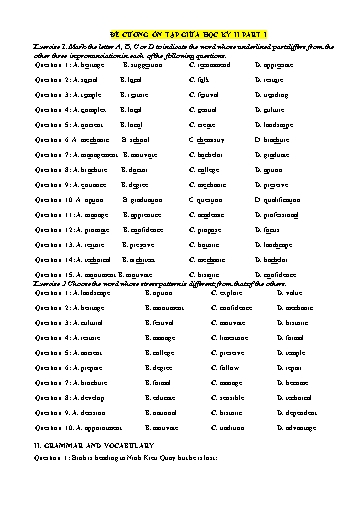
 Binh: “Excuse me, can you show me the way to Ninh Kieu Quay?”
The local: "You are near there; you just need to ____________ Ngo Quyen street.”
A. go straight on B. on your right C. go right and left D. go around
Question 2: Thomas gets lost on his way to Cai Rang floating market:
Thomas: "________________________."
The Vietnamese: “Go straight ahead until you reach Cai Son bridge!"
A. Can you book me a Grab car? B. How can I have Cai Rang floating market?
C. Can you show me the way to this place? D. What is the best price for the floating market?
Question 3: ______ teenagers to study local heritages, Can Tho university hosted several trips to other
provinces.
A. To encourage B. Encouraging C. To encouraging D. Encouraged
Question 4: For newcomers, the first place _______ in Cần Thơ is the bustling Cái Răng Floating
Market.
A. visiting B. to visiting C. to visit D. is visited
Question 5: ___________ helps protect and restore heritage by raising money for cultural projects.
A. Limestone B. Crowdfunding C. Valley D. State
Question 6: Marleen is the only girl ________ her opinion about going to historical sites.
A. to raise B. raising C. raised D. raises
Question 7: ___________ a perfect trip to famous heritages, they visited many tourism websites.
A. Planning B. To plan C. To planning D. Planned
Question 8: Exploring ancient temples and pagodas has become a ________ activity for tourists who
visit the Mekong Delta.
A. trending B. festive C. folk D. ancient
Question 9: Quin always concerned about the group project, but he never gave voice _____ it.
A. for B. at C. in D. to
Question 10: In an effort to __________ cultural diversity, the festival featured performances of folk
singing from mixed heritage communities.
A. recommend B. punish C. preserve D. reduce
Question 11: Son Doong Cave is the largest cave __________ in Phong Nha-Ke Bang National Park. Question 20: In the job market, having a specific set of skills and __________ can increase your
employment opportunities.
A. hobbies B. qualifications C. secrets D. ideas
Question 21: A __________ is an informational booklet that provides details about educational
programs and institutions.
A. novel B. brochure C. letter D. report
Question 22: He regrets __________ so much money on unnecessary things.
A. spend B. to spend C. having spent D. spent
Question 23: __________ finished all my homework, I had some free time to relax.
A. Having B. Have C. Had D. Has
Question 24: ____________ her fears, she gave an excellent speech.
A. Having overcome B. Having been overcome
C. Not having overcome D. Not having been overcome
Question 25: Independent thinkers aren't afraid to ____________ unique opinions in discussions.
A. carry out B. come up with C. make use of D. get around
Question 26: To maintain independence, avoid _________ into the habit of procrastination.
A. getting B. to get C. get D. got
Question 27: It was the sound of the distant thunder _____________ made the hikers decide to turn
back.
A. that B. where C. who D. whose
Question 28: Knowing how to use public transportation is essential to get _____ in the city.
A. onto B. into C. around D. within
Question 27: __________ skills refer to the ability to evaluate options, then make choices that are
effective and appropriate in a given situation.
A. Time-management B. Money-management C. Decision-making D. Self-motivated
Question 28: It was Henry _____ showed me how to earn my parent’s trust.
A. who B. which C. that D. A&C are correct.
Question 29: Emily makes ________ online resources to research and learn new things.
A. use of B. ends meet C. up with D. around
Question 30: Sarah __________ the habit of tidying up her room before going to bed each night. 8. You'll learn about urban lifestyles and traditions from the 15th to the 19th century and will see
 examples of ancient ____________. (ARCHITECT)
9. Without our heritage, we would lose touch with our past, and our future ____________ would not
 have a sense of their roots. (GENERATE)
10. Two 10th grade students suggested forming _______________societies or local groups who have
 akeen interest in their history and heritage. (HISTORY)
11. Trang An is a __________landscape complex that includes limestone karst mountains, caves, rivers,
 and rice paddies. (SCENERY)
12. The complex has been recognized as an important site for ____________ conservation and
 ecotourism. (DIVERSE)
13. There are a lot of ____________opportunities for school-leavers today. (EDUCATE)
14. Many school-leavers choose to go to university to study __________ subjects. (ACADEMY)
15. It's possible that students may need certain _____________or prerequisites to apply for this course,
 such as a high school diploma or previous experience in cooking. (QUALIFIED)
16. It ultimately depends on the specific __________ of the course and the institution offering it.
(REQUIRE)
17. Nowadays, school-leavers can apply for __________ in different industries. ( APPRENTICE)
18.Many young people find it hard to get a job immediately after __________. ( GRADUATE)
19. I want to become a restaurant cook, so I am looking for a _________ cooking course. (
PROFESSION)
20. It’s my parents who still think I don’t have the skill to be __________. (DEPEND) II.
 Rewrite the sentences without changing the meaning of the given ones.
To-infinitives
1. Most of students on our group spend 20 minutes cycling from home to school.
➔ It takes________________________________________________________.
2. Her parents don’t allow her to go out at night.
➔ She__________________________________________________________.
3. The man prefer working in the lab to teaching students at class.
➔ The man would rather __________________________________________.
4. The teacher didn’t remember to lock the door before leaving the class.
➔ The teacher forgot _____________________________________________.
5. You couldn’t go swimming because of the heavy rain.
➔ The rain was too_______________________________________________.
6. They say that the company is in difficulty.
➔ The company __________________________________________________. ➔ I remember ________________________________________________________________. 5.
 Some scientists have not reported the effects of climate change. They were accused of that.
➔ Some scientists were accused of________________________________________________.
Cleft sentences
1. Many teenagers spend a lot of time thinking and talking about being in a relationship.
➔It _______________________________________
2. Welsh boys gave hand-carved wooden spoons to girls as a symbol of their love.
➔It _______________________________________
3. Dating is left for the college years in Japan.
➔It _______________________________________
4. Once married, the South Korean man expects his wife to be a more traditional woman.
➔It _______________________________________
5. A South Korean boy often holds his girlfriend’s handbag during a date.
➔It _______________________________________
6. The drought made many people suffer in this area.
➔It _______________________________________
7. We expected a suitable meeting last week.
➔It _______________________________________
8. Renewable energy provides a better environment for all of us.
➔It_______________________________________
9. The environmentalist at the conference explained how renewable energy resources will change the
 environment.
➔ It_______________________________________
10. The firefighter saved many lives from the fire yesterday.
➔ It_______________________________________
 PART III
CLOZE TEST 1. Read the passage below and then choose the best answer (A, B, C or D) that fits
best for the gap.
Preserving heritage is a collective responsibility that requires conscious efforts and strategic approaches.
Firstly, documentation plays a crucial role (1) ________ safeguarding heritage. It involves thorough
research, and documentation of historical records, artifacts, and oral traditions (2) ________ with a
particular heritage. This process helps create an extensive archive that serves as a reference for future
generations and aids in understanding and appreciating the significance of heritage. CLOZE TEST 4. Read the following passage and circle A. B. C. or D to indicate the correct
answer to each of the questions.
 Building Confidence in Teens
Confidence is one's belief in their own ability. Confident people rationally believe they are capable of
doing things well and therefore aren't afraid to do those things or even try new things. Teens (1)
are confident to grow up have a good (2) Parents can help teens build their confidence
throughout their adolescence t cou. Provide a sate home environment and firm but fart disciplines This is
a foundation that your teens This is a foundation that your teen's confidence can stand on. Give your
teen choices. One of the things that confidence helps teens do is making a decision. You can help teens
make decision by offering them choices as often as possible. (3) your teen to try new things.
Be available to take them where they need to go and do so without complaining. Become your teen's
biggest fan, (4) it is in sports, or in school. Allow your teen to fail, do not fix their problems for
them. If they need you to help talk the problem through, ask open ended questions so that they come to
their own conclusions. Praise your teen when praise is suitable. We know that too (5) praise is
not good either, but suitable praise is necessary for your teen's self-confidence.
1. A. when B. who C. which D. where
2. A. feeling B. state C. sense D. ability
3. A. Believe B. Prefer C. Like D. Encourage
4. A. and B. however C. whether D. but
5. A. much B. many C. all D. some
READING COMPREHENSION
PASSAGE 1
 Preserving our heritage is a crucial task that involves safeguarding our cultural history and identity.
It means protecting both the physical objects and the intangible aspects of our past that have been passed
down to us. Things like historical sites, artifacts, traditions, and languages are all part of our heritage and
deserve to be taken care of.
 Nations should be in an attempt to preserve their heritage because heritage allows future
generations to learn from and appreciate the accomplishments and struggles of those who came before
us. It helps us understand where we come from and how our societies have developed over time. When
we preserve our heritage, we also feel a strong sense of belonging, as it connects us to our shared history
and cultural practices. In addition, preserving heritage promotes cultural diversity and encourages
communication between different cultures. It helps us appreciate the uniqueness of each culture and
promotes respect and understanding among people. By celebrating and protecting our diverse heritage,
we create opportunities for cultural exchange, which brings people together and helps build a more
harmonious and inclusive society.
 Preserving heritage is not just a responsibility; it is an investment in our collective memory,
identity, and the future well-being of generations to come. So let's cherish and protect our heritage,
ensuring that it continues to enrich and inspire us for years to come.
 (Adapted from Heritage Daily)
1. Which of the following can be the best title for the passage?
 A. The Importance of Preserving Cultural Heritage
 B. Safeguarding Our Heritage for Future Generations
 C. Promoting Cultural Diversity through Heritage Preservation
 D. The Significance of Heritage in Building Inclusive Societies
2. According to paragraph 1, preserving heritage means ________.
 A. protecting the environment around us so that it will be sustainable One of your most important goals as a parent is to raise children who become independent and
self-reliant people. However, some well-intended, but misguided parents have raised contingent children
rather than responsible ones.
 Contingent children are dependent on others for how they feel about themselves. Those children
are raised by parents who act on their own needs for power and use control to ensure that they remain
the dominant forces in their children's lives.
 Independent children differ from contingent children in several ways. If your children are
independent, you have provided them with the belief that they are competent and capable of taking care
of themselves. You offered them the guidance to find activities that are meaningful and satisfying. You
gave your children the freedom to experience life fully and learn its many important lessons.
 The most important thing about raising independent children is you understand the essential
responsibilities that you and they need to accept.
 Your responsibilities revolve primarily around providing your children with the opportunity,
means, and support to pursue their goals. The psychological means include providing love, guidance,
and encouragement in their efforts. The practical means include ensuring that your children have the
materials needed, proper instruction, and transportation, as well as other logistical concerns.
 Your child's responsibilities Involve doing what is necessary to maximize the opportunities that
you give them. These responsibilities include giving their best effort, being responsible and disciplined,
staying committed, and giving an achievement opportunity a realistic try, as well as, completing all tasks
and exercises, getting the most out of instruction, being cooperative, and expressing appreciation and
gratitude for others' efforts.
 (Excerpted from Parenting: Raise Indenendent Children)
Question 1. What is the passage mainly about?
A. Ways to raise independent children B. Contingent children
C. Independent children D. How to be good parents
Question 2. Which of the following is NOT TRUE about parents of independent children? A.
They offered their kids the guidance to find meaningful activities.
B. They gave their children the freedom to experience life.
C. They help their children believe that they are competent and capable of taking care of themselves.
D. They use control to ensure that they remain the dominant forces in their children's lives. Question 3.
 Which psychological means should parents provide their children to make them independent?
A. love, guidance and encouragement B. appreciation and gratitude C.
instruction, money and love D. instruction and transportation
Question 4. What does the word “taking care of” mean?
A. look after B. take after C. look into D. take over
Question 5. The word "They" in the paragraph 4 refers to
A. responsibilities B. children C. parents D. thing
 ĐÁP ÁNĐỀ CƯƠNG ÔN TẬP GIỮA HỌC KỲ II
 PART I
Exercise 1. Mark the letter A, B, C or D to indicate the word whose underlined part differs from the
other three in pronunciation in each of the following questions.
Question 1: A. heritage B. suggestion C. recommend D. appreciate
Question 2: A. social B. local C. folk D. restore
Question 3: A. temple B. restore C. festival D. trending
Question 4: A. complex B. local C. central D. culture
File đính kèm:
- de_cuong_on_tap_giua_hoc_ki_2_tieng_anh_lop_11_global_succes.docx


