

Đề cương ôn thi giữa học kì 2 Tiếng Anh Lớp 11 Global Success
 12 trang
17/11/2025
1791
12 trang
17/11/2025
1791
Bạn đang xem tài liệu "Đề cương ôn thi giữa học kì 2 Tiếng Anh Lớp 11 Global Success", để tải tài liệu gốc về máy hãy click vào nút Download ở trên.
Tóm tắt nội dung tài liệu: Đề cương ôn thi giữa học kì 2 Tiếng Anh Lớp 11 Global Success
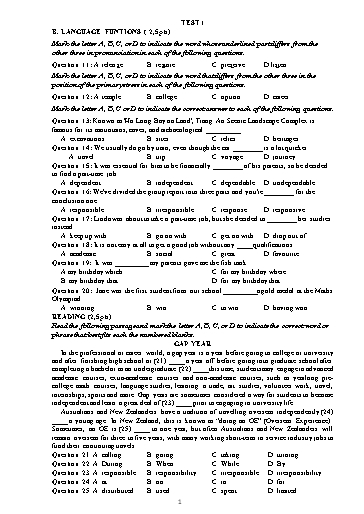
 Read the following passage and mark the letter A, B, C, or D on your answer sheet to indicate
the correct answer to each of the questions
 In Viet Nam festivals often take place during the three months in spring and in autumn
when people have a lot of leisure time. In addition, the climate in spring and autumn is especially
suitable for holding festivals and for festivals goers to enjoy. Traditional festivals constitute a
form of cultural activities, a spiritual product which the people have created and developed during
the course of history. From generation to generation, the Vietnamese people preserve the fine
tradition of “remembering the source while drinking water.” Festivals are events which represent
this tradition of the community as well as honour the holy figures named as “gods” -the real
persons in national history or legendary persons. The images of gods converge the noble
characteristics of mankind. They are national heroes who fought against foreign invaders,
reclaimed new lands, treated people, fought against natural calamities, or those legendary
characters who affect the earthly life.
 Accordingly, first and foremost, festivals are events when people pay tribute to that rendered
merits to the community and the nation. These are occasions when people come back to either
their natural or national roots, which form a sacred part in their mind. Furthermore, festivals
represent the strength of the commune or village, the local region or even the whole nation.
Worshipping the same god, the people unite in solidarity to overcome difficulties, striving for a
happy and wealthy life.
 Moreover, festivals display the demand for creativity and enjoyment of spiritual and material
cultural values of all social strata. They become a form of education under which fine traditional
moral values can be handed from one generation to the next in a unique way of combining
spiritual characters with competition and entertainment games. Festivals are also the time people
can express their sadness and worries in a wish that gods might bestow favour on them to help
them strive for a better life.
 (Adapted from: Overview of Traditional Festivals - Viet Mam, Country and Peoples)
Question 26. What is the best title of the passage?
 A. Social, educational and historical values of Vietnamese festivals
 B. When, how and why festivals in Vietnam keep their traditions
 C. Time, formation and meaning of traditional Vietnamese festivals
 D. Similarities, differences and changes in Vietnamese festivals
Question 27. What affects the time to hold festivals in Viet Nam?
 A. Festival holders’ timetable and festival goers’ preference
 B. The abundance of fruits and flowers and people’s health
 C. People’s preference of leisure time and climate
 D. Weather conditions and people’s working pattern
Question 28. Which of the followings best replace the word “course” in the second paragraph?
 A. Lesson B. Development C. Road D. Creation
Question 29. What does the word “they” in the second paragraph refer to?
 A. Gods B. Images C. Characteristics D. Invaders
Question 30. Which of the following is NOT mentioned as a value of festivals?
 A. Showing community’s union B. Remembering national heroes
 C. Questioning personal bad lucks D. Educating young generations
IV. WRITING (2,5pts)
Mark the letter A, B, C or D to indicate the underlined part that needs correction in each of
the following questions. (0,4pts)
Question 31: It is Mai when is the most intelligent student in her class..
 A. is B. when C. most D. in
Question 32. Many countries have successfully promotion their cultural heritage through
tourism.
 A. May B. countries C. promotion D. heritage
Write the second sentence so that it has a similar meaning to the first. (0,6pts)
 2 The story goes that when Viet Nam had just been formed, it had to fight against invaders. To assist the
Vietnamese in defending their country, the gods sent a family of dragons as (27) ______. This family of
dragons began spitting out jewels and jade. These jewels turned (28)______ the islands dotting the bay,
together forming a great wall against the invaders. By magic, numerous rock mountains abruptly appeared
on the sea before the invaders, and their ships struck the rocks and crashed into each other. After winning
the battle, the dragons were (29) ______ by the peaceful and magnificent sights of the Earth, and decided
to stay and live in this bay. The place (30)_____ the mother dragon descended was named Ha Long.
Question 26. A. and B. or C. but D. so
Question 27. A. protect B. protectively C. protectors D. protective
Question 28. A. in B. into C. out D. on
Question 29. A. presented B. raised C. gathered D. charmed
Question 30. A. where B. which C. who D. whose
Read the following passage and mark the letter A, B, C, or D to indicate the correct answer to each of
the questions. (1 point)
One way of training for your future occupation in Germany is by pursuing a dual vocational training
programme. Such programmes offer plenty of opportunity for on-the-job training and work experience.
Programmes usually last between two and three and a half years and comprise theoretical as well as
practical elements. You will spend one or two days a week, or several weeks at once, at a vocational
school where you will acquire theoretical knowledge that you will need in your future. The rest of the
time will be spent at a company. There you get to apply your newly acquired knowledge in practice, for
example by learning to operate machinery. You will get to know what your company does, learn how it
operates and find out if you can see yourself working there after completing your training.
This combination of theory and practice gives you a real head start into your job: by the time you have
completed your training, you will not only have the required technical knowledge, but you will also have
hands-on experience in your job. There are around 350 officially recognised training programmes in
Germany, so chances are good that one of them will suit your interests and talents. You can find out which
one that might be by visiting one of the jobs and vocational training fairs which are organised in many
German cities at different times in the year.
Employment prospects for students who have completed a dual vocational training programme are very
good. This is the reasons why this kind of training is very popular with young Germans: around two thirds
of all students leaving school go on to start a vocational training programme.
Question 31. Which of the following is probably the best title of the passage?
A. Employment Opportunities and Prospects in Germany
B. Higher Education System in Germany
C. Dual Vocational Training System in Germany
D. Combination of Theory and Practice in Studying in Germany
Question 32. The word "it" in the first paragraph refers to ____.
A. company B. machinery C. knowledge D. organisation
Question 33. Which of the following statements best describes the dual vocational training
programmes?
A. These programmes consist of an intensive theoretical course of two and a half years at a vocational
school.
B. These programmes require you to have only practical working time at a certain company.
C. These programmes offer you some necessary technical skills to do your future job.
D. These programmes provide you with both theoretical knowledge and practical working experience.
Question 34. The word "hands-on” in the second paragraph is closest in meaning to ______.
A. theoretical B. practical C. technical D. integral
Question 35. How many German school leavers choose this vocational training programme?
A. well over 75% B. around one out of five
C. less than a third D. about 70%
Complete the sentences using the prompts. (0,6 point)
Question 38. I borrowed this motorbike from my best friend.(Cleft sentence)
→ It ..
Question 39. Tom has opened a small shop behind the museum. He wanted to sell postcards and
souvernirs to tourists. (to infinitive clause)
→ We .
 4 teenagers have difficulty in identifying their own interests. There are a variety of well-organized career
talks and student counseling workshops to guide and help teenagers (20) ______ what course to take.
Furthermore, psychological tests are also used. Certain instruments such as surveys, interviews and
computer software can help to find out preferences, interests, or learning styles of the students.
Question 16: A. making B. taking C. giving D. having
Question 17: A. In addition B. Otherwise C. For example D. Therefore
Question 18: A. when B. that C. what D. where
Question 19: A. competition B. competitively C. competitive D. compete
Question 20: A. apply B. study C. decide D. employ
LANGUAGE FUNCTION (2.5pts)
Mark the letter A, B, C or D on your answer sheet to indicate the word whose underlined part differs
from the other three in pronunciation in each of the following questions.
Question 21: A. complex B. historic C. limestone D. confident
Mark the letter A, B, C or Don your answer sheet to indicate the word that differs from the other three
in the position of stress in each of the following questions.
Question 22: A. expensive B. important C. popular D. financial
Mark the letter A, B, C or D on your answer sheet to indicate the correct answer to each of the following
questions.
Question 23: Marry enjoys reading ______novels set in World War II.
 A. history B. historic C. historical D. historically
Question 24: More and more young people prefer ______education because they like to learn practical
skills.
 A. vocational B. higher C. lower D. upper
Question 25: My brother signed up for a ______computer course.
 A. self_motivated B. self_study C. motivate D. life skill
Question 26: To develop ______skill, please keep a diary for a task and appointments.
 A. decision-making B. time-management C. life skill D. self-study
Question 27: To develop time-management, teenagers should first ______making a to-do-list every day
or week.
 A. get into the habit of B. get around C. come up with D. carry out
Question 28: The authority plans to ______the monument which was damaged by the storm.
 A. restore B. preserve C. destroy D. damage
Question 29: Lan went to Hue ______the monuments there.
 A. see B. seeing C. to see D. saw
Question 30: ______to introduction to the course, we ask some questions.
 A. Listening B. Listen C. Having listened D. to listen
TEST 4
Mark the letter A, B, C, or D on your answer sheet to indicate the word whose underlined part differs
from the other three in pronunciation in each of the following questions.
Question 11. A. absorbs B. enrollsC. preservesD. consults
Mark the letter A, B, C, or D on your answer sheet to indicate the word that differs from the rest in the
position of the primary stress in each of the following questions.
Question 12. A. degreeB. natureC. entranceD. subject
Mark the letter A, B, C, or D on your answer sheet to indicate the correct answer to each of the following
questions.
Question 13. The local residents suspected the authorities______ having kept the pollution level secret
from the local people.
 A. about B. on C. of D. for
Question 14. A lot of _____ have been taken to reduce global warming and its consequences.
 A. ways B. methods C. rules D. measures
 6 A. Employment Opportunities and Prospects in Germany
 B. Higher Education System in Germany
 C. Dual Vocational Training System in Germany
 D. Combination of Theory and Practice in Studying in Germany
 Question 27. The word "it" in the first paragraph refers to ______.
 A. company B. machinery C. knowledge D. organisation
 Question 28. Which of the following statements best describes the dual vocational training
 programmes?
 A. These programmes consist of an intensive theoretical course of two and a half years at a
 vocational school.
 B. These programmes require you to have only practical working time at a certain company.
 C. These programmes offer you some necessary technical skills to do your future job.
 D. These programmes provide you with both theoretical knowledge and practical working
experience.
 Question 29. The word "hands-on” in the second paragraph is closest in meaning to ______.
 A. theoretical B. practical C. technical D. integral
 Question 30. How many German school leavers choose this vocational training programme?
 A. well over 75%B. around one out of five
 C. less than a third D. about 70%
 IV. WRITING
 Rewrite the sentences beginning with the given words or using suggestions.
 Question 31. They decided to cut down their carbon footprints. They were praised for that.
 They were praised for .
 Question 32. I applied to study at a university in Canada.
 It was at ..
 Question 33. We went to Hoi An because we wanted to see the beautiful old bridge and the French
 houses.
 We went to Hoi An to.
 Question 34. After I completed the project, I felt more confident in my abilities.
 Having.
 WRITING 1
 8 PROBLEMS
First, there is a lack of Interest in folk culture. Xoan singing has been handed down from
generation to generation. However, not many young people want to learn folk singing, and
older performers often have no one to pass down their skills. Second, there are limited
performance opportunities. Artists may have difficulty finding places to perform live.
SOLUTIONS
It is necessary to collect and restore old versions of xoan. It is also important to record or
publish them so that future generations can listen to the recordings or read the song
collections. This problem can be solved by organising xoan singing competitions or
concerts. In addition, there should be more live xoan performances in public places, such as
pedestrian streets or historic sites visited by many tourists. This way, xoan singing will reach
wider and newer audiences.
LISTENING
Exercise 1. Listen to the recording twice, fill in the blank with a suitable word.
 Today, I’m going to give you some (1) .. about record-keeping. Keeping
accurate records is very important, because if a (2) .. is unhappy about his
treatment, he may want to make a complaint to the (3) ... These records will help
us to make a case. Always write your name, the date and the time on all the records. Don’t use
pencil, or colored pens. Use black ink. If you make a mistake, just cross it out with a single line.
Don’t use (4) .. fluid. Don’t try to file the records away yourself, or they may get
lost. Put them in this box here. The administration manager will make sure they are filed away
(5) ...
Exercise 2. Listen to the recording twice, fill in the blank with a suitable word.
 Good afternoon and welcome to the 6.54 service to London, calling at Nottingham,
Leicester, Bedford and Luton. I’d like to (1) .. for our late running, which is
currently 18 – one eight – minutes behind (2) ... This was due to a signal failure.
However, we are (3) .. that we will be able to make up for this lost time and arrive
in London on schedule. There is a buffet service towards the rear of the train in coach C, serving
hot and cold drinks and snacks. Coach D is a quiet zone, so please keep (4) .. levels
down and make sure any music that you are listening to on headphones is turned (5)
...
Exercise 3. Listen to the recording twice, fill in the blank with a suitable word.
 Good morning ladies and gentlemen. I’d like to welcome you all to our 15th annual (1)
.. of traffic signs and signals. It’s (2) .. to see so many people here.
Let me give you the agenda for the day. For the first hour we will (3) .. from our
managing director, finance manager and our C.E.O. Then we’ll break for half an hour at eleven
o’clock for tea and coffee. Then we’ll meet again for a (4) .. lecture about the future
 10
File đính kèm:
- de_cuong_on_thi_giua_hoc_ki_2_tieng_anh_lop_11_global_succes.docx


