

Đề kiểm tra cuối học kì 1 Tiếng Anh Lớp 10 Global Success - Đề 3 (Có file nghe và đáp án)
 5 trang
27/10/2025
3045
5 trang
27/10/2025
3045
Bạn đang xem tài liệu "Đề kiểm tra cuối học kì 1 Tiếng Anh Lớp 10 Global Success - Đề 3 (Có file nghe và đáp án)", để tải tài liệu gốc về máy hãy click vào nút Download ở trên.
Tóm tắt nội dung tài liệu: Đề kiểm tra cuối học kì 1 Tiếng Anh Lớp 10 Global Success - Đề 3 (Có file nghe và đáp án)
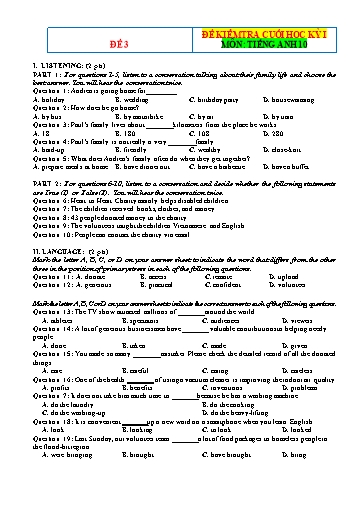
 Mark the letter A, B, C, or D to indicate the word CLOSEST in meaning to the underlined word in
the following question.
Question 20: Disadvantaged children are also taught essential skills for the job market.
 A. necessary B. various C. reliable D. practical
III. READING: (2 pts)
PART 1: Read the following passage carefully and then choose the best option to fit each numbered
blank (from 21 to 25).
 The Ig Nobel Prize is a copy of the famous Nobel Prize. It is given (21)______ achievements
and inventions that “first make people laugh, then make them think”. Its purpose is to celebrate unusual
and imaginative achievements, mostly in science, medicine, and technology. (22)______ people's
common belief that the prizes are given to (23)_________ works, the prize winners' findings need to be
based on serious research. Every year, a (24)_________ is held at Harvard University, and ten prizes
made of tinfoil are awarded to the winners, (25)_________ have to pay for their own accommodations
and transport to Cambridge.
 (Source: the workbook English 10-Pearson)
Question 21: A. to B. for C. at D. on
Question 22: A. Owning to B. Thanks to C. Contrary to D. Because of
Question 23: A. importance B. unimportant C. important D. importantly
Question 24: A. ceremony B. meeting C. party D. festival
Question 25: A. that B. whom C. which D. whose
PART 2: Read the following passage and mark the letter A, B, C, or D on your answer sheet to indicate
the correct answer to each of the questions (from 26 to 30).
 Music influences people in different ways or the same person differently at different times. Music
may seem to influence people differently. That is because people can react differently to music. We are
able to apply a choosing process to the music we hear. If someone hates jazz, then a jazz piece with a
positive effect will probably not make him feel good. A happy song might appear to make an angry
person angrier, yet it is not the music itself that is creating the anger; rather it is the positive effect of the
music. The angry person does not want to accept the song’s happy feeling: it points out his already
existing anger and makes that anger come to the surface. When a piece of music is played and we are
listening to it, our body, mind, and feelings are being affected. The musicians of ancient cultures such
as China, India, Turkey, and Greece understood the effects of music. In fact, Pathagoras, in ancient
Greece, introduced a whole science that concerned them. Because the musicians of these ancient cultures
understood these effects, they created music that was positive, uplifting, and beneficial. Once the effects
of music are better understood, the next step is to gain a better understanding of the music around us,
and what effect it is actually having.
 (Source: https://patadovietnam.edu.vn)
Question 26: What does the passage mainly discuss?
 A. the science of music
 B. understanding of music
 C. the effects of music on human feelings
 D. music and an angry person
Question 27: Which of the following is closest in meaning to the word “Once”?
 A. One time B. When C. Because D. If
Question 28: What does the word “itself” refer to?
 A. anger B. effect C. music D. song
Question 29: Which of the following is true about music mentioned in the passage?
 A. Music cannot be chosen.
 B. Music affects everybody in the same way.
 C. Music affects us in various ways.
 D. Music never makes us angry - What you think about it
Follow-up questions:
 1. What are your favorite music shows on TV?
 2. What do you dislike about the show? Why?
Topic 4. Talk about volunteering activities
You can use the following cues:
 - Kind of volunteering activities
 - Benefits of volunteering activities
 - What you think about volunteering activities
Follow-up questions:
 1. Have you ever taken part in any volunteering activities?
 2. Which volunteering activities have made the most impression on you?
5. Talk about one of the inventions that impresses you most:
You should say:
 - What the invention is/ Who invented it.
 - Why the invention impresses you.
 - How useful it is for life.
Follow-up questions:
 1. How long have you used it?
 2. How important is it in your daily life?
 ------THE END------
 ĐÁP ÁN
I. MULTIPLE CHOICE: Mỗi câu trắc nghiệm đúng được 0,2 điểm.
 Câu 1 2 3 4 5 6 7 8 9 10 11 12 13 14 15 16
 Đáp
 A D B D B F T T T F B D D C D B
 án
 Câu 17 18 19 20 21 22 23 24 25 26 27 28 29 30 31 32
 Đáp
 A C B A A C B A D C B C C D B A
 án
II. WRITING: Mỗi câu đúng được 0,2 điểm.
Question 33. Michael has played/ been playing golf for 2 months.
Question 34. The money collected from selling handmade was used to build a local center for
orphans.
Question 35. It is dangerous to exceed the speed limit.
TAPESCRIPT
Part 1
Listen to Paul and Andrea talking about their family life. What are two things that are different about
their families? Complete the chart.
P: So, Andrea, you're going home for the holiday?
File đính kèm:
- de_kiem_tra_cuoi_hoc_ki_1_tieng_anh_lop_10_global_success_de.docx
 De-thi-HK1-Tieng-Anh-10-Global-De-3-PART-1.mp3
- De-thi-HK1-Tieng-Anh-10-Global-De-3-PART-2.mp3


