

Đề kiểm tra cuối học kì 1 Tiếng Anh Lớp 10 Global Success - Đề 7 (Có file nghe và đáp án)
 8 trang
27/10/2025
11135
8 trang
27/10/2025
11135
Bạn đang xem tài liệu "Đề kiểm tra cuối học kì 1 Tiếng Anh Lớp 10 Global Success - Đề 7 (Có file nghe và đáp án)", để tải tài liệu gốc về máy hãy click vào nút Download ở trên.
Tóm tắt nội dung tài liệu: Đề kiểm tra cuối học kì 1 Tiếng Anh Lớp 10 Global Success - Đề 7 (Có file nghe và đáp án)
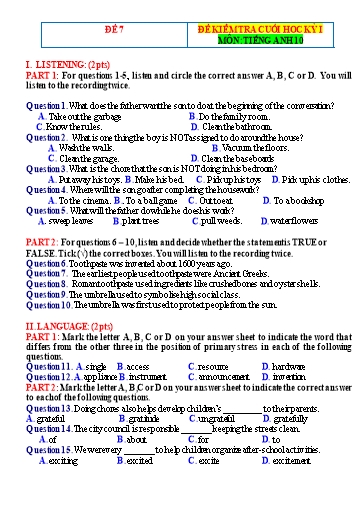
 Question 16. Too much carbon dioxide in the_________ can increase Earth’s average
temperature.
 A. atmosphere B. family C. music D. contest
Question 17. She used to be a heavy smoker, but she _______ last year.
 A. made a decision B. went on C. kicked the habit D. took up Question
18. Many people enjoy________ the news on their smartphones.
 A. read B. reads C. reading D. to read
 Question 19. While I _____ home from school, it ______ to rain. I was so soaking wet!
 A. walk/ starts B. walked/ was starting
 C. was walking/ was starting D. was walking/ started
PART 3: Mark the letter A, B, C or D to indicate the word OPPOSITE in meaning to the
underlined word in the following question.
 Question 20. Artificial intelligence allows computers to copy human behavior.
 A. Natural B. Valuable C. Useful D. Man-made
III. READING : (2pts)
 PART 1: Read the following passage carefully and then choose the best option to fit each
numbered blank (from 21 to 25 ).
 According to psychologists, most people do not realise the enormous benefits (21)_______
come to a family when parents and children share the housework. Children who share the
housework with their mums and dads do better at school, become more sociable, and have better
relationships with their teachers and friends. They learn good skills, are more (22)_______, and
tend to be overall good people. When men share the housework, they tend to have better
relationships with their wives. Women often feel happy when they see their husbands doing
housework (23)_______ it says, 'He cares about me and he doesn't want to put all of the
housework on me.' Women whose husbands do not contribute (24)_______ the household
chores are more vulnerable to illness and (25)_______ to think more about divorce.
Question 21. A. whose B. whom C. who D. that
Question 22. A. irresponsible B. responsible C. irresponsibly D. responsibility
 Question 23. A. because B. if C. while D. although
 Question 24. A. to B. for C. in D. with
Question 25. A. tend B. intend C. hope D. decide
 (Unit 1 - Tieng Anh 10 - Pearson)
PART 2: Read the following passage carefully and then choose the best option to fit each
numbered blank (from 26 to 30 ).
 Blues is a kind of slow sad music with strong rhythms. It was developed by AfricanAmerican
musicians in the American South. Early blues often took the form of a story about the unkind
treatment experienced by African Americans. Many elements of the blues have grown from the
music of Africa and religious music.
PART 3: In about 80 - 100 words, write a paragraph about ways to improve the
environment, following the guidelines below (1pt)
 - What activities they are
 - How many students are involved
 - How often these activities take place
 - What your expected results are
 - .......
 ------The end------
V. SPEAKING: (2,0 pts)
Students can choose one of these following topics to present: Topic
1: Talk about a volunteer work you would like to join You can
use the following cues:
 - What is the name of the volunteer work?
 - Where does it take place?
 - Who do you join with?
 - Why do you take part in the volunteer work?
 -
Topic 2 : Talk about your household chores. You
can use the following cues:
 - Family members’ responsibilities in your family.
 - The chores you like doing most.
 - The chores you dislike doing most.
 - What benefits do you think you can get from sharing household chores?
 -
 ĐÁP ÁN
 1 2 3 4
 D C D C
 5 6 7 8
 C T F F
 9 10 11 12
 T T C B
 13 14 15 16
 A C B A
 17 18 19 20
 C C D A
 21 22 23 24
 D B A A
 25 26 27 28
 A D A C
 29 30 31 32
 C D A C Tổ chức NB (0,05đ) - TH (0,1đ) VD (0,15đ) - VDC (0,2đ) -
 thông tin Thông tin bị lặp và - Thông tin còn Thông tin ít khi Thông tin không
 và tính ảnh hưởng đến diễn bị lặp. bị lặp. bị lặp.
 liên kết đạt. - Sắp xếp các ý - Sắp xếp ý - Sắp xếp ý
 (0,2đ) - Sắp xếp ý thiếu có logic, có tinh liên logic, mạch lạc, logic, mạch lạc cao.
 logic, thiếu tính liên kết, mặc dù tính mạch dễ đọc, dễ hiểu. Bài viết có tổng thể
 kết. lạc giữa các câu còn - Sử dụng hài hòa, trôi chảy,
 thấp hoặc máy móc. tự nhiên.
 - Ít sử dụng hoặc khá đa dạng và
 sử dụng lặp các - Sử dụng các chính xác các - Sử dụng đa
 phương tiện kết nối phương tiện kết nối phương tiện kết dạng và chính xác
 hoặc sử dụng tuy còn đơn giản nối. các phương tiện kết
 cácphương tiện kết nối nhưng đúng nghĩa. nối.
 chưa chính xác.
 Từ vựng NB (0,05đ) - TH (0,1đ) VD (0,15đ) VDC (0,2đ) -
 (0,2đ) Từ vựng liên quan - Từ vựng tạm đủ để - Từ vựng đa Từ vựng phong
 đến chủ đề hạn chế, diễn đạt thông tin liên dạng có liên phú có liên quan
 lặp hoặc không phù quan đến chủ đề. Một quan đến chủ đề. đến chủ đề, diễn
 hợp. số chỗ dùng từ chưa - Có sử dụng từ đạt tự nhiên. Dùng
 - Dạng từ, chính tả phù hợp hoặc viết đồng/ trái nghĩa, từ phù hợp, chính
 còn viết chưa đúng, không đúng dạng từ. kết hợp từ, thành xác.
 gây hiểu lầm cho ngữ,... -Ít lỗi sai -Sử dụng đa dạng
 người đọc. về chính tả. và chính xác các
 phương tiện kết
 nối.
Ngữ pháp NB (0,05đ) - Sử TH (0,1đ) -Sử VD (0,15đ) - VDC (0,2đ)
 (0,2đ) dụng cấu trúc câu đơn dụng cấu trúc câu Sử dụng đa dạng -Sử dụng đa dạng,
 giản. khác nhau. các cấu trúc câu. linh hoạt các cấu
 - Khá nhiều lỗi về ngữ - Nhiều lỗi về ngữ - Còn vài lỗi về trúc câu.
 pháp và gây khó hiểu pháp và gây khó hiểu ngữ pháp nhưng - Còn vài lỗi nhỏ về
 cho người đọc. cho người đọc. người đọc vẫn có ngữ pháp.
 thể hiểu.
III/ HƯỚNG DẪN CHẤM NÓI
GV cho điểm mỗi thành phần ứng với mức độ nhận thức học sinh đạt được.
 Tổng: 2 điểm Nhận biết Thông hiểu Vận dụng Vận dụng cao
 Nội dung: 0,8đ (0,1đ) (0,2đ) -Trả lời (0,3đ) (0,4đ)
 -Trả lời ở mức được yêu cầu cơ -Trả lời khá đầy -Trả lời đầy đủ
 tối thiểu yêu cầu bản của đề bài: đủ yêu cầu của yêu cầu của bài:
 của bài: có 1 số khá đầy đủ ý bài: đủ ý chính, đủ ý chính, các
 ý chính nhưng ý chính nhưng các ý thống ý thống nhất, có
 có thể chưa triển khai ý còn nhất, có liên liên quan, được
 được triển khai. rời rạch hoặc có quan, được triển triển khai cân
 -Không có dẫn ý không khai nhưng có xứng.
TAPESCRIPT FOR LISTENING:
Part 1
Son: Dad. Can I go outside to play?
Dad: Well, did you get you Saturday’s work done? Son: Ah, Dad. Do
I have to?
Dad: Well, you know the rules. No playing until the work is done. Son: So, what is
my work?
Dad: Well, first you have to clean the bathroom including the toilet. And don’t forget to scrub the
bathtub.
Son: No, I want to do the family room.
Dad: Well, okay, but you have to vacuum the family room and the hall, and be sure to dust everything. Oh,
and don’t forget to wipe the walls and clean the baseboards. [Okay.] And after that. [Oh, no.] Next, sweep
and mop the kitchen floor and be sure to polish the table in the living room.
Son: Okay. Okay.
Dad: And make your bed and pick up all your toys and put them away. And . . .
Son: More?
Dad: Yeah. And then, how about going out for lunch and getting a big milk shake, but you probably
don’t want to do that. Son: No, No. I want to.
Dad: Okay. While you’re doing your work, I’ll be out in the yard raking leaves and pulling weeds.
 (Adopted from Randall’s ESL cyber listening lab)
Part 2:
Hello, and welcome to “Fascinating Facts!” Today we’re going to take a look at some those ‘modern’ inventions
which turn out to be  well, not quite so modern at all! Let’s start with toothpaste. So you think, hmmm,
toothpaste – when was that invented? A hundred years ago? Maybe two hundred? But we find that actually,
toothpaste has been around for sixteen hundred years. People from Egypt used it, and then the Ancient Greeks
and Romans used it. Was it the same as modern toothpaste? Definitely not. Ancient Greek toothpaste used
ingredients like crushed bones and oyster shells. OK, another invention for you: the good old umbrella. If we
look at a number of ancient sculptures from Egypt and Persia, which is now called Iran, it’s clear that the
umbrella has been around for a long, long time, certainly more than two thousand years, Interestingly, it seems
that only kings or very important people had umbrellas in these sculptures. So they were a symbol of high social
class. But what were they for? In Europe we tend to think of umbrellas as things to protect us from the rain. But
historically, they protected people from the sun. And later, they became a fashion item. The next invention we
are going to look at today is.
File đính kèm:
- de_kiem_tra_cuoi_hoc_ki_1_tieng_anh_lop_10_global_success_de.docx
 De-thi-HK1-Tieng-Anh-10-Global-De-7-PART-1.mp3
- De-thi-HK1-Tieng-Anh-10-Global-De-7-PART-2.mp3


