

Đề kiểm tra Tiếng Anh Lớp 11 Global Success - Unit 3: Cities of the future - Test 1 (Có đáp án)
 3 trang
19/11/2025
2641
3 trang
19/11/2025
2641
Bạn đang xem tài liệu "Đề kiểm tra Tiếng Anh Lớp 11 Global Success - Unit 3: Cities of the future - Test 1 (Có đáp án)", để tải tài liệu gốc về máy hãy click vào nút Download ở trên.
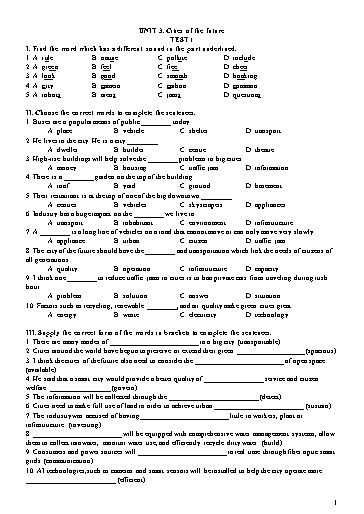
Tóm tắt nội dung tài liệu: Đề kiểm tra Tiếng Anh Lớp 11 Global Success - Unit 3: Cities of the future - Test 1 (Có đáp án)
 IV. Complete the sentences with the present simple or present continuous form of the verbs in
brackets.
1. I (go) ________________________ to the concert tonight.
2. This menu (seem) ________________________ really healthy.
3. I must stay in because I (expect) ________________________ a parcel.
4. His voice (sound) ________________________ amazing.
5. He (feel) ________________________ the jumper to see if it’s soft.
6. Water (be) ________________________ essential for all living things.
7. The chicken burger (taste) ________________________ amazing. My kids love it.
8. This dish’s presentation (look) ________________________ very appealing to me.
9. He always (get) ________________________mad when he is with his naughty son.
10. Mai and Linda (become) ________________________ more and more friendly after a year of
studying together.
V. Read the passage and choose A, B, C, or D to indicate the word or phrase that best fits each of
the numbered blanks.
 Sustainability is key in the (1) ________ of any smart city, and it’s related to other challenges:
 Waste management: Smart cities need to face different problems related to (2) ________
management, such as overfilled trash bins, unoptimized truck routes, or the need to (3) ________ mixed
materials for recycling. Smart waste management can help solve these kinds of issues. Sensors attached
(4) ________ trash bins can measure fill level, send an automatic alert if it reaches the limit, and optimize
trucks’ collection routes.
 Energy: “The city of the (5) ________ will definitely be energy-efficient. It might even produce
energy instead of consuming it. The main challenge is convincing companies and to (6) ________ more
in this area,” said Daniyar Tanatov’s, Partner Account Manager at Spaceti. Cities can produce more (7)
________ than they consume by using turbines, solar panels or even solar walls - buildings with solar
panels incorporated into their facade.
 Working hours: Unexpected, maybe? Current working hours vastly exceed what we could
consider (8) ________, concluded research conducted by the think tank Autonomy. Fewer working hours
would mean (9) ________ commuting, fewer products manufactured, and fewer resources used. (10)
________ such as Artificial Intelligence could help make the future of work sustainable.
1. A. develop B. develops C. developed D. development
2. A. waste B. time C. money D. human
3. A. separation B. separating C. separate D. separated
4. A. on B. in C. to D. with
5. A. past B. future C. present D. today
6. A. invest B. share C. recycle D. produce
7. A. water B. energy C. products D. electricity
8. A. sustain B. sustaining C. sustainable D. sustainably
9. A. less B. fewer C. more D. much more
10. A. Companies B. Governments C. Resources D. Technologies
VI. Match the questions with the correct responses.
 Questions Responses
1. What’s life in cities in the future like? A. Yes, we should.
2. Do you think Seoul is the most livable city in B. I’m really sure about it.
2050?
3. What should we do to reduce traffic jams in our C. We try to use wind and sun energy more.
city?
 2
File đính kèm:
- de_kiem_tra_tieng_anh_lop_11_global_success_unit_3_cities_of.doc
- KEY - 7. UNIT 3. Cities of the future - TEST 1.doc


