

Đề kiểm tra Tiếng Anh Lớp 11 Global Success - Unit 3: Cities of the future - Test 2 (Có đáp án)
 3 trang
19/11/2025
2391
3 trang
19/11/2025
2391
Bạn đang xem tài liệu "Đề kiểm tra Tiếng Anh Lớp 11 Global Success - Unit 3: Cities of the future - Test 2 (Có đáp án)", để tải tài liệu gốc về máy hãy click vào nút Download ở trên.
Tóm tắt nội dung tài liệu: Đề kiểm tra Tiếng Anh Lớp 11 Global Success - Unit 3: Cities of the future - Test 2 (Có đáp án)
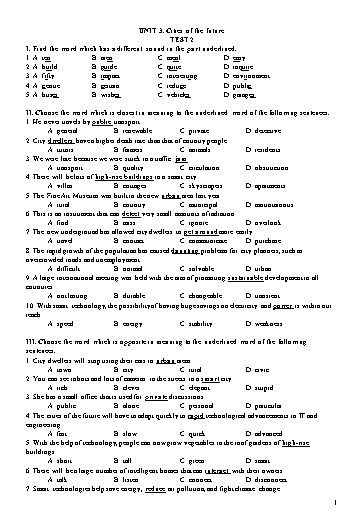
 A. reuse B. recycle C. increase D. decrease
8. Smart cities use modern technologies to save time and provide better services.
 A. help B. waste C. spare D. reserve
9. It is more than a hi-tech business district, but a template for future development.
 A. decline B. growth C. progress D. expansion
10. All trash is sucked into underground pipes, and is automatically sorted and recycled, buried, or
burned for fuel.
 A. voted B. selected C. disarranged D. ordered
IV. Circle the correct verb form.
1. The beefsteak smells / is smelling very good.
2. Sarah smells / is smelling the soup her mother has just made.
3. They seem / are seeming very happy to have their first son.
4. He can’t find the car key, he looks / is looking for it.
5. You look / is looking so beautiful in that wedding dress.
6. I think / am thinking that they are tired after a hard working day.
7. We think / are thinking of moving to the city centre.
8. The chef always tastes/ is tasting the food before it is served.
9. She wants / is wanting to be a fashion design in the future.
10. They have / are having a great time at the party right now.
V. Read the passage and choose the correct answer A, B, C, or D to complete each sentence.
 More and more people are living in cities. In an effort to prevent rapidly growing urban areas
from collapsing under their own weight, cities around the world are increasingly taking an intelligent
approach to how they organize and plan their traffic, energy supply and administrative systems. The right
technology is crucial for creating these “smart cities”.
 It is estimated that the world’s population will reach 9.7 billion by the year 2050, with 68% living
in urban regions. In order to ensure the future coexistence of those living in such densely populated areas,
there are numerous challenges that those who bear responsibility for modern cities need to address. With
more and more people living in increasingly crowded spaces, how can we make sure that we have clean
air and reduce waste? How can we facilitate mobility for millions of people? And how can we ensure that
administrative structures are in place and there is universal healthcare?
 One solution is to apply modern technologies to achieve a comprehensive “renewal” of today’s
cities. It is the rare urban planner who does not dream of the advantages of smart cities. For experts, a
smart city represents the integration of information technologies and data into both existing and new
infrastructure systems with the goal of enabling those in urban areas to live together sustainably,
efficiently and in social harmony, despite growing population density. But what exactly will the city of
the future look like? And what technologies are already making urban life smarter?
1. The population of cities is ________ day by day.
 A. increase B. decrease C. increasing D. decreasing
2. By 2050, the number of people living in urban areas will be ________ of the total world population.
 A. 68% B. 86% C. 7.9 billion D. 9.7 billion
3. The word “urban areas” in paragraph 1 refers to ________.
 A. cities B. citizens C. smart cities D. administrative systems
4. The word “crucial” in paragraph 1 is opposite in meaning to ________.
 A. important B. unimportant C. necessary D. agreeable
5. There are many challenges that need to be solved by ________.
 A. urban regions B. people organizing and planning traffic
 C. people living in densely populated areas D. people being responsible for modern cities
6. Applying modern technologies is a way to achieve ________.
 2
File đính kèm:
- de_kiem_tra_tieng_anh_lop_11_global_success_unit_3_cities_of.doc
- KEY - 8. UNIT 3. Cities of the future - TEST 2.doc


