

Đề kiểm tra Tiếng Anh Lớp 11 Global Success - Unit 7: Education options for school leavers - Test 2 (Có đáp án)
 3 trang
19/11/2025
1322
3 trang
19/11/2025
1322
Bạn đang xem tài liệu "Đề kiểm tra Tiếng Anh Lớp 11 Global Success - Unit 7: Education options for school leavers - Test 2 (Có đáp án)", để tải tài liệu gốc về máy hãy click vào nút Download ở trên.
Tóm tắt nội dung tài liệu: Đề kiểm tra Tiếng Anh Lớp 11 Global Success - Unit 7: Education options for school leavers - Test 2 (Có đáp án)
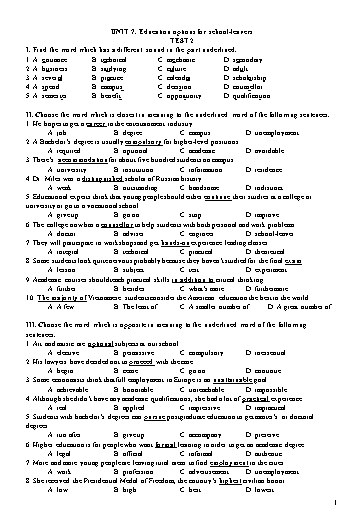
 9. He worked part-time at a bookshop when he was in university.
 A. full-time B. half a day C. break time D. pre-university
10. Only a minority of students got the maximum score in this exam.
 A. majority B. very few C. less D. some
IV. Choose the best option A, B, C, or D to complete the sentences.
1. He was accused of _________ confidential company documents.
 A. steal B. stole C. have stolen D. having stolen
2. I will never forget _________ a short vacation in Hoi An Ancient Town last year.
 A. have spent B. being spent C. having spent D. spent
3. ________ the evening meal, we decided to go for a walk.
 A. Having eaten B. Having been eaten C. To eat D. Have eaten
4. Having been told about the dangers of chemical fertilizers, the farmers _________ to bio-fertilizers.
 A. turned B. have turned C. having turned D. being turned
5. They object to him _________ private calls on the office phone.
 A. having been made B. having made C. have made D. made
6. ________ to the workshop by the director, he could hardly refuse.
 A. Being invited B. To invite C. Having invited D. Having been invited
7. The students in Grade 11A were praised for _________ the most trees in the schoolyard.
 A. having planted B. have planted C. planted D. plant
8. ________ in the event yesterday was an amazing experience for me.
 A. To participate B. Being participated C. Having participated D. Have participated
9. ________ the documents, she couldn’t answer the chairman’s questions.
 A. Having not read B. Not having read C. Haven’t read D. Haven’t been read
10. Not having finished the final test, my brother couldn’t _________ the university that he wished.
 A. entered B. enter C. having entered D. to enter
V. Read the passage and choose A, B, C, or D to indicate the word or phrase that best fits each of
the numbered blanks.
 One way of training for your future occupation in Germany is by pursuing a dual (1) _______
training programme. Such programmes offer plenty of opportunity for on-the-job training and work
experience. Programmes usually last between two and three and a half years and comprise (2) _______ as
well as practical elements. You will spend one or two days a week, or several weeks at once, at a
vocational school (3) _______ you will acquire the theoretical knowledge that you will need in your
future occupation. The rest of the time will (4) _______ at a company. There you get to apply your newly
acquired knowledge (5) _______ practice, for example by learning to operate machinery. You will get to
know what your company does, learn how (6) _______ operates and find out if you can see yourself
working there after completing your training.
 This (7) _______ of theory and practice gives you a real head start into your job: by the time you
have completed your training, you will not only have the required technical knowledge, but you will also
have (8) _______ experience in your job. There are around 350 officially recognized training programmes
in Germany, so chances are good that one of them will (9) _______ your interests and talents. You can
find out which one that might be by visiting one of the jobs and vocational training fairs which are
organized in many German cities at different times in the year.
 Employment prospects for students who have completed a dual vocational training programme are
very good. This is one of the (10) _______ why this kind of training is very popular with young Germans:
around two thirds of all students leaving school go on to start a vocational training programme.
1. A. optional B. educational C. vocational D. compulsory
2. A. theory B. theoretical C. theoretically D. theoretician
3. A. what B. where C. why D. when
 2
File đính kèm:
- de_kiem_tra_tieng_anh_lop_11_global_success_unit_7_education.doc
- KEY - 24. UNIT 7. Education options for school-leavers - TEST 2.doc


