

Đề kiểm tra Tiếng Anh Lớp 11 Global Success - Unit 7: Education options for school leavers - Test 3 (Có đáp án)
 4 trang
20/11/2025
1512
4 trang
20/11/2025
1512
Bạn đang xem tài liệu "Đề kiểm tra Tiếng Anh Lớp 11 Global Success - Unit 7: Education options for school leavers - Test 3 (Có đáp án)", để tải tài liệu gốc về máy hãy click vào nút Download ở trên.
Tóm tắt nội dung tài liệu: Đề kiểm tra Tiếng Anh Lớp 11 Global Success - Unit 7: Education options for school leavers - Test 3 (Có đáp án)
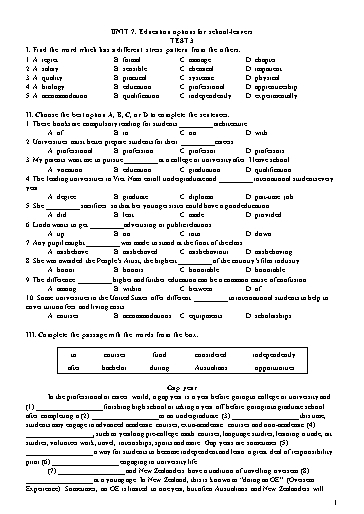
 remain overseas for three to five years, with many working short-term in service industry jobs to (9)
__________________ their continuing travels. Europe and Asia are popular destinations for doing an OE.
In Australia, through exchange programmes and benefits for youth, there are so many (10)
__________________ for a young person to broaden their mind through travel in a gap year.
IV. Circle the correct options in brackets.
1. (Have done / Having done) __________________ a lot of homework, I went to bed.
2. (Writing / Having written) __________________ the report, Mai felt relieved.
3. (Having photocopied / Photocopying) __________________ all the papers already, Sarah put them
back in the file.
4. (Not having had / Having not had) __________________ money to pay her tuition, she dropped out.
5. (Having failed / To having failed) __________________ the university entrance exams made him
decide to go to a vocational school.
6. (Received / Having received) _________________ the university degree, Janet started looking for job.
7. (Having learned / Having been learned) __________________ lots of practical skills, Thomas applied
for the position of regional manager.
8. (Not having trained / Not having been trained) __________________ officially made her not confident
in herself.
9. (Having finished / Having finish) __________________ the course excellently, she received the
school’s honorary degree.
10. (Graduated / Having graduated) __________________ with a journalism degree, she applied for a job
at a local newspaper office.
V. Read the passage and circle T (True) or F (False).
 British further education qualifications are respected by employers and academics worldwide.
There are two main types: academic courses, and vocational and professional courses. Academic courses
help you prepare for higher education at a university or college. They aim to develop your analytical
skills, critical thinking and knowledge. Vocational and professional courses give you the skills and
qualifications you need to enter and succeed in your chosen career. They offer technical training and
skills for the workplace.
 British further education providers invest heavily in facilities from libraries, computer centres and
science laboratories to sports centres, theatres and arts studios. Class sizes are restricted to ensure that you
have access to equipment and enough time to talk to your tutors and lecturers.
 British qualifications are a great boost to your cv and to your earnings. Employers are increasingly
looking for graduates with multicultural experience. Moreover, British colleges and universities have
strong links with industry many courses are designed in partnership with, and taught by, industry
professionals. Many include the option of a year in industry or a work placement, giving you real
professional experience.
 English is widely regarded as the language of business. Studying in the UK helps you learn
language quickly, through your studies, friends and everyday life. If you need any additional support,
there are lots of English language classes across the UK.
 The UK is a truly multicultural society, with a wonderful mix of people from many different
backgrounds. As a student, you’ll get to know people from all over the world and be inspired by many
cultures. Many colleges have international offices and advisers to ensure you feel welcome and are
supported throughout your time in British further education.
___________ 1. There are two main types of further education systems in Britain.
___________ 2. Academic courses help you develop your analytical skills, critical thinking and
knowledge.
___________ 3. Vocational and professional courses provide you with technical training and skills for the
workplace.
 2 C. After he had been taken to hospital and had an operation, he fell from the horse back.
 D. Having fallen from the horse back, he was taken to hospital and had an operation.
5. He has become his own boss for a long time. He is hard to accept orders from another.
 A. He is hard to accept having become his own boss for a long time.
 B. He is hard to accept orders from another, so he has become his own boss for a long time.
 C. Having become his own boss for a long time, he is hard to accept orders from another.
 D. After he had accepted orders from another, he became his own boss for a long time.
VIII. Circle the underlined part A, B, C, or D that needs correction.
1. She will be their first choice on secretary position.
 A B C D
2. He regretted not having study hard when he was in university.
 A B C D
3. Have misunderstood the question caused him to give the wrong answer.
 A B C D
4. Having heard that the caves were danger, I didn’t want to go there.
 A B C D
5. She was a philosopher major at an Ivy League college.
 A B C D
6. Farming is not an attract career option for many young people.
 A B C D
7. Will you intend to study abroad after graduation from high school?
 A B C D
8. University students usually have an advantage than students from vocational schools.
 A B C D
9. Have passed the preliminary round, the candidates were interviewed directly by the director.
 A B C D
10. Academic courses help us develop analytical skills, critical thinking and knowledge for higher
 A B C D
educational at a university or college.
 4
File đính kèm:
- de_kiem_tra_tieng_anh_lop_11_global_success_unit_7_education.doc
- KEY - 25. UNIT 7. Education options for school-leavers - TEST 3.doc


