

Đề ôn tập giữa học kì 1 Tiếng Anh Lớp 11 Global Success - Đề 1 (Có file nghe)
 3 trang
12/11/2025
2251
3 trang
12/11/2025
2251
Bạn đang xem tài liệu "Đề ôn tập giữa học kì 1 Tiếng Anh Lớp 11 Global Success - Đề 1 (Có file nghe)", để tải tài liệu gốc về máy hãy click vào nút Download ở trên.
Tóm tắt nội dung tài liệu: Đề ôn tập giữa học kì 1 Tiếng Anh Lớp 11 Global Success - Đề 1 (Có file nghe)
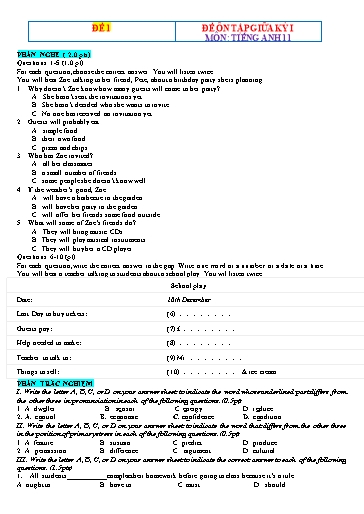
 2. Parents can't always respond effectively to agressive ____________ of their children
A. generation B. thought C. behaviour D. roles
3. To decide the winner of the competition, the examiners ________ candidates' dishes now.
A. taste B. tasted C. are tasting D. was tasting
4. With better transportation, more people will be able to move around easily, and it will reduce traffic
_________
A. noise B. pollution C. congestion D. transport
5. A smart city is a modern urban area that uses _______________technologies to provide services, solve
problems, and support people better.
A. a great deal of B. a range of C. the number of D. the amount of
6. All food products should carry a list of ________ on the packet.
A. areas B. parts C. ingredients D. chemicals
IV. Read the following passage and mark the letter A. B. C. or D to indicate the correct answer to each
of the questions. (2.0 pts)
 In American, although most men still do less housework than their wives, that gap has been halved since the
1960s. Today, 41 per cent of couples say they share childcare equally, compared with 25 percent in 1985.
Men's greater involvement at home is good for their relationships with their spouses, and also good for their
children. Hands-on fathers make better parents than men who let their wives do all the nurturing and childcare.
They raise sons who are more expressive and daughters who are more likely to do well in school - especially in
math and science.
 In 1900, life expectancy in the United States was 47 years, and only four per cent of the population was 65
or older. Today, life expectancy is 76 years, and by 2025, it is estimated about 20 per cent of the U.S.
population will be 65 or older. For the first time, a generation of adults must plan for the needs of both their
parents and their children. Most Americans are responding with remarkable grace. One in four households
gives the equivalent of a full day a week or more in unpaid care to an aging relative, and more than half say
they expect to do so in the next 10 years. Older people are less likely to be impoverished or incapacitated by
illness than in the past, and have more opportunity to develop a relationship with their grandchildren.
 Even some of the choices that worry people the most are turning out to be manageable. Divorce rates are
likely to remain high, and in many cases marital breakdown causes serious problems for both adults and kids.
Yet when parents minimize conflict, family bonds can be maintained. And many families are doing this. More
non-custodial parents are staying in touch with their children. Child-support receipts are rising. A lower
proportion of children from divorced families are exhibiting problems than in earlier decades. And stepfamilies
are learning to maximize children's access to supportive adults rather than cutting them off from one side of the
family.
1. Which of the following can be the most suitable heading for paragraph 1?
A. Men's involvement at home
B. Benefits of men's involvement at home
C. Drawbacks of men's involvement at home
D. Children studying math and science
2. Nowadays, ____ of men help take care of children.
A. 50% B. 41% C. 25% D. 20%
3. According to the writer, old people in the USA ____.
A. are experiencing a shorter life expectancy
B. receive less care from their children than they used to
C. have better relationships with their children and grandchildren
D. may live in worst living conditions
4. Which of the following is NOT true about divorce rates in the USA?
A. They will still be high.
B. They can cause problems for both parents and children.
C. More problems are caused by children from divorced families.
D. Children are encouraged to meet their separate parents.
5. The word "equivalent” in paragraph 2 is closest in meaning to ____.
A. comparable B. opposed C. dissimilar D . constrasting
6. The word "manageable” in paragraph 3 is closest in meaning to ____.
A. difficult B. challenging C. demanding D. easy
File đính kèm:
- de_on_tap_giua_hoc_ki_1_tieng_anh_lop_11_global_success_de_1.docx
 Nghe-De-on-tap-giua-HK1-De-1-Part-1.mp3
- Nghe-De-on-tap-giua-HK1-De-1-Part-2.mp3


