

Đề ôn tập kiểm tra chất lượng giữa kì 2 Tiếng Anh Lớp 11 Global Success - Năm học 2023-2024 - Trường THPT Lê Lợi (Có đáp án)
 5 trang
24/11/2025
4070
5 trang
24/11/2025
4070
Bạn đang xem tài liệu "Đề ôn tập kiểm tra chất lượng giữa kì 2 Tiếng Anh Lớp 11 Global Success - Năm học 2023-2024 - Trường THPT Lê Lợi (Có đáp án)", để tải tài liệu gốc về máy hãy click vào nút Download ở trên.
Tóm tắt nội dung tài liệu: Đề ôn tập kiểm tra chất lượng giữa kì 2 Tiếng Anh Lớp 11 Global Success - Năm học 2023-2024 - Trường THPT Lê Lợi (Có đáp án)
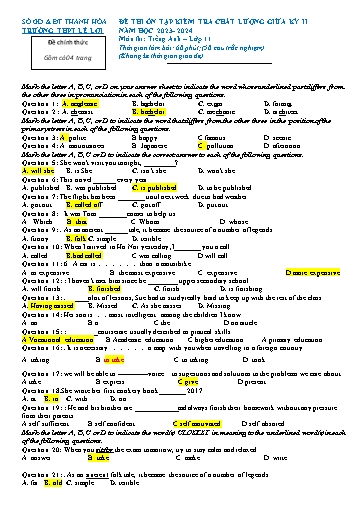
 Mark the letter A, B, C or D to indicate the word(s) OPPOSITE in meaning to the underlined word(s)in each
of the following questions.
Question 22: In order to protect endangered species, it is important that all people join in.
A. participate B. leave C. take part D. enjoy
Question 23: The maintenance of this company is dependent on international investment.
A. affective B. self-reliant C. self-restricted D. reliant
Mark the letter A, B, C, or D on your answer sheet to indicate the sentence that best completes each of the
following exchanges
Question 24: "I would like to make an arrange with you tonight !" ~ Mary: "........."
A. Alright .I will see you then !B. I don't like your sayings.
C. You are telling a lie.D. Thank you very much! I am afraid.
Question 25: Tom: “I wish you a happy new year ” Tim: “______.”
A. I don't quite agree with you B. The same to you .Thanks
C. I don't hope soD. I hope so
Read the following passage and mark the letter A, B, C, or D on your answer sheet to indicate the correct
word or phrase that best fits each of the numbered blanks.
Mark the letter A, B, C, or D on your answer sheet to indicate the underlined part that needs correction in
each of the following questions.
Question 26: She gives her little sister a lovely doll for her birthday yesterday.
 A B C D
Question 27: E- books are becoming more and more popular nowadays because of its convenience.
 A B C D
Question 28: The party has won a historical victory at the polls.
 A B C D
Mark the letter A, B, C, or D on your answer sheet to indicate the sentence that is closest in meaning to each
of the following questions
Question 29: It is not necessary for you to do this project.
A. You would do this project.B. You can’t do this project.
C. You must do this project. D. You needn’t do this project.
Question 30: . Some scientists have distorted the effects of climate change. They were accused of that.
A. Some scientists were accused of having falsify the effects of climate change.
B. Some scientists were accused of having been honest about the effects of climate change.
C. Although some scientists have distorted the effects of climate change, they were not accused.
D. Some scientists were accused of having falsified the effects of climate change
Question 31: I started writing this essay hours ago and it's still not right.
A. I have been writing this essay for hours and it's still not right.
B. It's hours ago since I last wrote this essay correctly.
C. The last time I started writing this essay was hours ago, which is still not right.
D. I didn't stop to write this essay hours ago and it's still not right.
Mark the letter A, B, C, or D on your answer sheet to indicate the sentence that best combines each pair of
sentences in the following questions.
Question 32He arrived in class. He realized he had forgotten his book on the bus.
A. No sooner had he realized he had forgotten his book on the bus than he arrived in class.
B. Had he arrived in class, he would have realized he had forgotten his book on the bus.
C. Only after he had realized he had forgotten his book on the bus did he arrive in class.
D. Not until he arrived in class did he realize he had forgotten his book on the bus
Question 33: Alice registered for the course. She then received the scholarship.
A. Hardly had Alice registered for the course than she received the scholarship.
B. Only after Alice registered for the course, she received the scholarship.
C. Having received the scholarship, Alice registered for the course.
D. Having Registered for the course , Alice received the scholarship.
Read the following passage and mark the letter A, B, C, or D on your answer sheet to indicate the correct
word or phrase that best fits each of the numbered blanks . C. It's easier to master than people think. D. It’s difficult to carry out.
Read the following passage and mark the letter A, B, C, or D on your answer sheet to indicate the correct
answer to each of the questions.
Do you think education is better now than it was in your grandparents' time? Many older people in the UK
believe the opposite. “Schools were better in our day,” they complain. “There isn't enough discipline these
days. Kids don't work as hard as we did, either. The syllabus isn't as challenging, so clever students aren't being
stretched enough. They need to study things in greater depth. Exams are much, much easier now as well.”
Were schools better years ago? Some British teenagers travelled back in time to a 1950s boarding school. They
got a big surprise! The first shock came when the teenagers met their new teachers. Dressed in traditional black
gowns, they look so frosty and uncaring! They were really authoritarian, too, so anyone caught breaking the
rules - talking in classes, mucking about in the playground or playing truant – was in big trouble! Punishments
included writing 'lines' or staying after class to do detention. The naughtiest kids were expelled.
Things were just as bad after class. At meal times the students had to endure a diet of plain, no-nonsense,
healthy food. Homework was obligatory and it took ages! Copying essays off the Internet wasn't an option, as
personal computers didn't exist in the 1950s!
At the end of 'term' everyone sat 1950s-style exams. The old exams were much longer than their twenty-first
century equivalents and involved learning huge amounts of facts by heart. History papers were all dates and
battles. Maths papers were trickier, too; calculators weren't around in the 1950s, so the students had to
memorise multiplication tables and master long division. Our candidates found this really difficult.
The exam results surprised a lot of people. Students predicted to do well in their real-life, twenty-first century
exams often got low grades in the 1950s exams. Does this prove modern exams are too easy? Do twenty-first
century kids rely too much on modern technology, like calculators and computers?
The TV series of That 'll teach 'em! focused on a 1960s vocational school. UK school-kids study a range of
academic subjects these days. But in the 1960s, children judged to be less ‘able' went to vocational schools.
These helped them learn job skills. Boys studied subjects like metalwork, woodwork or gardening. In some
classes, they even learned how to milk goats! The girls' timetables included secretarial skills. They also learned
to cook, clean and sew - probably not much fun for most girls.
.
.Question 44.The word "authoritarian” in the second paragraph is closest in meaning to_________.
A. inexperienced B. impolite C. unreasonable D. strict
Question 45 . Which of the following statements is TRUE about the food the students ate at school?
A. It wasn't cooked properly. B. It wasn't delicious.
C. It wasn't nutritious. D. There wasn't much of it.
Question46. The word "obligatory” in the third paragraph is closest in meaning to_________.
A. compulsory B. difficult C. long D. complicated
.Question47 According to the passage, how did exams in the 1950s differ from those in the twenty-first
century?
A They covered more subjects. B. It took students less time to do them.
C. There was more to remember. D. They were less difficult.
.Question48 What was surprising about the students' results after taking the 1950s-style exams?
A. All the students found the exams difficult. B. Students didn't do as well as expected.
C. Students who were predicted to fail did rather well.
D. Students did better than twenty-first century exams.
Question49. The word “these” in the last paragraph refers to_________.
A. school-kids B. subjects C. series D. vocational schools
Question50. Which of the following statements is TRUE according to the passage?
A. Vocational schools provided poorer children with equipment.
B. Vocational schools took children who were good at studying.
C. Vocational schools prepared students for employment.
D. Vocational schools were a complete waste of time
.
-------------------------------- HẾT --------------------------------
File đính kèm:
- de_on_tap_kiem_tra_chat_luong_giua_ki_2_tieng_anh_lop_11_glo.docx


