

Kế hoạch bài dạy minh họa Tiếng Anh Lớp 9 Global Success theo CV5512 - Unit 10: Planet earth
 48 trang
09/10/2025
2232
48 trang
09/10/2025
2232
Bạn đang xem 30 trang mẫu của tài liệu "Kế hoạch bài dạy minh họa Tiếng Anh Lớp 9 Global Success theo CV5512 - Unit 10: Planet earth", để tải tài liệu gốc về máy hãy click vào nút Download ở trên.
Tóm tắt nội dung tài liệu: Kế hoạch bài dạy minh họa Tiếng Anh Lớp 9 Global Success theo CV5512 - Unit 10: Planet earth
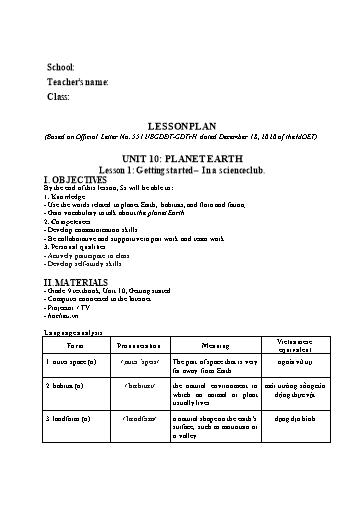
 4. essential (adj) /ɪˈsenʃl/ necessary or needed. vụ cựng quan trọng
 5. preserve (v) /prɪˈzɜːv/ to keep something as it is, bảo tồn
 especially in order to prevent
 it from being damaged.
 6. grassland (n) /ˈɡrɑːslổnd/ a large area of land covered khu vực đồng cỏ
 with grass.
 Assumption
 Anticipated difficulties Solutions
 Students may lack experience of group/ - Encourage students to work in groups so that
 teamwork. they can help each other.
 - Give short, clear instructions and help if
 necessary.
 III. PROCEDURES
 1. WARM-UP (5 mins)
 a. Objectives:
 - To activate students’ knowledge on the topic of the unit.
 - To lead in to the unit.
 b. Content:
 - Think!
 - Making a Solar System picture
 c. Expected outcomes:
 - Students can have some ideas about Natural Wonders.
 d. Organisation:
 TEACHER’S ACTIVITIES STUDENTS’ ACTIVITIES CONTENTS
Option 1: Think! Name of the planet:
- Have class play a game with two - Work in 2 groups Mercury, Venus, Earth, Mars,
groups. Jupiter, Saturn, Uranus, and
 Neptune
- Give two groups two sets of names
 - Listen instruction
of planets.
- Draw a picture of the Solar System
without the names of planets.
- Set the time and ask the two
groups to stick the names of planets - Stick the names of planets
on the position from the Sun
outward.
- When time is up, teacher stops the
game and checks the answers.
- The team with the most correct
answers wins. c. Expected outcomes:
 - Students understand the conversation and topic of the lesson and can complete the tasks
 successfully
 d. Organisation
 TEACHER’S ACTIVITIES STUDENTS’ ACTIVITIES CONTENTS
Task 1: Listen and read. (7 mins)
- Set the context: Have Ss look at the - Look at the heading, pictures Questions:
Heading In a Science club, the and answer the questions - What can you see in the
conversation and the pictures, and pictures?
 - What do you think Mr. An,
answer some questions. Encourage Nick and Lan are talking
Ss to answer, but do not confirm about??
whether their answers are right. Suggested answers:
- Play the recording twice for Ss to
 - Listen to the recording. - We can see the giraffes, a
listen and read along. Then invite
 - Read the conversation aloud. globe, plants and sea / ocean.
some pairs of Ss to read the - They are talking about Earth,
conversation aloud. it’s another name, its living
 things and non-living things
- Refer to the questions previously - Listen Picture:
asked. Confirm the correct answers.
 The dialogue on page 104
Task 2: Read the conversation again and tick (√) T (True) or F (False). (7 mins)
 - Work in pairs to do the Answer key:
- Ask Ss to work in pairs to read the activity.
conversation. 1. F 2. T
- Ask them to underline the key 3. F 4. T
words and phrases in the statements. 5. T
Then have pairs work together for
one or two minutes to check if the - Listen and check.
statements are true or false.
For example:
1. The students are asking about the
Solar System.
2. Another name for Earth is the Blue
Planet.
3. Water covers four fifths of Earth. c. Expected outcomes:
 - Ss can answer some information about the Earth
 d. Organisation
 TEACHER’S ACTIVITIES STUDENTS’ ACTIVITIES CONTENTS
Task 5: Quiz: Work in groups. Answer the following questions. (10 mins)
 Suggested Answer:
- Ask Ss to work in pairs to read the - Work in pairs to do the quiz.
information to answer the questions. 1. 7 (Asia, Africa, North
 - Try to guess
- Encourage Ss to guess as many America, South America,
 Europe, Australia and
answers as possible. - Report
- Ask some Ss to report the answers Antarctica)
they have thought of / worked out
 2. 5 (Arctic, Atlantic, Indian,
 Pacific, and Southern)
 3. 1
 4. 1. Oxygen (O2), medical use,
 2. Nitrogen (N2): fire
 suppression, provides an inert
 atmosphere 3. Helium (He):
 balloons, medical equipment
 4. Argon
 (Ar): welding, provides an iner
 t atmosphere for
 materials 5. Carbon
 dioxide (CO2): carbonated soft
 drinks
 5. Mars
 e. Assessment
 - T and other Ss listen to the answers and comment.
 5. CONSOLIDATION
 a. Wrap-up
 - Refer to the unit title again then together with Ss, orally list the issues that Mr. An and the
 students discuss in their science club.
 b. Homework
 - Do exercises in the workbook.
 - Start preparing for the Project of the unit:
 Teacher asks Ss to open their book p.113, look at the picture and say what the topic of the
 project is (Our flora and fauna). They will design a poster and present it at the end of this Unit.
 - Explain the project requirements: In groups, Ss think about their area and the flora and fauna
 of the area. Otherwise, they can choose an area they know. Remind Ss to use the guiding
 questions to prepare: Board plan
 Date of teaching
 UNIT 10: PLANET EARTH
 Lesson 1: Getting started
* Warm-up
I. Presentation
* Vocabulary
1. outer space (n)
2. habitat (n)
3. landform (n)
4. essential (adj)
5. preserve (v)
6. grassland (n)
II. Practice
Task 1: Listen and read.
Task 2: Read the conversation again and tick (√) T (True) or F (False).
Task 3: Write a word or phrase from the box under the correct picture.
Task 4: Complete each sentence with a word or phrase from 3
III. Production
Task 5: Quiz: Work in groups. Answer the following questions.
*Homework 5. climate change (n) /ˈklaɪmət tʃeɪndʒ/ changes in the world’s biến đổi khớ hậu
 weather, particularly and
 increase in temperature.
 Assumption
 Anticipated difficulties Solutions
 Students may have difficulties in Provide students some tips by identifying the
 distinguishing the sounds /sl/ and /sn/. letters that may include each sound.
 Some students will excessively talk in the - Define expectation in explicit detail. Have
 class. excessively talkative students practise.
 - Continue to define expectations in small chunks
 (before every activity).
 III. PROCEDURES
 1. WARM-UP (5 mins)
 a. Objectives:
 - To activate students’ prior knowledge and vocabulary related to the topic.
 - To enhance students’ skills of cooperating with teammates.
 b. Content:
 - Brainstorm
 - Wordly word chain
 c. Expected outcomes:
 - Students can recall some phrases about the planet Earth
 d. Organisation:
 TEACHER’S ACTIVITIES STUDENTS’ ACTIVITIES CONTENTS
Option 1: Brainstorm Words/phrases:
- Give Ss a few minutes to play a - Listen and answer Solar System, outer space,
game. Have Ss form two groups. landforms, water bodies, flora
- Give Ss pictures of things and strips and fauna, liquid water, glacier
of paper with words / phrases
including Solar System, outer space,
landforms, water bodies, flora and
fauna, liquid water, glacier
- Ask the groups to stick the words /
phrases to the right pictures.
- The group with most correct
answers wins.
- Ask Ss to open their books to page
106. - Ask Ss to work individually to - Work individually to do the Answer key:
complete the sentences. task. 1. food chain
- Ask some Ss to read aloud their - Read aloud 2. grassland
sentences. 3. nature reserves
- Check the answers as a class. - Check 4. poles
- Correct Ss’ pronunciation if 5. habitats
necessary.
Task 3: Choose the correct answer A, B, C, or D (5 mins)
- Ask Ss to work in pairs to choose - Work in pairs to do the task Answer key:
the correct answer for each sentence. 1. C 2. B 3. C
- Ask some Ss to read out their - Read out answers. 4. A 5. B
answers or to write their answers on
the board.
- Check the answers as a class. Then - Check
have Ss read the sentences aloud as a
class.
- Correct Ss’ pronunciation if
necessary.
EXTRA ACTIVITY Pictures:
 - Play games
- Have Ss play a word game. Have Ss
work in two groups. Show a picture
with initial letter (s) of the word/
phrase describing the things in the
pictures. The group with more correct Answer key:
answers wins. 1. habitat loss
 2. nature reserve
 3. ecological balance
 4. polluted
 5. global warming
 6. climate change
 e. Assessment
 - Teacher’s observation and feedback
 3. ACTIVITY 2: PRONUNCIATION (15 mins)
 a. Objectives:
 - To help Ss become aware of the stressed words in a sentence;
 - To help Ss practise stressing the correct words in a sentence to create rhythm for the
 sentence.
 b. Content:
 - Task 4: Listen to the sentences and pay attention to the bold syllables. Does the speaker place
 stress on them?
 - Task 5: Circle the stressed syllables in the sentences. Listen, check, and repeat.
 c. Expected outcomes: b. Homework
- Do exercises in the workbook. UNIT 10: PLANET EARTH
 Lesson 3: A closer look 2
I. OBJECTIVES
By the end of this lesson, Ss will be able to:
1. Knowledge
- Use non-defining relative clauses.
2. Competences
- Develop communication skills
- Be collaborative and supportive in pair work and teamwork
3. Personal qualities
- Compare living place
- Develop self-study skills
- Actively join in class activities
II. MATERIALS
- Grade 9 textbook, Unit 10, A closer look 2
- Computer connected to the Internet
- Projector / TV
- hoclieu.vn
Language analysis
 Non-defining relative clauses
 Usage Example
 - Add extra information.
 - Earth, which is the third planet from the
 - Have a comma when using non-defining
 Sun, depends much on the Sun for its energy
 relative clauses.
 Assumption
 Anticipated difficulties Solutions
 Students may find it confusing when to use Give short and clear explanations with legible
 the grammar points. examples for each case.
 Students may have underdeveloped co- - Give clear instructions, give examples before
 operating skills. letting students work in groups.
 - Provide feedback and help if necessary.
III. PROCEDURES
1. WARM-UP (7 mins)
a. Objectives:
- To create an active atmosphere in the class before the lesson
– To lead Ss into the new unit. - Students know how to use the non-defining relative clause.
 d. Organisation
 TEACHER’S ACTIVITIES STUDENTS’ ACTIVITIES CONTENTS
Grammar Explanation
- Ask Ss to work individually to read
the Remember box. - Follow instructions
- Write examples of a sentence with a
non-defining relative clause and one - Read the Remember box
with a defining relative clause on the carefully and listen to the
board. teacher.
- Ask some Ss to underline the
relative clauses in the two examples.
Ask them to point out the differences
between pairs of relative clauses.
- Explain the differences in (1)
sentence punctuation (,), (2) the Examples:
position of the clause, (3) use/ She gave me the cupcake that
function of each type of relative was red velvet flavoured.
clause, and (4) whether they can be She gave me a cupcake, which
omitted or not, (5) whether the was red velvet flavoured.
relative pronouns can be omitted or
replaced with that.
Task 1: Complete the sentences with correct relative pronouns. (7 mins)
- Have Ss work in pairs to look at - Work in pairs to do the task. Answer key:
Remember box to fill the blanks. 1. which 2. who
- Check the answers as a class. - Listen and check 3. whose. 4. which
- Ask if these pronouns can be - Answer 5. which
replaced with that or not.
- Ask several Ss to read aloud the full - Read aloud.
sentences. Correct their
pronunciation if necessary.
Task 2: Underline the relative clauses. Tick (√) if the relative clause can be omitted. (7 mins)
- Remind Ss that non-defining - Listen. Answer key:
relative clauses cannot be omitted 1. V______ The second planet
from a sentence. They are used to from the Sun is Venus, which
give more information about the
 is sometimes called Earth’s
noun in front of it. sister.
- Have Ss work in pairs to underline - Work in pairs to do the task. 2. V______ The Ocean, which
the relative clauses and tick if the is the body of salt water,
relative clauses can be omitted. contains 97% of Earth’s water.
- Write sentence 2 and 3 on the board 3. ______ Landforms make up
and ask one student to go to the board the areas which include
to do as required by the task. mountains, hills, plains and
- Check the student’s answers. plateau.
Correct any mistakes and re-explain - Listen and check. 4. V______ One of the world’s
the rule if necessary. most famous earth scientists is
- Check the other sentences as a class. James Hutton, who was a
 British geologist.
File đính kèm:
- ke_hoach_bai_day_minh_hoa_tieng_anh_lop_9_global_success_the.docx
