

Kế hoạch bài dạy minh họa Tiếng Anh Lớp 9 Global Success theo CV5512 - Unit 4: Remembering the past
 40 trang
09/10/2025
4512
40 trang
09/10/2025
4512
Bạn đang xem 30 trang mẫu của tài liệu "Kế hoạch bài dạy minh họa Tiếng Anh Lớp 9 Global Success theo CV5512 - Unit 4: Remembering the past", để tải tài liệu gốc về máy hãy click vào nút Download ở trên.
Tóm tắt nội dung tài liệu: Kế hoạch bài dạy minh họa Tiếng Anh Lớp 9 Global Success theo CV5512 - Unit 4: Remembering the past
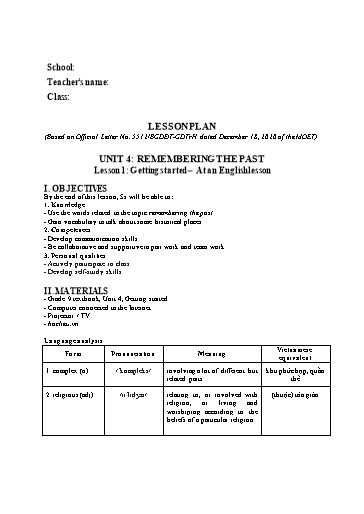
 3. monument (n) /ˈmɒnjumənt/ a structure or building that is tượng đài
 built to honour a special person
 or event.
 4. magnificent /mổɡˈnɪf.ɪ.sənt/ very good, beautiful, or trỏng lệ
 (adj) deserving to be admired.
 5. preserve (v) /prɪˈzɜːv/ to keep something as it is. bảo tồn
 6. heritage (n) /ˈher.ɪ.tɪdʒ/ features belonging to the di sản
 culture of a particular society,
 such as traditions, languages,
 or buildings, that were created
 in the past and still have
 historical importance.
 7. occupy (v) /ˈɒkjupaɪ/ take control chiếm giữ
 8. occupied (adj) /ˈɒkjupaɪd/ being used by someone or with cú người ở
 someone in it.
 9. ancient (adj) /ˈeɪnʃənt/ of or from a long time ago, cổ đại, lõu đời.
 having lasted for a very long
 time.
 10. generation (n) /ˌdʒenəˈreɪʃn/ all the people of about the same thế hệ
 age within a society.
 11. found (v) /faʊnd/ to bring something into thành lập
 existence.
Assumption
 Anticipated difficulties Solutions
 Students may lack experience of group/ - Encourage students to work in groups so that
 teamwork. they can help each other.
 - Give short, clear instructions and help if
 necessary.
III. PROCEDURES
1. WARM-UP (5 mins)
a. Objectives:
- To activate students’ knowledge on the topic of the unit.
- To lead in to the unit.
b. Content:
- Think!
- Memory lane
c. Expected outcomes: 8. occupied (adj)
 9. ancient (adj)
 10. generation (n)
 11. found (v)
 e. Assessment
 - Teacher checks students’ pronunciation and gives feedback.
 3. ACTIVITY 2: PRACTICE (30 mins)
 a. Objectives:
 - To help Ss read for specific information about historical place
 - To help Ss learn words and phrases related to historical place
 - To help students use the words in context.
 b. Content:
 - Task 1: Listen and read.
 - Task 2: Read the conversation again and answer the questions.
 - Task 3: Complete each sentence with a word or a phrase from the box.
 - Task 4: Look at the pictures and complete the sentences.
 c. Expected outcomes:
 - Students understand the conversation and topic of the lesson and can complete the tasks
 successfully
 d. Organisation
 TEACHER’S ACTIVITIES STUDENTS’ ACTIVITIES CONTENTS
Task 1: Listen and read. (7 mins)
- Begin by asking Ss some questions. - Look at the pictures and Questions:
- Set the context for the listening and answer questions What do you see in the
reading: Ask Ss to look at the title of picture(s)?
the conversation and the picture. Ask What do you know about it /
them some questions like: them?
What do you think they are
discussing?
- Then ask Ss to look at the title / the
picture and guess what the
conversation between the teacher and
the Ss might be about.
- Play the recording one or twice for
Ss to listen and read along. Then have
some pairs of Ss read the dialogue
aloud. - Listen to the recording. The dialogue on page 40
- Ask Ss what they are talking about. - Read the conversation aloud.
Now confirm the correct answer.
(They are talking about historic
buildings / our history / the past / life
in the past )
- Have Ss say the words in the text
that they think are related to the unit’s - Find the words in the text that
topic. Have them pronounce the are related to the topic. TEACHER’S ACTIVITIES STUDENTS’ ACTIVITIES CONTENTS
Task 5: Game: Remembering past events. (10 mins)
- Have Ss work in groups. Ask them - Work in groups to answer Answer key:
to answer all the questions. questions. 1. King Ly Thai To (Ly Cong
- Set a time limit (3-4 min.) for Ss to Uan).
discuss and finish the task. 2. In 1492.
- T may need to explain to the Ss if 3. In 1776.
they don’t know the answers. 4. In 1911.
 5. World War I started/ broke
 out.
 6. King Bao Dai (1913 – 1997)
 e. Assessment
 - T and other Ss listen to the answers and comment.
 5. CONSOLIDATION
 a. Wrap-up
 - Ask one or two Ss to tell the class what they have learnt.
 - Ask Ss to say aloud some words / phrases and the grammar points they remember from the
 lesson. Tells Ss that they will learn these language points in the following lessons.
 b. Homework
 - Do exercises in the workbook.
 - Start preparing for the Project of the unit:
 Teacher asks Ss to open their book p.49, look at the picture and say what the topic of the project
 is (poster of life in their neighbourhood 40 years ago). They will design a poster and present it
 at the end of this Unit.
 Teacher randomly puts Ss in groups and lets group leader assign tasks to each group member,
 making sure that all group members contribute to the project work.
 - T may suggest some steps for Ss to follow:
 1. Collecting information (asking their grandparents and / or old people, searching the Internet,
 reading books / magazines, brainstorming ideas, etc.)
 2. Organising ideas and visuals, and designing the posters
 3. Practising explaining their posters and answering questions about the content
 - Help Ss set a deadline for each task and support them throughout the process.
 - In each of the next lessons, spend a few minutes checking Ss’ progress, helping them with
 any topic-related or functional language they need, e.g. cooking, eating habits, home life,
 transport,  and solving any other problems that may arise with their projects.
 Board plan
 Date of teaching
 UNIT 4: REMEMBERING THE PAST
 Lesson 1: Getting started
 * Warm-up
 I. Presentation UNIT 4: REMEMBERING THE PAST
 Lesson 2: A closer look 1
I. OBJECTIVES
By the end of this lesson, Ss will be able to:
1. Knowledge
- Use the lexical items related to the topic Remembering the past
- Pronounce the sounds /m/ and /l/ in words and sentences correctly.
2. Competences
- Be collaborative and supportive in pair work and teamwork
- Access and consolidate information from a variety of sources
3. Personal qualities
- Actively participate in class and school activities
- Develop self-study skills
II. MATERIALS
- Grade 9 textbook, Unit 4, A closer look 1
- Computer connected to the Internet
- Projector / TV
- hoclieu.vn
Language analysis
 Form Pronunciation Meaning Vietnamese equivalent
 1. structure (n) /ˈstrʌktʃə/ something that has been cấu trỳc
 made or built from
 parts, especially a large
 building.
 2. promote (v) /prəˈməʊt/ to encourage people to thỳc đẩy
 like, buy, use, do, or
 support something.
 3. observe (v) /əbˈzɜːv/ to obey duy trỡ, tuõn theo
 4. benefit (v) /ˈben.ɪ.fɪt/ To be helped by giỳp ớch
 something or to help
 someone. - Have students share their ideas.
 e. Assessment
 Teacher’s feedback.
 2. ACTIVITY 1: VOCABULARY (20 mins)
 a. Objectives:
 - To provide students new vocabulary.
 - To revise some vocabulary related to Remembering the past.
 b. Content:
 - Vocabulary pre-teaching
 - Task 1: Complete the table.
 - Task 2: Complete the sentences, using the correct forms of the words from 1.
 - Task 3: Complete the sentences with the words from the box.
 c. Expected outcomes:
 - Students can identify some vocabulary about Remembering the past and use them in different
 contexts
 d. Organisation
 TEACHER’S ACTIVITIES STUDENTS’ ACTIVITIES CONTENTS
Vocabulary pre-teaching (5 mins)
- Teacher introduces the vocabulary - Students guess the meaning New words:
by: of words. 1. structure (n)
+ providing explanations of the 2. promote (v)
words 3. observe (v)
+ showing pictures illustrating the 4. benefit (v)
word.
Task 1: Complete the table. (5 mins)
- Have Ss work in pairs. Tell them to - Work in pairs to do task 1 Answer key:
look at the verbs given in the left p.42 1. promotion
column and give their equivalent 2. recognition
nouns. 3. contribution
- Check their answers as a class. - Listen and correct mistakes. 4. observation
- Have Ss read the verbs and nouns 5. preservation
aloud. Correct their pronunciation if 6. occupation
necessary.
EXTRA ACTIVITY: - Work in teams to play games. Suggestion:
- Put Ss in groups. Each group finds build → building
three verbs in Getting Started, and do → do / doing
then give their equivalent nouns. need → need
- Representatives from each group thank → thanks
gives their groups’ answers. wish → wish
- Check their answers as a class. know → knowledge
 decide → decision
 damage → damage - Explain the two sounds of /l/ in the - Give some words that have
Remember! box and invite Ss to give sounds /m/ and /l/
some examples.
Task 5: Listen and repeat the sentences. Pay attention the underlined words. (7 mins)
- Have Ss quickly read the sentences -Listen and follow instructions. Audio script:
and look carefully at the underlined 1. The collection includes
words. objects of the Middle Ages.
- Then play the recording for Ss to 2. You should be careful when
listen. -Listen shopping in this mall.
- Play the recording again. Let Ss -Listen and repeat 3. This monument is small but
listen and repeat sentence by magnificent.
sentence, paying attention to the 4. They maintain these wind
underlined words. mills as working museums.
 5. David fell on the ground and
 hurt his ankle.
EXTRA ACTIVITY Possible answers:
Ask each student to give at least one - Give word having sounds /m/ (remember, life, let, look,
word having sound /l/ and one word and /l/ in this unit. temple, complex, largest,
having sound /m/, preferably words Cambodia, )
in this unit.
 e. Assessment
 - Teacher’s observation and feedback on student’s pronunciation.
 4. CONSOLIDATION (5 mins)
 a. Wrap-up
 - Ask one or two Ss to tell the class what they have learnt. Draw Ss’ attention to the objectives
 on the board or show them the slide with the objectives. Tick the objectives that have been
 learn.
 b. Homework
 - Do exercises in the workbook.
 - Find 3 more words that have the sounds /m/ and /l/
 Board Plan UNIT 4: REMEMBERING THE PAST
 Lesson 3: A closer look 2
I. OBJECTIVES
By the end of this lesson, Ss will be able to:
1. Knowledge
- Recognise and use past continuous and wish + past simple.
2. Competences
- Develop communication skills
- Be collaborative and supportive in pair work and teamwork
3. Personal qualities
- Compare living place
- Develop self-study skills
- Actively join in class activities
II. MATERIALS
- Grade 9 textbook, Unit 4, A closer look 2
- Computer connected to the Internet
- Projector / TV
- hoclieu.vn
Language analysis
 Past continuous
 Form Example
 We were cooking all morning because we
 S + was/were + Ving
 had our friends coming for lunch.
 Wish + past simple
 Form Example
 I wish I had enough money to travel around
 the world.
 S + wish + S + past simple
 I wish (that) my mother didn’t have to
 work so hard.
Assumption
 Anticipated difficulties Solutions
 Students may find it confusing when to use Give short and clear explanations with legible
 the grammar points. examples for each case.
 Students may have underdeveloped co- - Give clear instructions, give examples before
 operating skills. letting students work in groups.
 - Provide feedback and help if necessary.
III. PROCEDURES
File đính kèm:
- ke_hoach_bai_day_minh_hoa_tieng_anh_lop_9_global_success_the.docx
